Blog
Removing Stickers and Decals Without Marking Paint
Heat softens the adhesive so the vinyl lifts instead of tearing. The two things that cause damage are a blade on paint and skipping the reprotection afterwards.
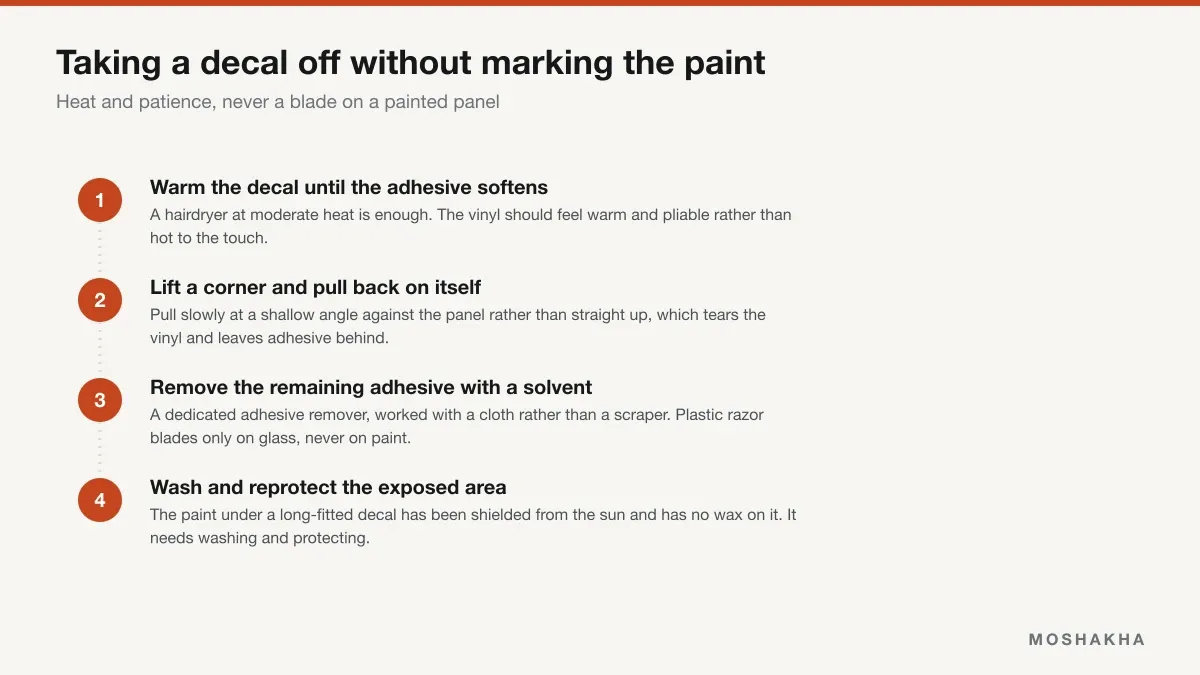
Dealership badges, old parking permits, previous owners’ decals. The removal is simple and the two common mistakes are both avoidable.
Heat does the work
Cold vinyl tears into fragments and leaves the adhesive behind. Warm vinyl lifts in one piece and brings most of the adhesive with it.
A hairdryer on a moderate setting is enough, and it’s safer than a heat gun — a heat gun works faster but concentrates far more heat, and overheating paint or distorting nearby plastic trim is easy to do.
Aim for the vinyl feeling warm and pliable, not hot to the touch.
Pull back over itself, not away
Lift a corner and pull it back across the panel at a shallow angle, so the vinyl folds back on itself as it releases.
Pulling straight up puts tension on a small area and tears it. The shallow angle spreads the load along the bond line and is the difference between one piece and thirty.
Work slowly. If it starts tearing, stop and apply more heat rather than more force.
No blades on paint
Plastic razor blades are fine on glass. On a painted panel the risk-to-benefit is simply wrong — a solvent and patience achieves the same thing without the possibility of a permanent gouge.
For the residue: a dedicated adhesive remover, applied and given dwell time, then worked with a cloth. Isopropyl alcohol handles light residue.
See the microfiber towels from our guideKeep towels used for solvent work out of the general paint rotation — they hold dissolved adhesive that transfers. The same discipline as tar removal, covered in removing bugs and tar.
The ghost outline isn’t damage
This catches people out and reads as a mistake.
Paint under a long-fitted decal has been shielded from UV while everything around it weathered slightly. So once the sticker’s gone you can see its outline as a difference in tone.
That’s weathering, not harm. A polish over the surrounding area helps blend it, and it reduces over time as the exposed patch catches up. On an older car it can be quite pronounced and worth expecting before you start.
Reprotect the area afterwards
The paint under a decal has had no wax or sealant on it for as long as the decal was there, and the solvent you just used stripped whatever was around the edges.
Wash the panel, then reapply protection to that area. Skipping it leaves a bare patch in the middle of a protected panel, which contaminates faster than everything around it.
Which protection to use, and why the durability differs, is in wax vs sealant vs ceramic coating.
Frequently asked questions
What's the best way to remove a car decal?
Warm it first with a hairdryer or heat gun on low until the vinyl is pliable, then lift a corner and pull it back over itself at a shallow angle rather than straight up. Heat softens the adhesive so the vinyl releases in one piece; cold vinyl tears into fragments and leaves most of the adhesive behind, which is what turns a ten-minute job into an hour.
Will removing a sticker damage the paint underneath?
On sound factory paint, correctly done, no. Two things cause damage: using a blade or scraper on the panel, and aggressive solvent left to sit. The more common surprise isn't damage but a visible outline — paint under a long-fitted decal has been shielded from UV, so it can be slightly different in tone from the paint around it.
How do I get the sticky residue off afterwards?
A dedicated adhesive remover, worked with a cloth rather than a scraper, applied and given dwell time rather than rubbed. Isopropyl alcohol handles light residue. Plastic razor blades are acceptable on glass but should not be used on paint — the risk-to-benefit is wrong when a solvent and patience achieves the same thing.
Why is there a ghost outline where the sticker was?
The paint underneath was protected from UV while everything around it continued to fade slightly, so you're seeing a difference in weathering rather than damage. On older cars it can be quite visible. A polish over the surrounding area helps blend it, and time will reduce it as the exposed area weathers too.
Can I use a heat gun, or is a hairdryer safer?
A hairdryer is safer and usually sufficient. A heat gun works faster but concentrates far more heat, and it's easy to overheat paint or distort plastic trim. If you use one, keep it moving, hold it well back, and aim for the vinyl feeling warm and pliable rather than hot to the touch.