Reviews
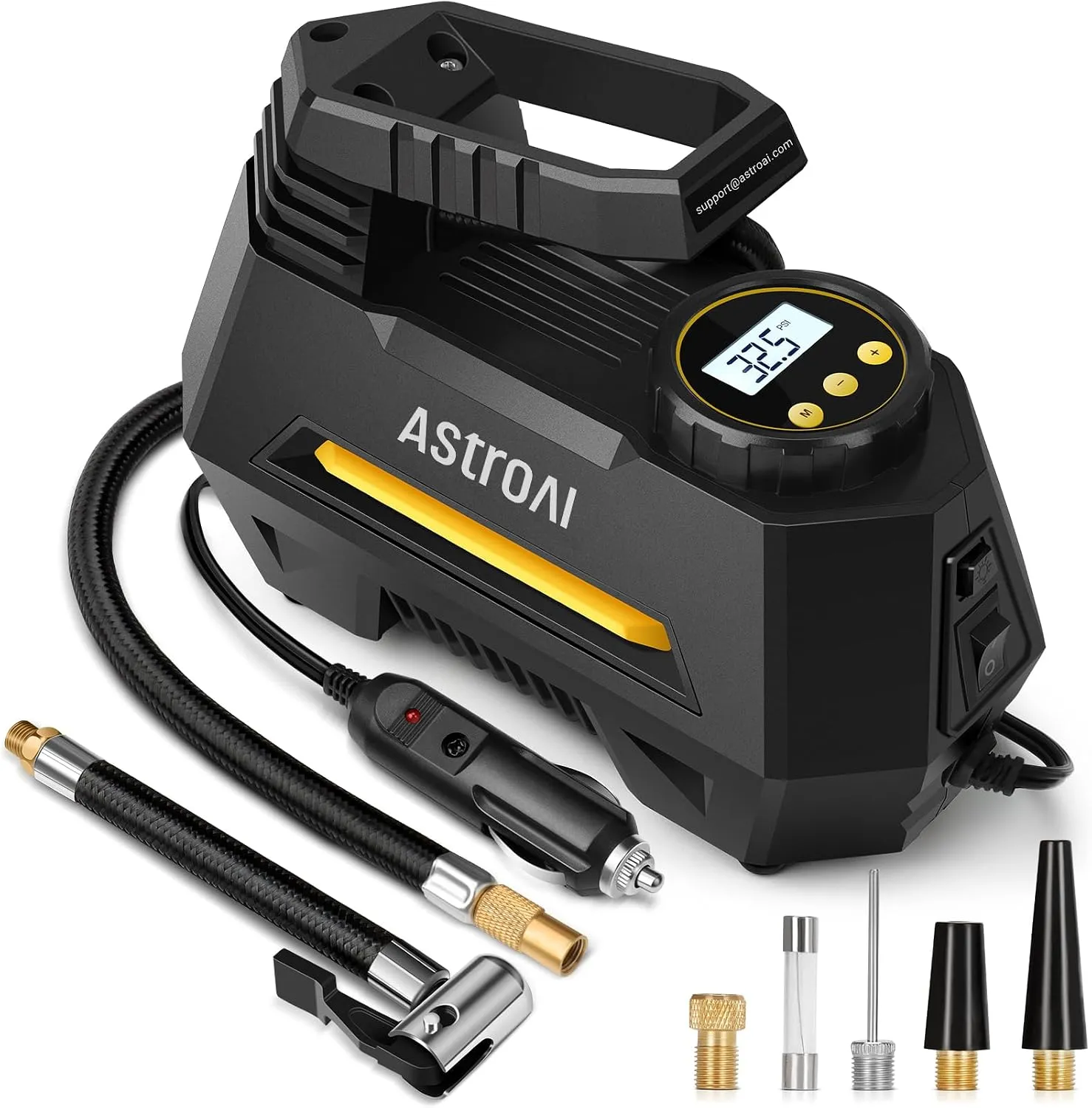
AstroAI AIRUN H Review: Auto Shut-Off Is the Feature
Set the pressure, walk away, it stops. Why corded beats cordless for topping up four tires — and the one thing to check about your car before buying it.
Moshakha is reader-supported. When you buy through links on our site, we may earn an affiliate commission at no extra cost to you. How we make money.
Pros
- Auto shut-off at a preset pressure — set it and stop watching
- Corded, so there's no charge state to manage between uses
- Digital gauge is easier to read accurately than a bourdon dial
- LED light, which matters because punctures happen at night
Cons
- Needs a 12V socket that stays live with the ignition off
- 9.8ft cord is tight on a long wheelbase — check it reaches all four
- Loud, and slow on a fully flat tire
Tire inflators are sold on maximum PSI, which is close to irrelevant for a car. The spec that actually changes the experience is on the back of the box.
Auto shut-off is the whole product
Set the target pressure. Walk away. It stops.
That sounds minor and it isn’t, because the alternative is standing over a running compressor watching a gauge — and built-in gauges read pressure at the compressor rather than in the tire, so they read slightly high. Combine that with a loud motor and a distracted person and over-inflation is the normal outcome.
Over-inflation isn’t harmless. It reduces the tire’s contact patch, hurts wet grip, and wears out the center of the tread. The correct target pressure, and why it isn’t the number on the sidewall, is in how to check tire pressure.
Corded is the right call here
Counterintuitive, because cordless sounds better.
A cordless inflator is more pleasant to use and will be flat on the day you need it, because it’s been sitting in the trunk unused for eight months. A corded unit has no charge state to manage. For something whose entire job is to work on an unplanned day, that’s the more important property.
Cordless earns its place in one specific case: inflating something away from the car — a bike, a trailer, or a car whose battery is already dead. That’s a genuine use, and it’s why the range includes one.
Check your 12V socket first
This is the thing to verify before ordering, not after.
Many modern cars cut power to the 12V socket when the ignition is off. If yours does, you’d have to run the engine to use this — unpleasant generally, and genuinely unsafe in a closed garage.
It takes ten seconds to test: key out, plug something in, see if it lights up. Full explanation in does your car’s 12V socket stay on with the ignition off.
What it isn’t
It’s slow on a fully flat tire. This is a compact 12V compressor, not workshop equipment. Topping up a few PSI is quick; filling from zero takes real patience.
Judge it as a maintenance tool that also covers an emergency, rather than as recovery equipment. That’s the honest framing, and it’s still the right thing to own.
It’s loud. All of them in this class are.
Should you buy it?
Yes, if your 12V socket stays live, and you want something that makes monthly pressure checks realistic rather than a trip to a garage forecourt.
No, if your socket cuts with the ignition — buy the cordless or dual-power version instead, both in best tire inflators.
Paired with a jump starter, it covers the two failures that actually strand people — the argument for that pairing is in car emergency kits.
Frequently asked questions
Why does auto shut-off matter so much?
Because manually watching a gauge while a compressor runs is how people over-inflate. Built-in gauges read pressure at the compressor rather than in the tire, so they read slightly high, and it's easy to overshoot while distracted. Setting a target and letting the unit stop itself removes the judgement call entirely — and over-inflation reduces your contact patch, hurts wet grip and wears the center of the tread.
Corded or cordless — which is better?
Corded, for a unit that lives in the car. A cordless inflator is more convenient right up until the day you need it and the battery is flat, which is likely because it's been sitting unused for months. A corded 12V unit has no charge state to manage. Cordless wins only when you need to inflate something away from the car — a bike, a trailer, or a car whose battery is already dead.
Will it work with my car's 12V socket?
Check before buying, because many modern cars cut power to the socket when the ignition is off. If yours does, you'd have to run the engine to use this, which is unpleasant and unsafe in a closed garage. It's the single most common cause of disappointment with any corded 12V accessory, and it isn't the product's fault.
How long does it take to inflate a tire?
Quick for topping up a few PSI, which is the normal use. Slow on a fully flat tire — this is a compact 12V compressor, not a workshop unit, and filling a tire from zero takes real patience. Judge it as a maintenance tool rather than roadside recovery equipment.
Is the 9.8ft cord long enough?
For most cars, yes, reaching all four tires from a front 12V socket. On a long-wheelbase vehicle, a truck or a van it can be tight to the rear tires. Measure from your socket to the furthest wheel before buying if you drive something large.