Blog
Does Your Car's 12V Socket Stay On With the Ignition Off?
Some cars cut 12V socket power the moment you turn the key off. Why it varies, how to actually test yours, and why it matters before buying anything corded.
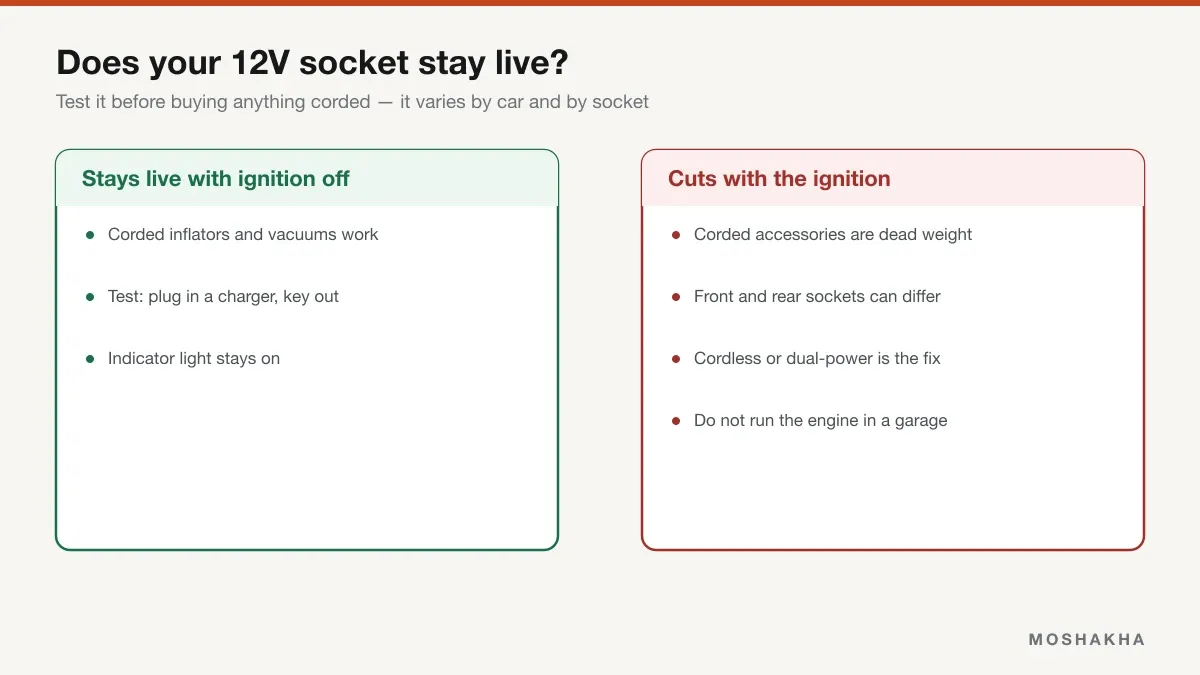
This question shows up constantly in reviews of corded 12V accessories — inflators, vacuums, coolers — as a one-star complaint that reads like a product defect. It usually isn’t. It’s a wiring decision the manufacturer made, and it varies by car in ways that aren’t obvious from the outside.
Why manufacturers do this at all
A 12V socket that stays powered indefinitely is a battery drain waiting to happen. Leave a phone charger plugged in and forget about it for a few days, and a socket with no cutoff will flatten the battery. Cutting power when the ignition is off is a deliberate protection feature — the tradeoff is that anything you own that depends on the socket being live simply stops working the moment you take the key out.
This is exactly the failure mode behind most one-star reviews of corded car accessories. The product works fine. The car’s wiring just doesn’t support the way the buyer expected to use it.
It isn’t consistent — even within one car
The frustrating part is that this isn’t a simple “newer cars do this, older cars don’t” rule. Some manufacturers wire the front console socket to stay live while a rear-seat socket cuts out, or the reverse. Trim level can matter too. Guessing from a similar car you’ve owned before isn’t reliable enough to buy equipment around.
How to actually test yours
Skip the guessing. With the engine off and the key out of the ignition (or, for push-button start cars, with the car fully powered down rather than just in accessory mode), plug something with a visible indicator light into the socket you intend to use. If it lights up, that socket stays live. If nothing happens, it cuts with the ignition.
Test the specific socket you plan to use the accessory from, not just “a socket in this car” — front and rear can genuinely differ.
Why this matters before you buy a corded inflator
See the corded inflator we tested this againstOur top pick in best tire inflators is exactly this scenario: a corded 12V unit, which is the right choice only if your socket stays live with the ignition off. Confirm that first. If your car cuts power, the cordless/dual-power alternative in the same guide sidesteps the issue entirely by running on its own battery and falling back to 12V only when convenient, not as a requirement.
The same logic applies to any corded 12V accessory, not just inflators — check the socket before you buy the device, not after a one-star-review moment in your own driveway.
Don’t just run the engine instead
If your socket cuts out, running the engine to power a corded accessory works, but skip it in an enclosed garage — that’s a carbon monoxide risk, not just an inconvenience. If this comes up often enough that running the engine is a regular workaround, that’s the actual signal to switch to a cordless accessory or a jump-starter-style battery pack — see our NOCO Boost GB40 review for a battery-powered option that sidesteps the socket question entirely.
Frequently asked questions
Why do some cars cut 12V socket power with the ignition off?
Manufacturers do it to prevent a corded accessory left plugged in from slowly draining the battery over hours or days. It's a deliberate protection feature, not a fault — the tradeoff is that any accessory you own that relies on the socket being live simply won't work with the key out.
How do I test whether my socket stays on?
With the engine off and the key removed from the ignition (or the car in accessory-off mode for push-button start vehicles), plug in something with a visible power indicator — a phone charger with a light, or the corded accessory itself — and see whether it powers on. That's a direct test; don't rely on guessing from the car's age or trim level, since it varies even within a manufacturer's own lineup.
Does this vary by trim level or only by model?
Both, and inconsistently enough that you shouldn't assume based on a similar car. Some manufacturers wire front and rear sockets differently within the same vehicle — the front socket might stay live while a rear one cuts out, or vice versa. Test the specific socket you intend to use.
What should I buy if my socket cuts out?
For a tire inflator, a cordless/dual-power model that runs on its own battery and falls back to 12V works around the limitation entirely. For anything else corded, a mains-powered version with a household plug, or accepting that the accessory only works with the engine running, are the practical options.
Does running the engine to power a 12V accessory cause any harm?
Not to the car, but it's worth avoiding in an enclosed space — running an engine in a closed garage to power an accessory is a carbon monoxide risk, not just an inconvenience. If you regularly need a corded accessory with the engine off, that's the strongest argument for a cordless alternative instead.