Buying Guides
Best Tire Inflators 2026: Corded, Cordless and the Trap
A portable inflator is the cheapest safety item you can carry. Our picks across corded and cordless — and the 12V socket problem that makes half of them useless.
Moshakha is reader-supported. When you buy through links on our site, we may earn an affiliate commission at no extra cost to you. How we make money.
At a glance
Check whether your car's 12V socket stays live with the ignition off before buying anything corded.
| Product | Award | Best for | Rating | Jump to review |
|---|---|---|---|---|
| AstroAI AIRUN H Tire Inflator (12V) | Best overall | Topping up four tires without worrying about battery charge | Details | |
| AstroAI Cordless Tire Inflator 160PSI | Best cordless | Bikes, trailers and anywhere you can't reach a 12V socket | Details | |
| AstroAI Tire Inflator 12V DC / 120V AC Dual Power | Best for home and car | One unit that lives in the garage and travels in the trunk | Details | |
| AstroAI Tire Inflator with Integrated Storage | Best for the trunk | Living permanently in the trunk without a tangle of cable | Details |
A portable inflator is one of the cheapest genuinely useful things you can keep in a car, and it is more likely to be the thing that gets you home than the spare wheel is.
Most punctures are slow leaks from a nail or a corroded valve, not blowouts. A slow leak means you can reinflate and drive to a garage. That is a far better outcome than changing a wheel on a hard shoulder, and many new cars no longer carry a spare at all.
Read this before you buy anything corded
Check whether your car’s 12V socket stays live with the ignition off.
Many modern cars cut power to the cigarette-lighter socket when the ignition is off. A corded inflator in that car means running the engine to use it — acceptable at a roadside, genuinely unsafe in a closed garage.
Test it in thirty seconds: plug in a phone charger, turn the car off, see if it still charges. If it doesn’t, buy cordless.
This single check prevents the most common complaint about every product in this category, and almost no roundup mentions it.
How we chose
Specification analysis — duty cycle, stated max pressure, auto shut-off behavior, gauge type and power options — plus aggregated long-term owner feedback with attention to failure patterns after the first year. We have not lab-tested inflation times. No brand paid for a place here.
Auto shut-off is the feature that matters
Set the target pressure and the compressor stops there by itself.
Without it you are watching a small gauge on a vibrating, noisy device and guessing when to stop — which is how tires end up over-inflated. Over-inflation reduces the contact patch, hurts wet grip and wears the center of the tread.
Every pick here has it. Treat it as a requirement rather than a feature.
Where the built-in gauge misleads you
Every inflator’s gauge reads pressure at the compressor, not inside the tire. Hose length and fitting resistance mean the two differ, usually by a couple of PSI.
For topping up, that’s fine. If you want an accurate figure, let the compressor stop, disconnect, and check with a separate gauge. This is also why two inflators can disagree and both be working correctly.
What pressure to actually use
The placard in the driver’s door jamb, not the number on the tire sidewall.
The sidewall figure is the tire’s maximum safe pressure. Inflating to it is a common and consequential mistake. The correct pressure for your car is on the placard, and it differs front to rear on many vehicles.
Check cold — driving heats the air and raises the reading by several PSI.
How to check tire pressure properly covers the full routine.
What to carry alongside it
An inflator handles the slow leak. It doesn’t handle a flat battery, which is the other common roadside failure — see our jump starter guide. Between the two you cover most of what actually strands people.
The picks in detail
Best overall
1. AstroAI AIRUN H Tire Inflator (12V)
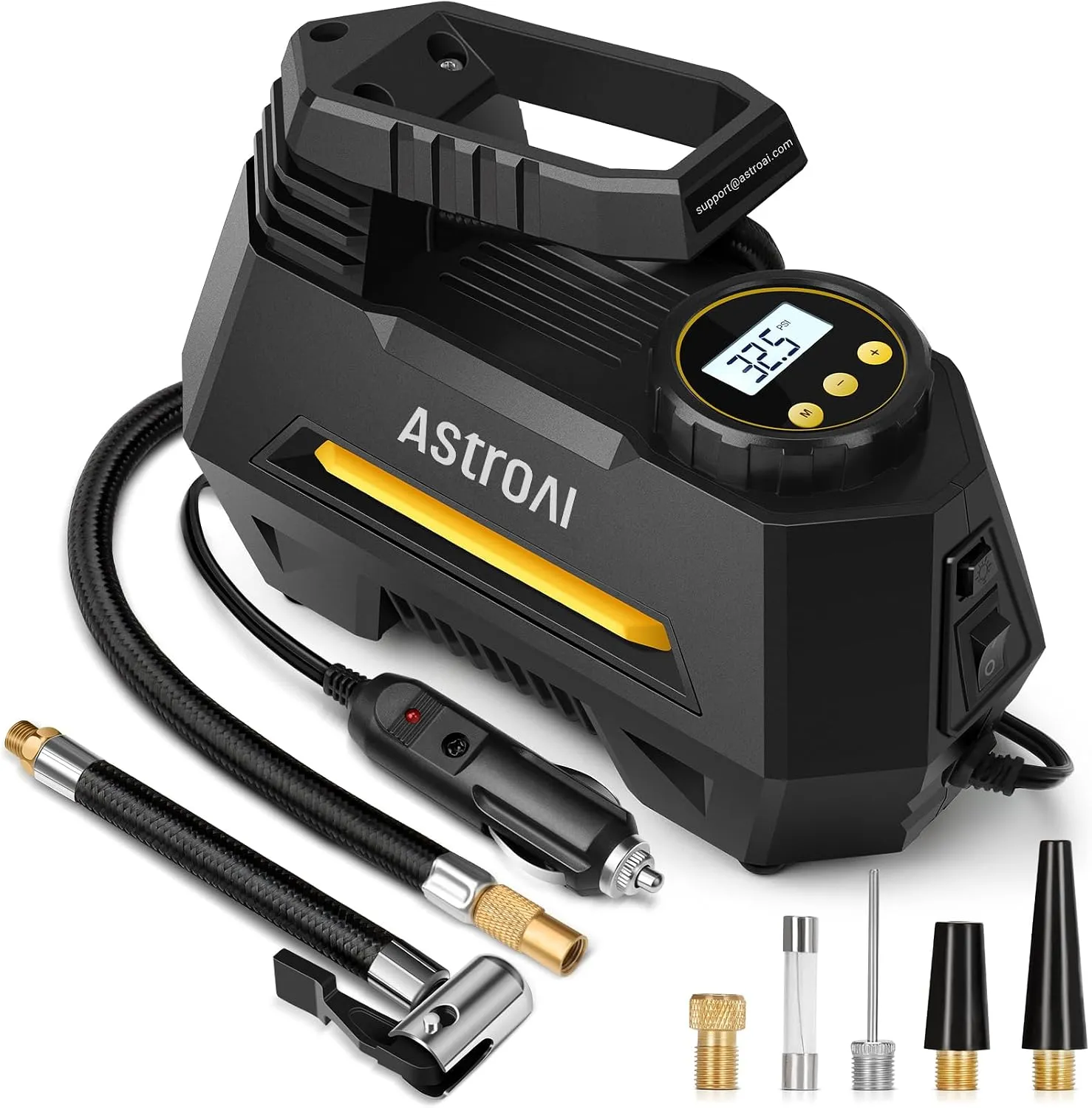
Best for: Topping up four tires without worrying about battery charge
A 12V corded unit with auto shut-off at a preset pressure, a digital gauge and a 9.8ft cord. Auto shut-off is the feature that matters: you set the target pressure, walk away, and it stops. Manually watching a gauge while a compressor runs is how people end up over-inflating.
Pros
- Auto shut-off at a preset pressure — set it and stop watching
- Corded, so no charge state to manage
- Digital gauge is easier to read than a bourdon dial
- LED light, which matters because punctures happen at night
Cons
- Needs a 12V socket that stays live with the ignition off
- 9.8ft cord is tight on a long wheelbase — check it reaches all four
- Loud, and slow on a fully flat tire
Best cordless
2. AstroAI Cordless Tire Inflator 160PSI
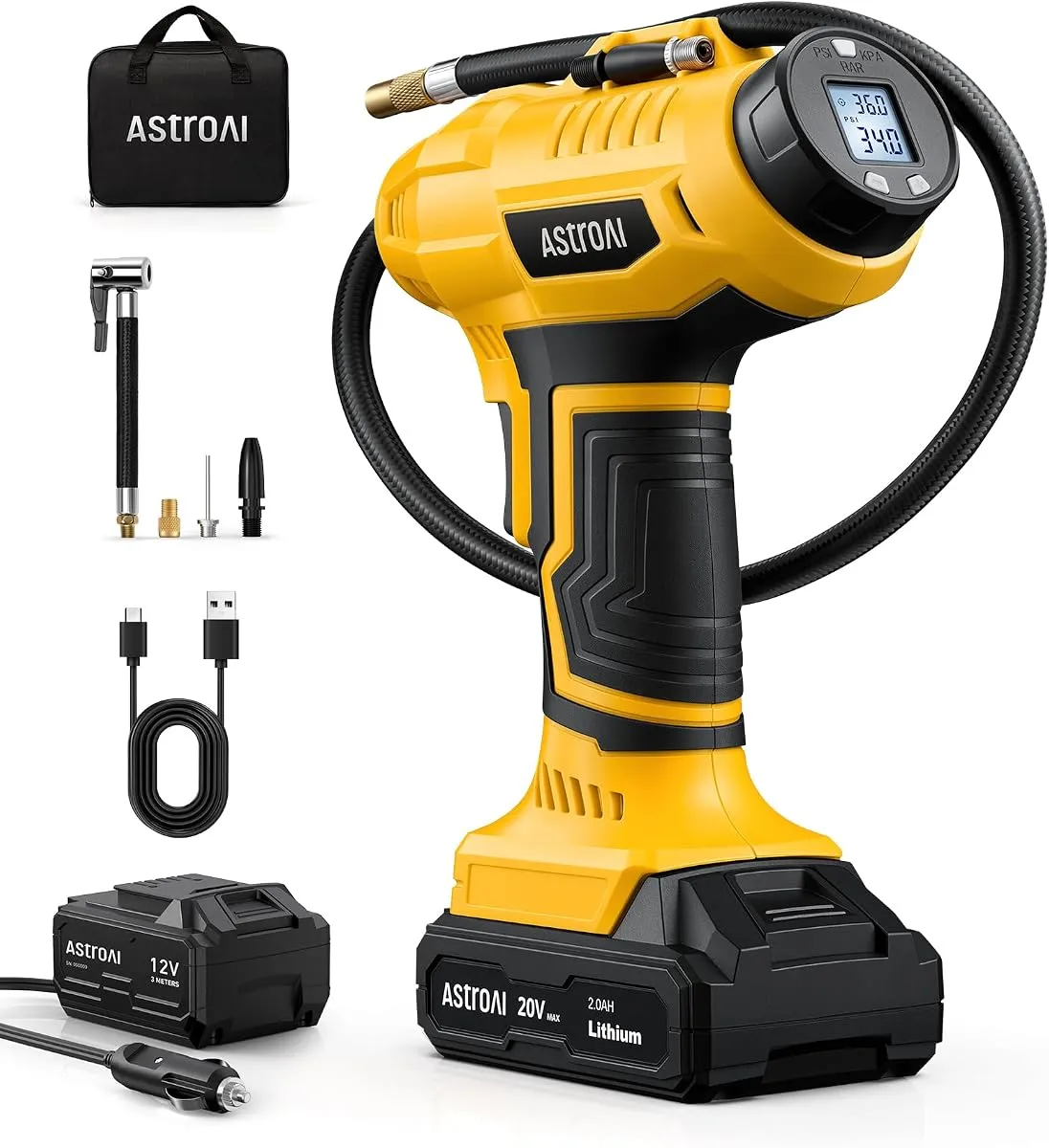
Best for: Bikes, trailers and anywhere you can't reach a 12V socket
Battery-powered with a dual power supply, so it runs cordless or from 12V. The genuine advantage is not convenience — it's that a cordless unit works on a bicycle, a trailer, or a car whose battery is already flat, which is exactly when you may also need a jump starter.
Pros
- Works away from the car entirely
- Dual power — falls back to 12V when the battery is down
- 160 PSI covers light truck and trailer tires
Cons
- Battery self-discharges — check it periodically or it's flat when needed
- More expensive than corded for the same output
- Runtime limits it to topping up, not inflating from flat
Best for home and car
3. AstroAI Tire Inflator 12V DC / 120V AC Dual Power
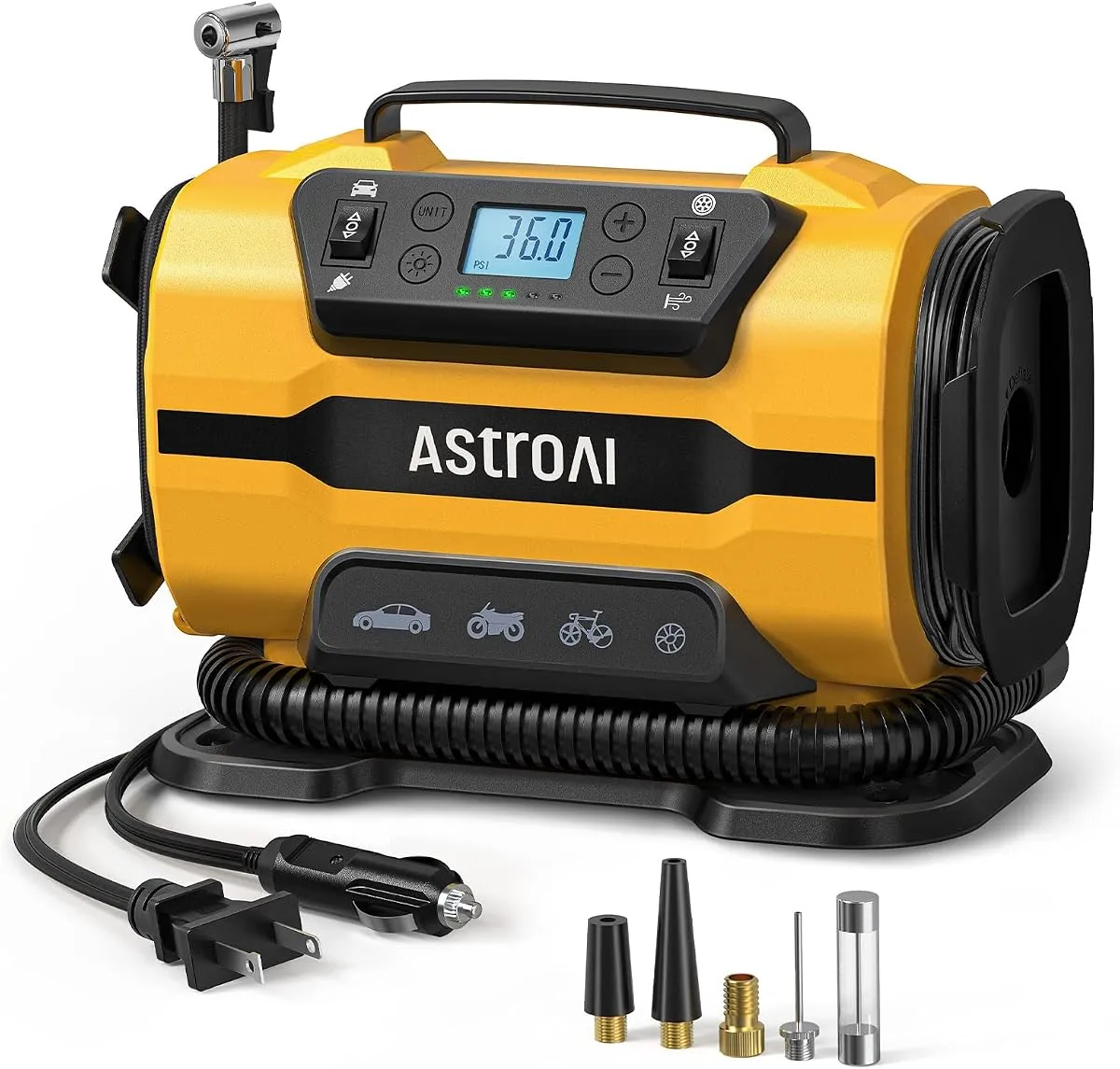
Best for: One unit that lives in the garage and travels in the trunk
Dual metal motors and a mains plug as well as 12V. The mains option is the useful part — inflating from mains in the garage is much faster than from a 12V socket, because a cigarette-lighter circuit is fused low and limits the current the compressor can draw.
Pros
- Mains power is substantially faster than 12V
- Dual metal motors handle sustained use better than single plastic
- Covers car, bike, mattresses and sports equipment
Cons
- Bulkier than a 12V-only unit
- Two cables to store and keep track of
Best for the trunk
4. AstroAI Tire Inflator with Integrated Storage
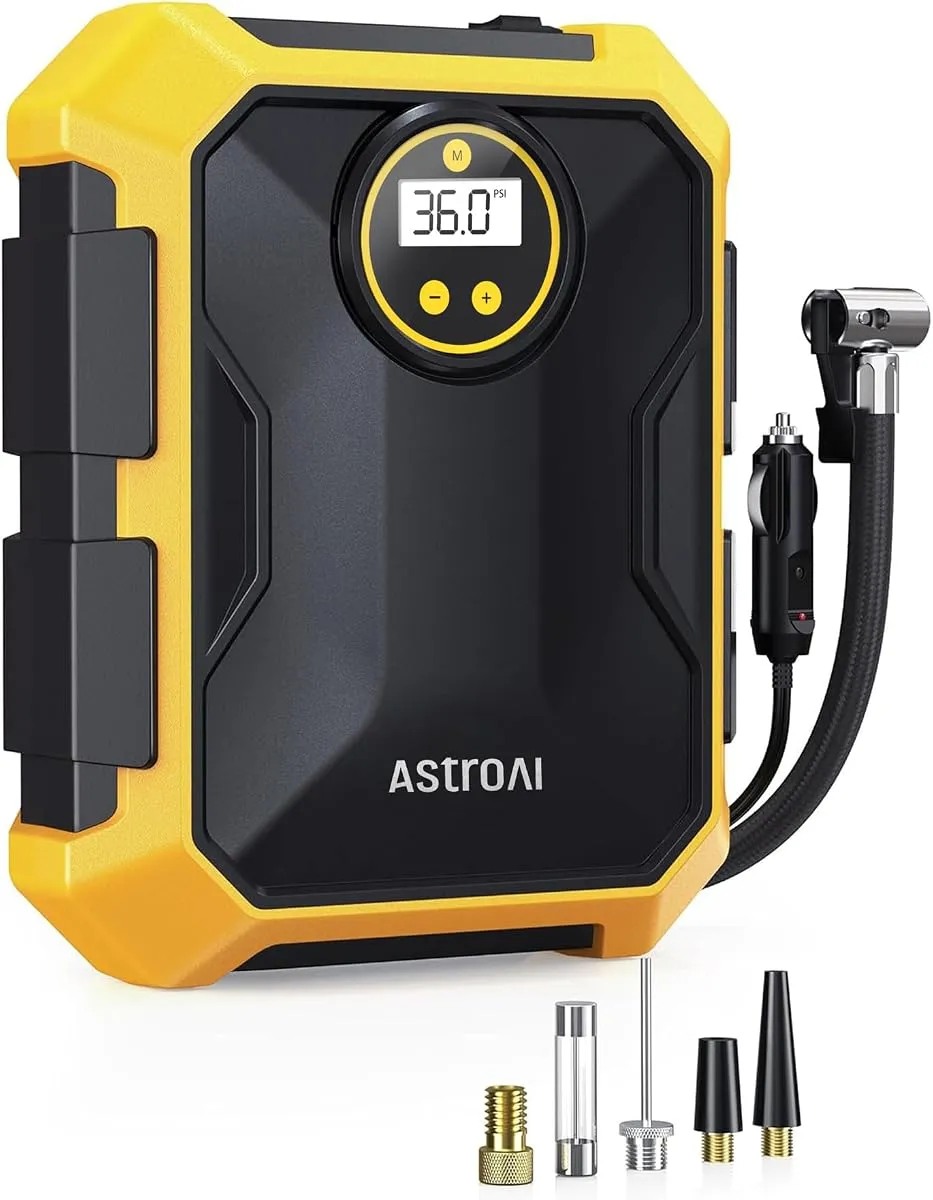
Best for: Living permanently in the trunk without a tangle of cable
The same core 12V design with the cord and nozzles stored in the body. That sounds trivial and isn't: an inflator you can grab and use in thirty seconds gets used, and one that means untangling a cable in the rain in the dark stays in the trunk while you drive on a soft tire.
Pros
- Everything stored in the unit — nothing loose to lose
- Fast to deploy, which is the whole point of carrying one
- Cheapest of the picks here
Cons
- Same 12V socket dependency
- Storage compartment is the first thing to break
Frequently asked questions
Will a tire inflator work if my car's 12V socket turns off with the ignition?
No, and this is the most common disappointment with any corded 12V accessory. Many modern cars cut power to the socket with the ignition off. You can run the engine, which is fine outdoors but unsafe in a closed garage, or buy a cordless unit. Check your car before you buy.
How long should it take to inflate a tire?
Topping a car tire up by a few PSI should take one to two minutes. Inflating from genuinely flat takes far longer — often ten minutes or more — and small 12V compressors get hot doing it. Most have a duty cycle; running them continuously past it shortens their life considerably.
Are digital gauges more accurate than dial gauges?
Not inherently, but they are much easier to read correctly, which matters more in practice. The bigger accuracy issue with any built-in gauge is that it reads pressure at the compressor rather than in the tire. For a precise figure, check with a separate gauge after the compressor stops.
Can I use a tire inflator to seat a tubeless tire bead?
No. Seating a bead needs a large, sudden volume of air, which is a completely different requirement from the slow steady flow these produce. That job needs a tank or a workshop compressor. A portable inflator maintains pressure; it does not mount tires.
What tire pressure should I use?
The figure on the placard in your driver's door jamb or fuel flap, not the number molded into the tire sidewall. The sidewall figure is the tire's maximum safe pressure, not the correct pressure for your vehicle. Check when the tires are cold — driving raises pressure by several PSI.
Do I need one if my car has a spare?
Yes, arguably more than a spare. Most punctures are slow leaks from a nail rather than blowouts, and an inflator lets you reinflate and drive to a garage rather than changing a wheel at the roadside. Many new cars ship with no spare at all — only a sealant kit.