How-To Guides
How to Check Tire Pressure (And the Number to Use)
The sidewall number is not your target pressure. Where to find the right figure, why cold matters, and what TPMS does and doesn't tell you.
Tire pressure is the highest-impact, lowest-effort maintenance item on a car. It affects braking distance, wet grip, fuel consumption and how fast the tires wear out — and almost everyone gets the target number wrong.
The number on the sidewall is not your target
This is the single most common error.
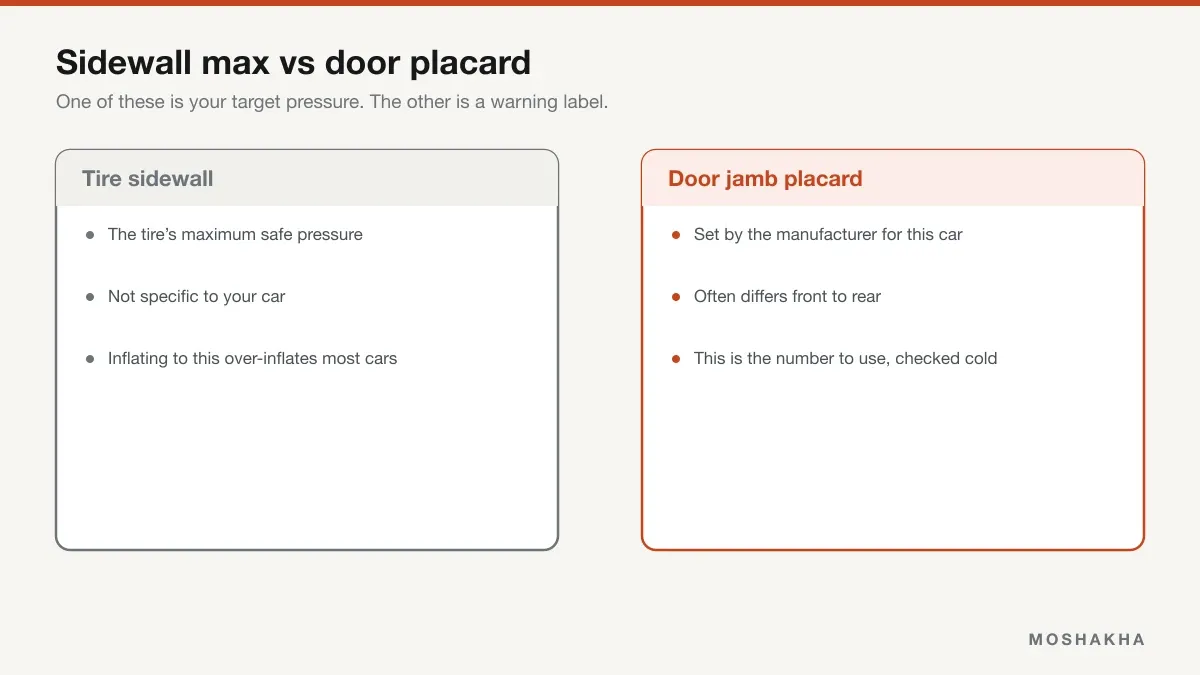
The figure molded into the tire sidewall — typically something like “MAX 51 PSI” — is the maximum pressure that tire can safely contain. It is a property of the tire, not a recommendation for your car.
Your target is on the placard: a sticker in the driver’s door jamb, sometimes on the fuel flap or in the glovebox. It’s set by the manufacturer for your vehicle’s weight and suspension, and it’s frequently different front to rear.
Inflating to the sidewall number over-inflates most cars substantially. The tire balloons slightly, the contact patch shrinks, wet grip drops and the center of the tread wears out early.
Cold means cold
The placard figure is a cold specification: parked three hours, or driven under a mile.
Driving heats the air inside the tire and raises the reading by several PSI. Check warm and bleed down to the placard number and you’ll be meaningfully under-inflated once it cools — which is the worse error of the two.
Temperature swings are not leaks
Pressure drops roughly 1 PSI per 10°F of temperature fall.
A tire set correctly on a mild autumn afternoon can be several PSI low on the first proper cold morning, which is why TPMS lights cluster around the first frost. That’s physics, not a puncture. It still needs correcting.
TPMS is an alarm, not a gauge
Most direct TPMS systems only warn once pressure is around 25% below target. That’s far past the point where wet braking and tread wear are affected.
Indirect systems — which infer pressure from wheel rotation speed rather than measuring it — are less precise again.
Treat the light as “you may have a puncture”, not as “your pressures are fine until this comes on”. Check monthly with a gauge.
Check the spare
Spares sit unused for years and lose pressure the whole time. A flat spare found at the roadside is no spare at all.
Space-savers usually need a considerably higher pressure than road tires — often around 60 PSI. That figure is on the spare’s own sidewall, and it’s one of the few times the sidewall is the number you want.
What you need
A decent gauge and something to add air with. Pencil gauges are cheap and imprecise; a digital or quality dial gauge is better and still inexpensive.
For adding air, a portable inflator means never depending on a forecourt air line that’s out of order — and it’s the same device that gets you home after a slow puncture.
Frequently asked questions
Should I use the pressure on the tire sidewall?
No. The sidewall figure is the maximum pressure the tire can safely hold, not the pressure your car needs. Your target is on the placard in the driver's door jamb. Inflating to the sidewall number over-inflates most cars significantly, reducing grip and wearing the center of the tread.
How often should I check tire pressure?
Monthly, and before any long trip. Tires lose roughly one PSI per month through normal permeation, and more in cold weather. Waiting for the TPMS warning is not a strategy — most systems only alert once pressure is already around 25% below target, by which point handling and wear are affected.
Why does my tire pressure drop in cold weather?
Air contracts as it cools, so pressure falls roughly one PSI for every 10°F drop in temperature. A tire correctly set on a warm autumn afternoon can be several PSI low on the first cold morning. This is normal and not a leak, but it does need correcting.
Does TPMS mean I don't need to check manually?
No. Most TPMS only warns when pressure is already about 25% below the target, which is well past the point where wear and wet grip suffer. Indirect systems, which infer pressure from wheel speed, are less precise still. Treat TPMS as a puncture alarm, not a maintenance tool.
Should I check pressure hot or cold?
Cold, always, because the placard figure is a cold specification. If you must check warm, expect a reading a few PSI higher and do not bleed air down to the placard number — that leaves the tire under-inflated once it cools.
Is nitrogen fill worth paying for?
Marginally, and rarely worth the cost for road cars. Nitrogen permeates slightly more slowly and is less affected by moisture, so pressure is a little more stable. Ordinary air is already 78% nitrogen, and checking monthly achieves more than the gas ever will.