Blog
Wheel and Rim Care: Why Wheel Tools Must Never Touch Paint
Brake dust is metallic and scratches paint on contact. The wheel cleaning order, why dedicated tools are non-negotiable, and what damages finishes.
Wheels are the dirtiest part of a car and the one most likely to cause paint damage — not directly, but through the tools you use on them.
The rule that matters most
A tool that has touched a wheel never touches paint again.
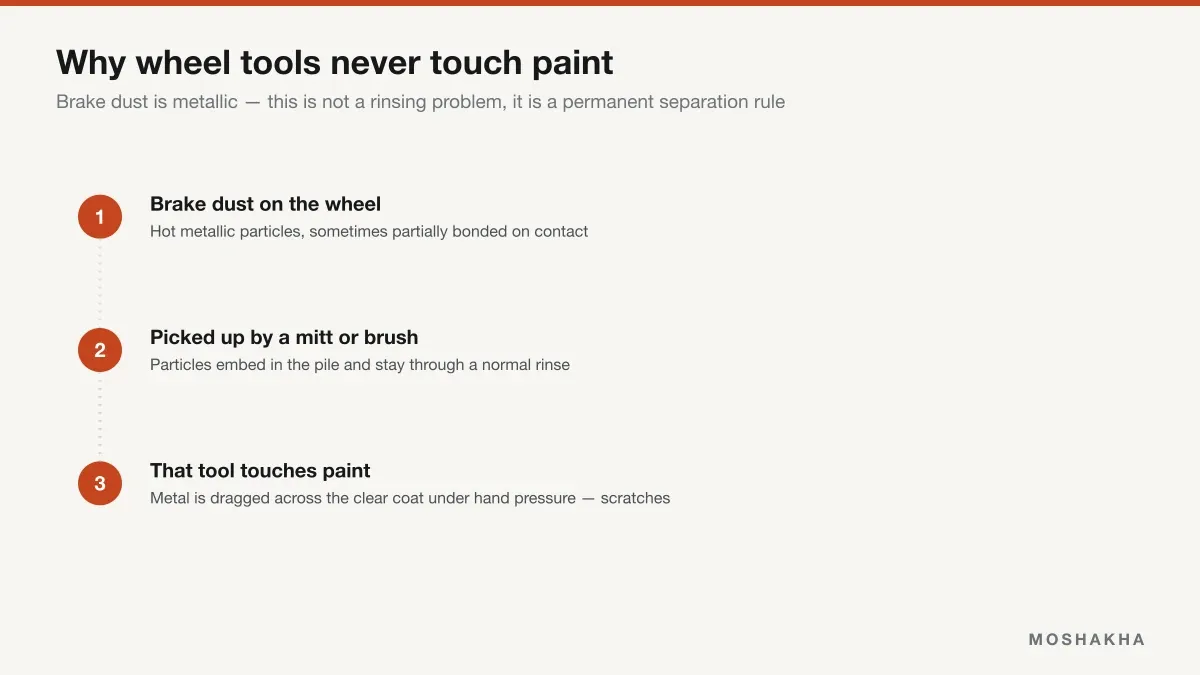
Brake dust isn’t ordinary dirt. It’s metallic particles worn off the pads and rotors, often hot enough on contact to partially bond to whatever they land on. Those particles embed in a mitt or brush and stay there through rinsing.
Drag that mitt across a door panel and you’re scratching paint with tiny pieces of metal. This isn’t a risk to be managed with care — it’s a reason for permanent separation:
- A dedicated wheel mitt or brush, never used elsewhere
- A separate bucket, or wheels done entirely before your wash buckets are set up
- Separate towels, marked so they can’t drift back into the paint pile
Snipping a corner off retired wheel towels is a simple mark that survives laundering.
Wheels first, always
They’re the filthiest part of the car, and cleaning them sprays contamination onto the lower panels and arches. Doing wheels first means the body wash that follows removes whatever splashed.
Clean them one at a time, and rinse each before the cleaner dries — most wheel cleaners are far more difficult to remove once they’ve dried on.
Choosing a cleaner
pH-neutral is the safe default. It’s effective on normal brake dust and won’t harm factory painted, clear-coated alloys.
Acidic cleaners are aggressive and appropriate only for severe, bonded contamination — and only on finishes you’ve confirmed tolerate them. They can permanently etch polished, anodised and bare metal, and repeated use dulls clear coat.
Iron-removing fallout cleaners dissolve bonded brake dust chemically rather than through scrubbing. They’re the right answer for wheels that look dirty no matter how hard you scrub, and they’re gentle in use — the color change as they react is iron dissolving, not damage.
If you don’t know the finish, start pH-neutral. You can escalate; you can’t un-etch.
Getting into the barrel
The face is easy. The inner barrel holds most of the brake dust and is what makes wheels look gray from behind.
A long-handled soft brush or a small wheel mitt reaches it. Do this properly and wheels stay clean far longer, because the barrel is where contamination accumulates and redistributes from.
Lug nut recesses and around the valve stem need a small detailing brush.
Tires and arches
Do these after the wheel face, not before — tire cleaner splashed onto a clean wheel means redoing it.
Scrub the tire sidewall with a stiff brush and an all-purpose cleaner. Old dressing builds up as a brown film that “browns” a few days after each application; removing that build-up is what makes a new dressing look right.
Apply dressing to an applicator, not directly to the tire, and wipe off the excess. Overapplied dressing slings onto your clean paint the first time you drive.
Protecting them
A wheel sealant or ceramic coating makes the next clean dramatically easier — brake dust sits on the coating instead of bonding to the wheel. It’s one of the higher-return protective steps available, because wheels get far dirtier than paint does.
Apply to genuinely clean, decontaminated, dry wheels or it seals contamination in.
Where this fits in the wash
Wheels are step one of the two-bucket wash method, and the separation of tools described here is one of the main defences against swirl marks.
Frequently asked questions
Why do wheels need separate cleaning tools?
Brake dust contains hard metallic particles from the pads and rotors. Embedded in a mitt or brush, they scratch paint on contact — this is not a matter of rinsing carefully. Any tool used on wheels must be permanently retired from paint use.
Should wheels be cleaned first or last?
First, always. They are the dirtiest part of the car and cleaning them throws contamination onto surrounding panels. Doing them first means the subsequent body wash removes anything that has splashed.
Are acidic wheel cleaners safe?
On most factory painted alloys, a pH-neutral cleaner is the safer default. Strong acidic cleaners can etch polished, anodised and bare metal finishes permanently, and repeated use dulls clear-coated wheels. Reserve them for severe contamination on finishes you have confirmed are compatible.
Can I use the same bucket for wheels and paint?
No. Brake dust settles in the bucket and gets picked up by your paint mitt on the next dunk. Use a separate wheel bucket, or clean the wheels entirely before setting up your wash buckets.
What causes wheels to look permanently dirty even after cleaning?
Usually bonded brake dust that has heat-welded into the clear coat, or clear coat that has failed from prolonged neglect. An iron-removing fallout cleaner dissolves bonded particles. If the clear coat itself has degraded, cleaning cannot restore it.