How-To Guides
Cleaning Wheel Arches Without Spreading the Mess
Arches are the dirtiest part of the car, so doing them after the paint means rework. The order, the tools, and why gloss dressing belongs nowhere near them.
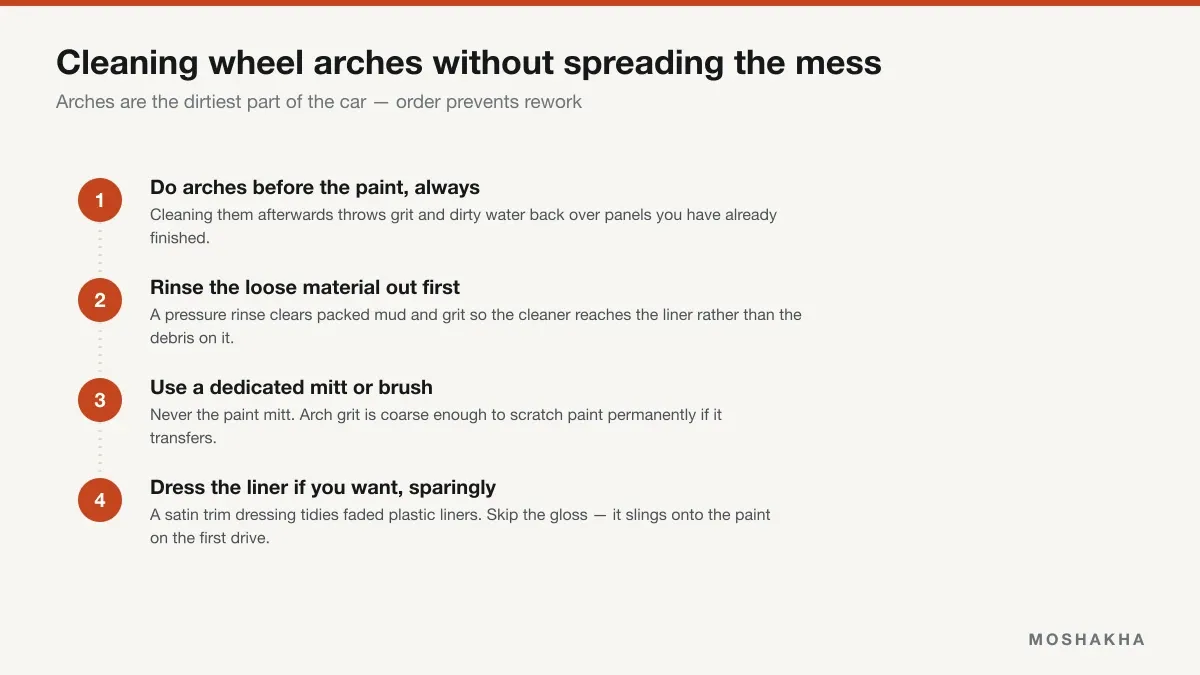
Wheel arches are the dirtiest part of a car and the part most people clean last, if at all. Both of those are mistakes, and the first one causes the most rework.
Order first: arches before paint
Arches hold packed mud, road grit, brake dust and — in winter — salt. Cleaning them after the bodywork means blasting all of that back onto panels you’ve already washed and dried.
Doing them first means any mess you make gets cleaned up by the wash that follows. This is the same logic as washing wheels before paint, and it’s the single biggest time saver in the whole routine.
Rinse before you apply anything
Packed debris blocks the cleaner from reaching the liner. Spraying chemical over a layer of dried mud just wets the mud.
A proper pressure rinse clears the loose material so the cleaner contacts the surface you actually want cleaned.
See the pressure washer from our guideArches are the job that most justifies owning one — the Sun Joe SPX3000 review covers how it handles this kind of heavy rinsing versus the lighter paint work it’s usually bought for.
Full-strength APC is genuinely correct here
Arch liners are unpainted plastic, and the metal around them is coated specifically for this environment. This is one of the few places on a car where aggressive chemistry has nothing delicate to damage.
Elsewhere in the car, APC strength is exactly what ruins dashboards — the boundaries are in interior detailer vs all-purpose cleaner. In the arches, use it neat.
Never the paint mitt
This is the rule worth being absolute about. Arch grit is coarse, sharp, and does not reliably rinse out of a mitt. A mitt that’s been in an arch will carry that grit onto bodywork the next time it’s used.
Keep dedicated arch tools, and store them physically apart from paint tools so there’s no possibility of grabbing the wrong one. That separation logic extends to buckets too — see is a third wash bucket worth it.
Rinse up inside, not just at the opening
Cleaner left in the arch holds road grime and runs out onto paint later as streaks. Direct water up into the liner where the suspension components sit, not merely at the visible opening.
Go easy on dressing
A satin trim dressing tidies faded black liners and marginally eases the next clean.
Gloss dressing in an arch is a bad idea for an obvious reason: it’s a high-speed spray environment, and the product slings straight onto your lower paint on the first drive. Matte or satin, applied thinly, excess wiped off.
The wheels themselves are a separate job with different chemistry — that’s in wheel and rim care.
Frequently asked questions
Should I clean wheel wells before or after washing the car?
Before, without exception. Wheel arches carry the coarsest, heaviest contamination on the vehicle. Cleaning them after the bodywork sprays that material back onto panels you've already washed and dried, forcing a rewash or leaving grit sitting on clean paint.
Can I use my regular wash mitt on wheel arches?
No, and this is the mistake with the most expensive consequences. Arch grit is coarse and sharp, and it embeds in a mitt in a way that doesn't reliably rinse out. That mitt then carries it onto bodywork the next time you use it. Keep separate tools for arches and store them apart from paint tools.
Is it safe to pressure wash inside the wheel arch?
Generally yes — the area is designed to withstand road spray, salt and stone impact. Use sensible distance and avoid aiming a narrow, high-pressure jet directly at wiring connectors, ABS sensors, or the edges of underbody trim clips, since concentrated pressure at close range can force water past seals or dislodge fasteners.
What causes the white residue in my wheel arches?
Usually dried road salt in winter regions, or mineral deposits from hard water. Both indicate the arch isn't being rinsed regularly, and salt in particular is the corrosive agent that matters most for underbody rust. Regular rinsing through salting season addresses it far better than any cleaner applied occasionally.
Should I dress the plastic arch liners?
It's optional and purely cosmetic, but a satin dressing does make faded liners look better and slightly eases the next clean. Avoid glossy dressings — the arch is a high-speed, high-spray environment, and gloss product slings onto the lower paint on the first drive.