Buying Guides
Best Pressure Washers for Cars: PSI Is Not the Spec
High PSI damages paint and trim. Why GPM and nozzle choice matter more, our picks for car use, and the pressure range that's actually safe on paint.
Moshakha is reader-supported. When you buy through links on our site, we may earn an affiliate commission at no extra cost to you. How we make money.
At a glance
Chosen for car use specifically — the highest-PSI machine is the wrong machine here.
| Product | Award | Best for | Rating | Jump to review |
|---|---|---|---|---|
| Sun Joe SPX3000-QW2 (2200 PSI, 1.1 GPM) | Best overall | Car washing with enough capability for a patio without being dangerous on paint | Details | |
| Sun Joe SPX4003-ULT (14.5-Amp, with brushes) | Best bundle | Starting from nothing and wanting the brushes included | Details | |
| Sun Joe SPX-RB1 Rotary Wash Brush Kit | For wheels only | Wheel barrels and arches — never paint | Details | |
| Sun Joe SPX-UB1 Feather Bristle Utility Brush | Gentler option | Sills, arches, and lower panels that need agitation without a mitt | Details |
A pressure washer is genuinely useful for washing a car, and the specification everyone buys on is the one most likely to damage the paint.
PSI is the wrong number to optimise
Listings lead with PSI because it’s a big number that sounds like capability. For car washing it is closer to a risk rating.
Water at high pressure through a narrow nozzle will lift failing clear coat, force water past trim seals, blast at stone chips and get underneath paint edges, and strip decals. None of this requires an unusual machine — a standard domestic unit with a narrow tip fitted will do it.
Roughly 1200–1900 PSI at the surface is the sensible range for paint. Note “at the surface”: a 2200 PSI machine with a wide fan held a foot away is gentler than a 1600 PSI machine with a narrow tip pressed close.
How you use it matters more than what it’s rated at.
GPM is the number that actually helps
Gallons per minute is flow rate, and flow is what carries loosened dirt off the panel.
Pressure dislodges; flow removes. For rinsing a car, higher flow at moderate pressure beats high pressure at low flow — which is why professional detailers generally aren’t using the most powerful machines on the shelf.
Nozzles: the only ones you should own for a car
| Nozzle | Angle | Use on a car |
|---|---|---|
| Red | 0° | Never. Will damage paint immediately |
| Yellow | 15° | Wheel arches and stubborn wheel grime only |
| Green | 25° | Lower panels, sills — with care |
| White | 40° | The car nozzle. Rinsing and general washing |
| Black | 65° / soap | Applying detergent |
| Turbo | rotating 0° | Never on a vehicle |
If you own a pressure washer and use it on your car, the white 40° tip should be the one that lives on the wand.
The foam cannon is the point
For car washing specifically, this is the real reason to own the machine.
Pre-foaming covers the car in detergent that loosens and lifts grit before anything touches the paint. Since almost all swirl marks come from dragging grit across a panel, removing grit without contact is the single most effective thing you can do.
It doesn’t replace the contact wash — bonded road film still needs a mitt. It substantially reduces how much grit that mitt encounters, which is exactly the goal of the two-bucket method.
Our top pick is the one we’ve written up in full — the Sun Joe SPX3000 review covers what the included foam cannon actually changes about a wash, and where 1.1 GPM becomes the limiting factor.
How we chose
Specification analysis — motor rating, flow rate, nozzle set, and included accessories relevant to car use — plus aggregated long-term owner feedback with attention to fitting and pump failures after the first season. No lab testing, no paid placement.
Where we’d draw a line
We would not put a powered brush of any kind on paint. Rotary and utility brushes are fine on wheels, arches and sills — surfaces where marring doesn’t matter and dirt is heaviest — but a wash mitt is the correct tool for painted panels, and nothing here changes that.
Anything used on wheels never returns to paint. Brake dust is metallic and scratches on contact.
The picks in detail
Best overall
1. Sun Joe SPX3000-QW2 (2200 PSI, 1.1 GPM)
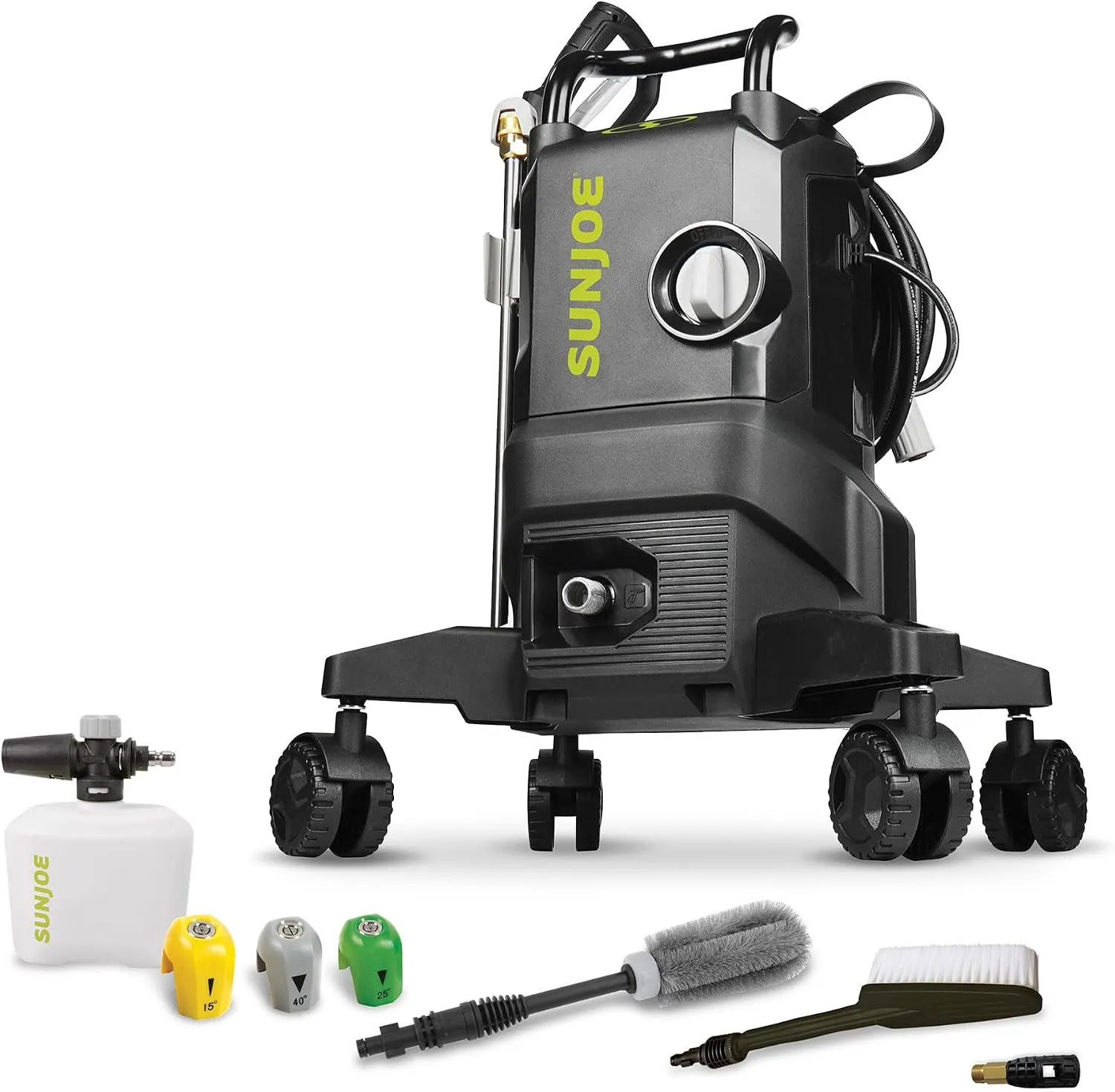
Best for: Car washing with enough capability for a patio without being dangerous on paint
2200 PSI with quick-connect nozzles and a foam cannon included. For car use the foam cannon is the reason to own a pressure washer at all — pre-foaming lifts grit off the paint before your mitt touches it, which does more for avoiding swirl marks than any washing technique.
Pros
- Foam cannon included — the actual point of a pressure washer for cars
- Quick-connect nozzles make swapping to a wide fan trivial
- 2200 PSI is capable without being reckless on paint
- Wheels and onboard storage; easy to move and put away
Cons
- Electric means a cable and a tap — no roadside use
- 1.1 GPM is modest; flow matters more than pressure for rinsing
- Plastic fittings are the usual long-term weak point
Best bundle
2. Sun Joe SPX4003-ULT (14.5-Amp, with brushes)
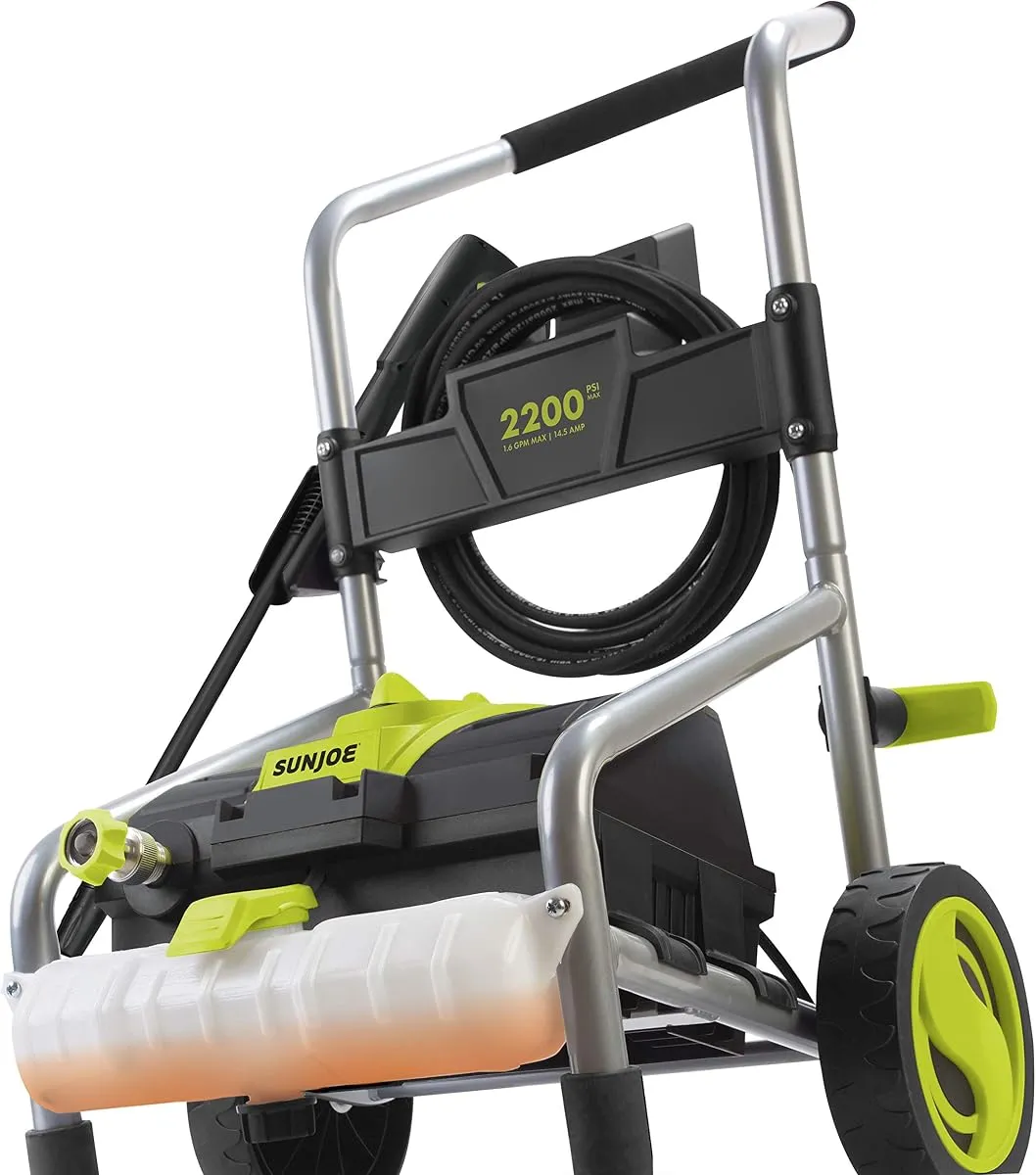
Best for: Starting from nothing and wanting the brushes included
A higher-amperage motor bundled with a utility brush and a wheel-and-rim brush. The wheel brush is genuinely useful — wheels are the dirtiest part of the car and the one place where aggressive cleaning is safe, provided that brush never touches paint afterwards.
Pros
- Wheel and rim brush included, which is a real need
- Higher-amp motor sustains pressure better under load
- One purchase covers the whole wash setup
Cons
- Bundled brushes are adequate rather than excellent
- Bulkier to store
- Keep the utility brush strictly off paint
For wheels only
3. Sun Joe SPX-RB1 Rotary Wash Brush Kit
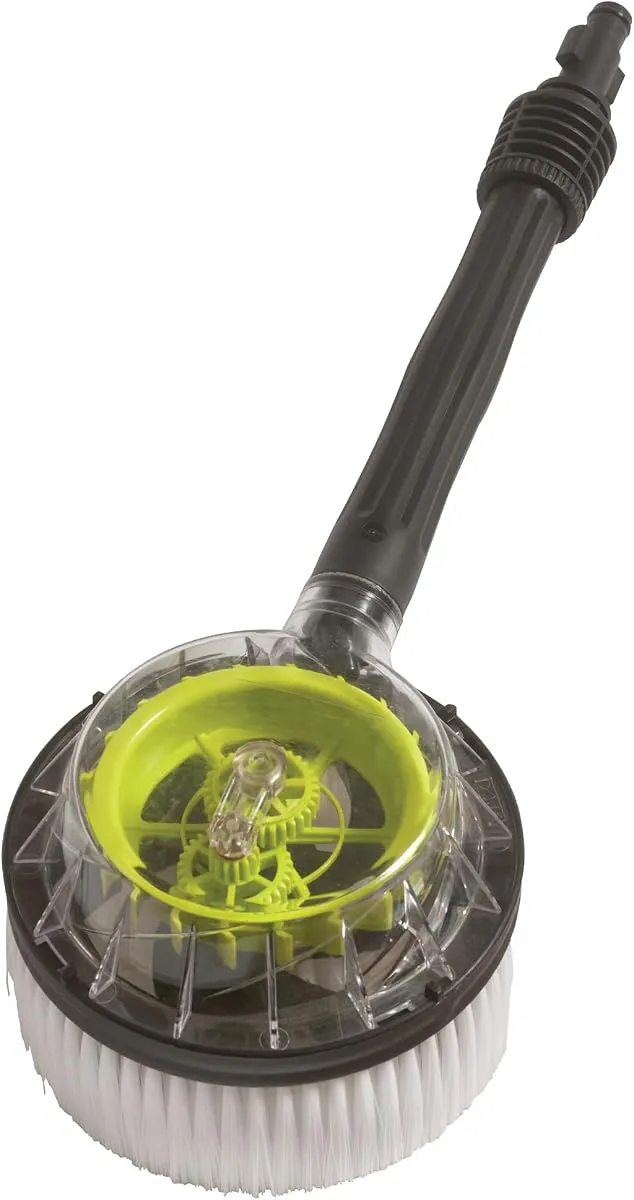
Best for: Wheel barrels and arches — never paint
A rotary brush driven by the water flow. Useful on wheels, arches and other hard surfaces where the risk is nil. We would not put a powered brush on paint under any circumstances, and neither should you — but for the dirtiest parts of a car it saves real scrubbing time.
Pros
- Saves genuine effort on wheel barrels and arches
- Water-driven — no separate power needed
- Cheap add-on to an existing SPX machine
Cons
- Must never touch paint
- Only fits the SPX series
- Traps grit; rinse thoroughly before storing
Gentler option
4. Sun Joe SPX-UB1 Feather Bristle Utility Brush
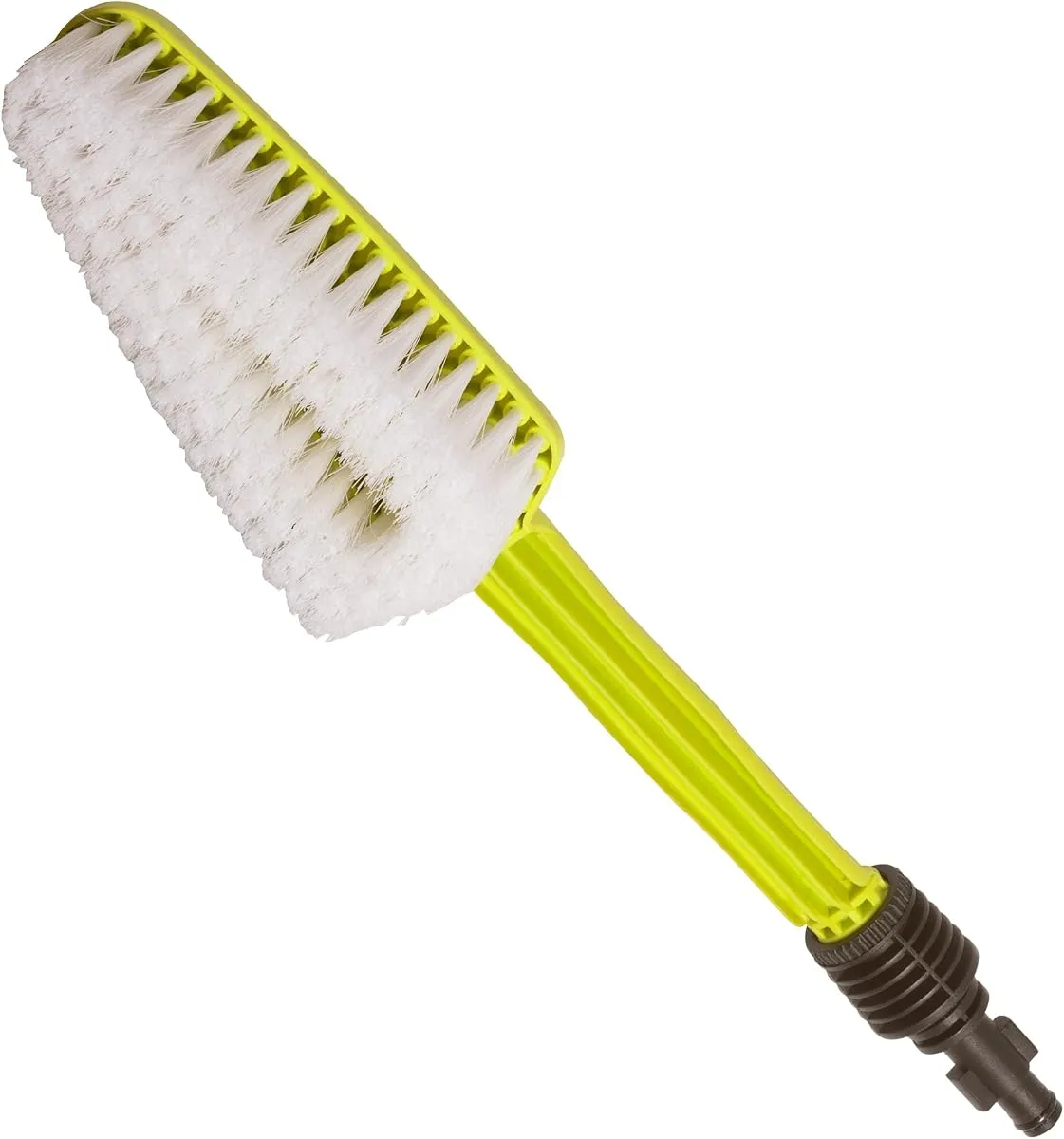
Best for: Sills, arches, and lower panels that need agitation without a mitt
Softer bristles than the rotary kit, intended for gentler scrubbing. Still not a paint tool in our view — a wash mitt is safer on any painted surface — but it is a reasonable choice for the filthy lower sections you would rather not drag a clean mitt through.
Pros
- Softer than the rotary brush
- Good on sills, arches and lower plastic trim
- Cheap
Cons
- Still riskier than a mitt on paint — we would not use it there
- SPX series only
Frequently asked questions
Can a pressure washer damage car paint?
Yes, particularly on older or previously repaired paint. Damage comes from too narrow a nozzle, holding it too close, or aiming directly at an edge or a stone chip where water can get under the paint. Use a wide fan nozzle, keep about a foot of distance, and never use a turbo or zero-degree tip on a car.
What PSI is safe for washing a car?
Roughly 1200 to 1900 PSI at the surface is a sensible range, and how you use the machine matters more than its rating. A 2200 PSI washer with a 40-degree fan nozzle held at a sensible distance is gentler than a 1600 PSI machine with a narrow tip pressed close to the panel.
Is GPM more important than PSI for cars?
For rinsing, yes. Flow rate carries loosened dirt away, while pressure is what risks paint damage. A machine with higher GPM and moderate PSI rinses better and more safely than a high-pressure, low-flow unit, which is why professional detailers rarely use the highest-pressure machines available.
Do I need a foam cannon?
It is the main reason to own a pressure washer for car washing. Pre-foaming loosens and lifts grit before anything touches the paint, which removes a large share of the swirl-mark risk. It reduces the grit load rather than eliminating it, so you still need the two-bucket method for the contact wash.
Electric or gas pressure washer for a car?
Electric, in nearly every case. Gas machines produce far more pressure than a car needs, are heavier, louder and require maintenance. The extra capability is only useful for stripping concrete or paint — neither of which you want near a vehicle.
Can I use a pressure washer instead of hand washing?
Not entirely. A pressure washer removes loose dirt and applies foam, but road film bonded to paint needs contact to release. The realistic sequence is pre-rinse, foam, contact wash with a mitt, then rinse — the machine reduces the contact work rather than replacing it.