How-To Guides
The Two-Bucket Car Wash Method, Step by Step
The single highest-impact habit for avoiding swirl marks. What the two buckets do, why grit guards matter, and the full wash sequence in order.
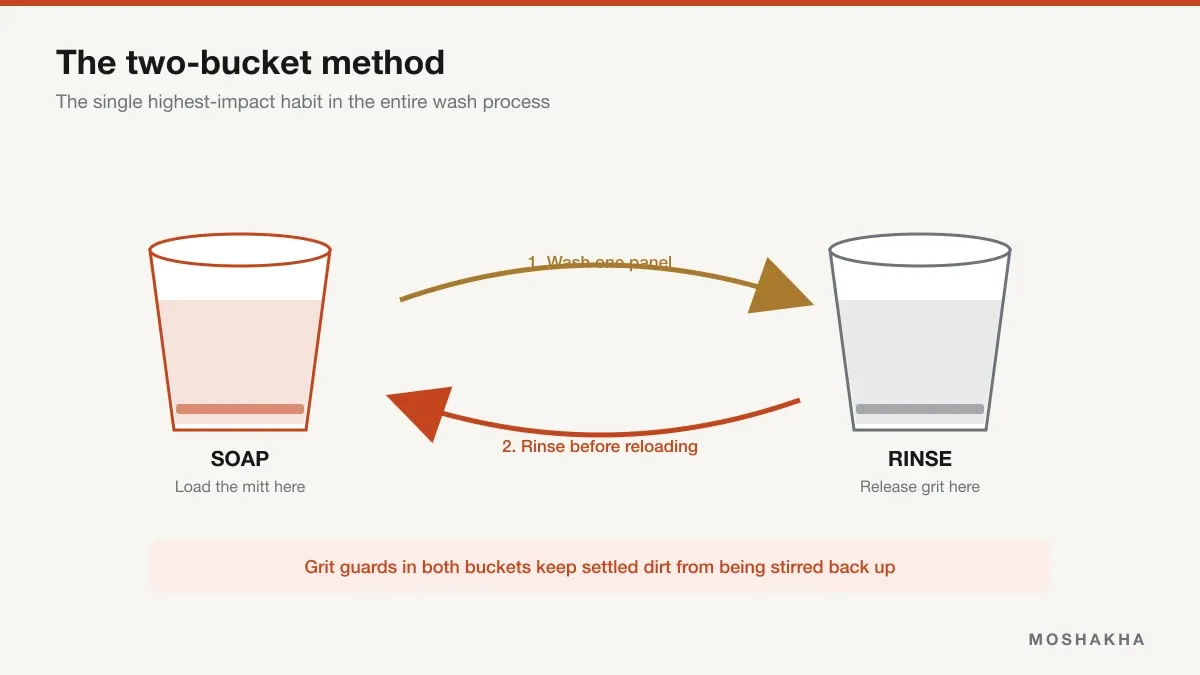
If you do only one thing differently, do this. The two-bucket method costs about the price of one bucket and prevents more paint damage than any product you can buy.
What the second bucket is for
A single bucket has an obvious problem that’s easy to miss while you’re doing it.
You dunk a clean mitt, wash a panel, and the mitt comes back carrying road grime. You dunk it again — into your soap. Now the soap has grit in it. Four panels later you’re washing your car with a bucket of dilute sandpaper, and every subsequent panel gets worse.
The second bucket gives the dirt somewhere else to go. Rinse the mitt in plain water first, then reload it with soap. Your soap bucket stays clean from start to finish.
That’s the entire method. Everything else is refinement.
Grit guards
A grit guard is a plastic grate that sits in the bottom of the bucket. Dirt settles below it, and the grate stops your mitt reaching that dirt when you dunk.
Without one, the rinse bucket does half a job: dirt goes in, then gets stirred back into suspension the next time you plunge a mitt through it. They cost very little and one in each bucket is the sensible setup.
The order matters as much as the buckets
Wheels first, always, with separate tools. Brake dust is metallic and scratches paint on contact. There is no version of this where the same mitt does wheels and panels.
Then top to bottom. Roof, glass, upper panels, then doors, then the lower third and bumpers. Gravity means the bottom of your car holds most of the grit, and working downward keeps that grit away from panels you’ve already cleaned.
Straight lines, never circles. Any marring that does happen will be far less visible as parallel lines than as overlapping arcs. Circular motion is what turns light scratches into the halo pattern people call swirl marks.
The mistakes that undo it
- Washing in direct sun. Shampoo dries on the panel, you scrub to remove it, and the scrubbing does the damage.
- A mitt that isn’t loaded enough. Lubrication protects the paint. A damp mitt drags.
- Pressing harder on stubborn dirt. Rinse the panel again instead. Pressure is what turns a trapped particle into a scratch.
- Continuing with a dropped mitt. It has picked up sharp grit from the ground. Retire it until it’s been laundered.
- Letting the car air-dry. Water spots are mineral deposits, and removing them is a harder job than avoiding them.
What to use
Any decent mitt works — the method matters more than the media. If you’re still using a sponge, that comparison is worth reading first, because the two-bucket method cannot fully compensate for a tool that traps grit against your paint by design.
For specific picks, see our wash mitt guide and drying towel guide.
The shampoo matters more than people assume, because the suds are the lubrication that lets grit slide off the paint rather than grind across it — our car wash soap guide covers why pH-neutral matters and how little of a concentrate you actually need per bucket.
Frequently asked questions
Why two buckets instead of one?
With one bucket, every time you dunk a dirty mitt you contaminate your soap. Within a few panels you are washing the car with gritty water. The second bucket gives the dirt somewhere else to go, so the soap bucket stays clean for the whole wash.
Do I really need grit guards?
They are cheap and they meaningfully improve the method. A grit guard keeps settled dirt trapped at the bottom of the bucket instead of being stirred back up when you dunk the mitt. Without one, the rinse bucket becomes a dirt-redistribution system by the end of the wash.
Is three buckets better?
Marginally, and mainly for wheels. Some detailers run a third bucket dedicated to wheel tools so brake dust never enters either paint bucket. If you have the space it is a sensible addition, but two buckets plus separate wheel tools covers most of the benefit.
Can I use the two-bucket method with a pressure washer and foam cannon?
Yes, and they complement each other. Pre-foaming loosens and lifts grit before contact, which means less for the mitt to drag. You still need two buckets for the contact wash — foam reduces the grit load rather than eliminating it.
How often should I change the water?
Change the rinse bucket if the water becomes visibly murky, which usually happens on a genuinely filthy car. On a fortnightly maintenance wash one fill of each is normally enough.
Does this work for a rinseless wash?
The principle carries over, but the execution differs — rinseless washing uses a bucket of solution and many clean towels rather than one mitt and two buckets. The shared idea is the same: never bring grit back to the paint.