Blog
Is a Third Wash Bucket Worth It?
The jump from one bucket to two removes almost all the risk. What a third bucket actually adds — and the one version of it that's genuinely worth the space.
The two-bucket method is one of the few pieces of car care advice that’s both widely repeated and actually correct. The three-bucket version gets recommended as the next step up — which is true in one form and mostly marketing in another.
Where the actual risk reduction happens
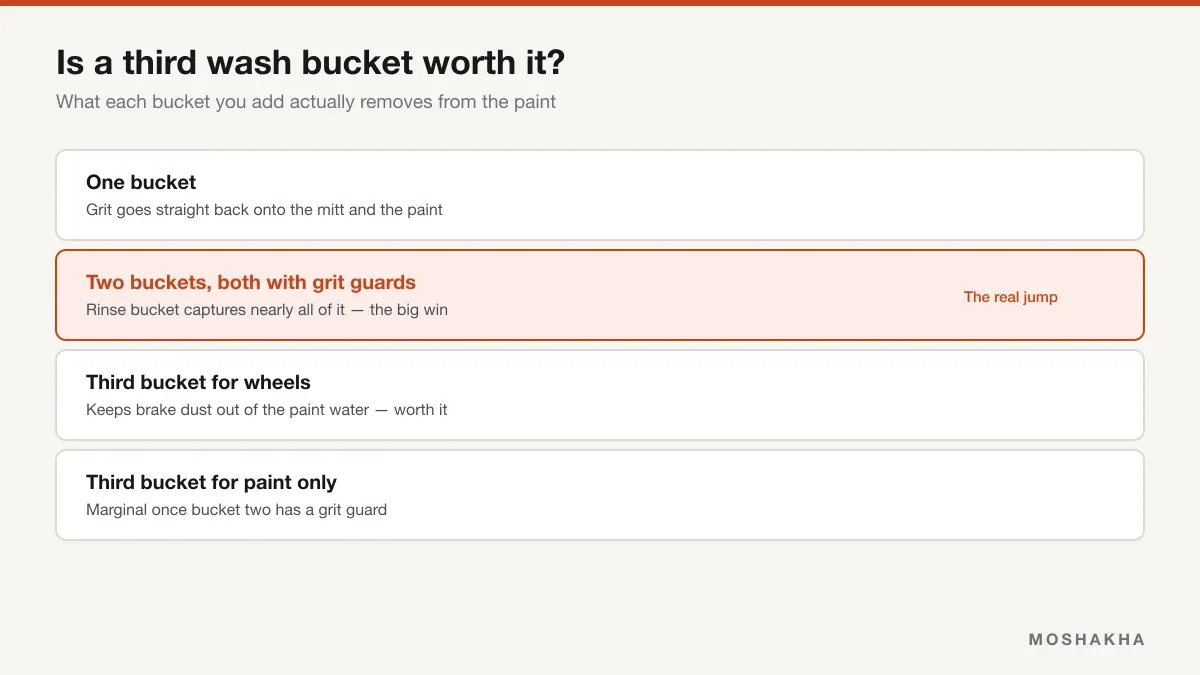
One bucket: grit released from the mitt goes straight back into the same water, and the next dunk loads it right back onto the mitt. You’re rubbing accumulated road grit across paint for the entire wash.
Two buckets, both with grit guards: the rinse bucket captures released grit below a barrier, so it isn’t stirred back up when you dunk. This is the big jump — the one that takes a wash from actively damaging to genuinely paint-safe.
Third bucket: whatever it adds, it’s adding it on top of a problem that’s already been largely solved.
The third bucket that is worth it
Dedicate it to wheels.
Brake dust is metallic, sharp, and far more abrasive than the organic road film on your paint. You never want that migrating into the water that touches body panels. A separate wheel bucket, with its own mitt and its own guard, keeps those two contamination streams apart permanently.
Wheels should be washed first anyway, before paint — cleaning them afterwards throws grit over panels you’ve already finished. The wheel-specific routine is in wheel and rim care.
See the wash mitt from our guideThe third bucket that mostly isn’t
Using a third bucket as a second rinse stage for paint gives you diminishing returns. A grit guard in a single rinse bucket already keeps released dirt out of circulation. Adding another rinse stage refines something that was already working.
It isn’t wrong — it’s just not where your next improvement is. If you have two buckets with guards and want the next real gain, it’s pre-foaming before contact, not another bucket. That reasoning is in the foam cannon guide.
Grit guards outrank bucket count
This is the part worth internalizing: two buckets with grit guards beat three buckets without them. The guard is what makes a rinse bucket function as a trap rather than a reservoir of suspended grit. If you’re deciding where to spend, buy the guards first.
A hose is a legitimate substitute
Rinsing the mitt under a running hose or pressure washer between panels uses fresh water every time, which is strictly cleaner than any rinse bucket. It costs more water and means juggling equipment, but if you already have the pressure washer out, it’s a perfectly valid alternative to the second bucket.
The full sequence, including panel order and mitt handling, is in the two-bucket method.
Frequently asked questions
What is the three bucket wash method?
It adds a third bucket to the standard wash-and-rinse pair. In most versions the third bucket is dedicated to wheels, keeping brake dust and coarse road grit entirely out of the water that touches your paint. A less common version uses the third bucket as a second rinse stage for paint.
Is a third bucket actually necessary?
For wheels, it's genuinely worth it — brake dust is far more abrasive than body dirt, and you never want that grit migrating into paint water. As a second rinse stage for paint alone, the benefit is marginal once your rinse bucket has a grit guard, which is doing most of that work already.
Do grit guards make a real difference?
Yes, and they matter more than the bucket count. A grit guard lets released dirt settle below a barrier so that dunking the mitt doesn't stir it back into suspension. Two buckets with grit guards outperform three buckets without them, which is why the guards are the higher-priority purchase.
Should wheels be washed before or after the paint?
Before, in almost every case. Wheels and arches are the dirtiest parts of the car, and cleaning them afterwards throws grit and dirty water over panels you've already finished. Doing them first, with dedicated tools and their own bucket, means any mess you make gets cleaned up by the wash that follows.
Can I just rinse the mitt with a hose instead of a rinse bucket?
It works, and it's arguably cleaner than a rinse bucket since the water is always fresh. The tradeoffs are water use and the practical annoyance of juggling a hose and a mitt. If you're already using a pressure washer, rinsing the mitt under it between panels is a legitimate alternative to the second bucket.