How-To Guides
Wash Mitt vs Sponge: Which Is Actually Safer for Paint?
Sponges trap grit against your paint; mitts lift it away. Here's why that difference causes swirl marks, and how to wash safely with whichever you own.
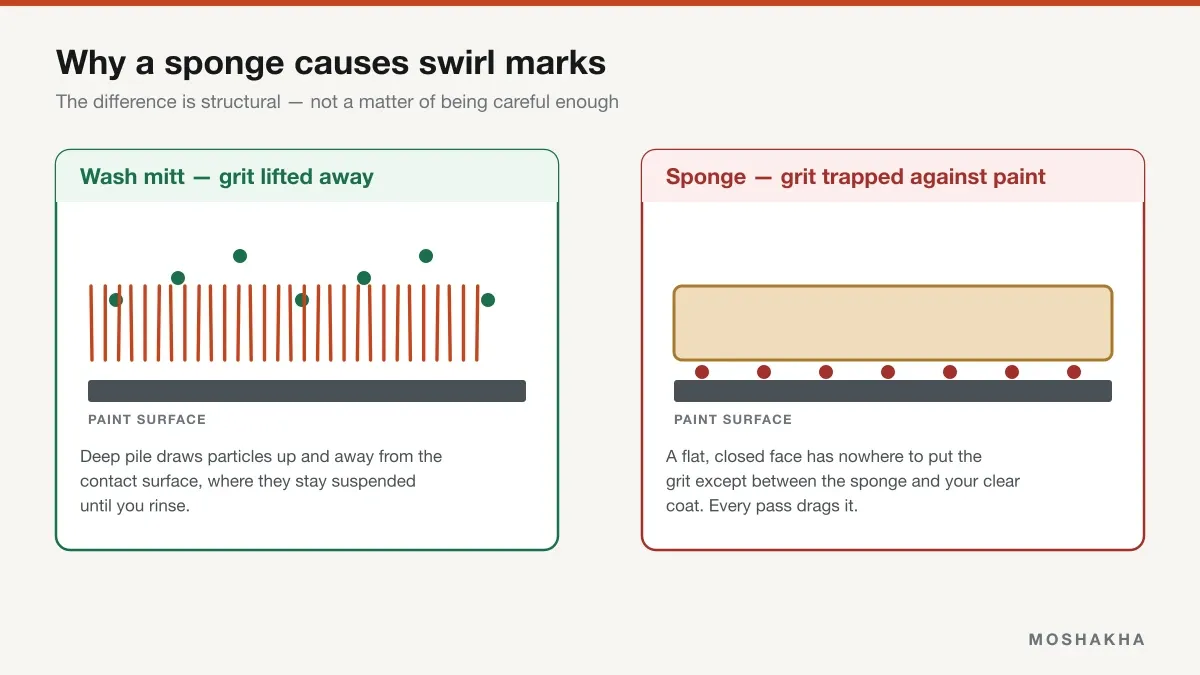
If you take one thing from this page: the sponge is the problem, not your technique.
A wash sponge and a wash mitt look like interchangeable tools that do the same job. They aren’t. They differ in one structural way that determines whether your wash removes dirt or grinds it into your clear coat.
The actual difference
A sponge has a flat, closed face. When you drag it across a dirty panel, it lifts some grit — and then holds that grit in the thin gap between the sponge and your paint. There is nowhere else for the particles to go. Every subsequent pass drags them across the surface under the pressure of your hand.
A mitt has a deep pile. Fibers or chenille noodles pull grit up into the pile, away from the contact surface, where it stays suspended until you rinse it out. The paint never sees most of it.
That’s it. That’s the whole difference — and it is enough to determine whether a fortnightly wash routine slowly destroys your finish or preserves it.
Why swirl marks appear
Swirl marks are not one big scratch. They’re thousands of microscopic ones, all roughly the same depth, catching light from a point source — the sun, or a service-station forecourt light — and scattering it in a halo.
Two things make them worse:
Circular motion. Circles concentrate marring into overlapping arcs that read as distinct swirls. Straight lines produce scratches that are far less visible.
Pressure. The harder you press, the deeper the particle cuts. A sponge encourages pressure because it doesn’t clean well without it. A well-loaded mitt shouldn’t need any.
Dark paint doesn’t swirl more than light paint. It just shows what’s already there.
What to do if you only own a sponge
Assuming you’re not buying anything today:
- Rinse the sponge in clean water after every single panel, not every few.
- Use far more shampoo than feels necessary — lubrication is doing the protecting.
- Never press. If dirt isn’t coming off, rinse the panel again rather than scrubbing.
- Straight lines only.
- Bin any sponge that has touched the ground.
This reduces the risk. It does not remove it, because the flat face still has nowhere to put the grit. A mitt costs less than a single bottle of decent shampoo — and the shampoo is doing half the protecting either way, since the suds are what keeps grit sliding rather than dragging.
Doing it properly
The steps above cover a full safe wash. The two habits that matter most:
- Two buckets. Rinse bucket, soap bucket, grit guards in both.
- Top to bottom. Cleanest panels first, filthiest last.
Wheels are the exception to every rule — always first, always with separate tools that never touch paint. Brake dust is metallic and scratches on contact.
What to buy
Any decent mitt beats any sponge. If you want specific picks — including which mitt suits bug-covered front ends and why a wheel-only mitt is non-negotiable — see our best car wash mitts guide.
And once the car is clean, the other half of the risk is drying it. A saturated or dropped drying towel undoes a careful wash just as efficiently as a sponge does; our drying towel guide covers that.
Frequently asked questions
Does a sponge really cause swirl marks?
It substantially increases the risk. A sponge has a flat, closed-cell face that presses dirt against the paint and drags it along the panel. Every particle caught between the sponge and the clear coat becomes a fine scratch. Under direct sunlight, thousands of these read as swirl marks.
Are all wash mitts equally safe?
No, but the gap between any decent mitt and a sponge is far bigger than the gap between a cheap mitt and an expensive one. What matters is that the pile lifts grit away from the contact surface and releases it when rinsed. A foam core also helps by spreading hand pressure.
Can I still use a sponge if I am very careful?
You can reduce the risk by rinsing constantly and never pressing, but you cannot eliminate the structural problem: the flat face has nowhere to put the grit except against your paint. Given a mitt costs under $15, careful sponge use is a lot of effort to preserve a worse tool.
What about the sponges at automatic car washes?
Avoid them entirely. Communal brushes and sponges at coin-op bays have been used on hundreds of filthy vehicles and are loaded with embedded grit. They are among the most reliable ways to scratch your paint.
Is a microfiber or chenille mitt better?
Both are safe. Chenille noodle mitts hold more suds and are cheaper; 70/30 microfiber mitts release trapped dirt more readily in the rinse bucket and usually last longer. For most people the choice matters much less than using two buckets and washing top to bottom.
What is the two-bucket method?
One bucket holds soap solution, the other plain rinse water. After each panel you rinse the mitt in the plain water to release grit before reloading it with soap. It keeps your soap bucket clean, and it is the highest-impact habit in the entire wash process.