Blog
Microfiber Care 101: How to Wash Towels Without Ruining Them
Fabric softener destroys microfiber. Here's the correct wash routine, why heat matters, how to sort towels by job, and how to revive absorbency.
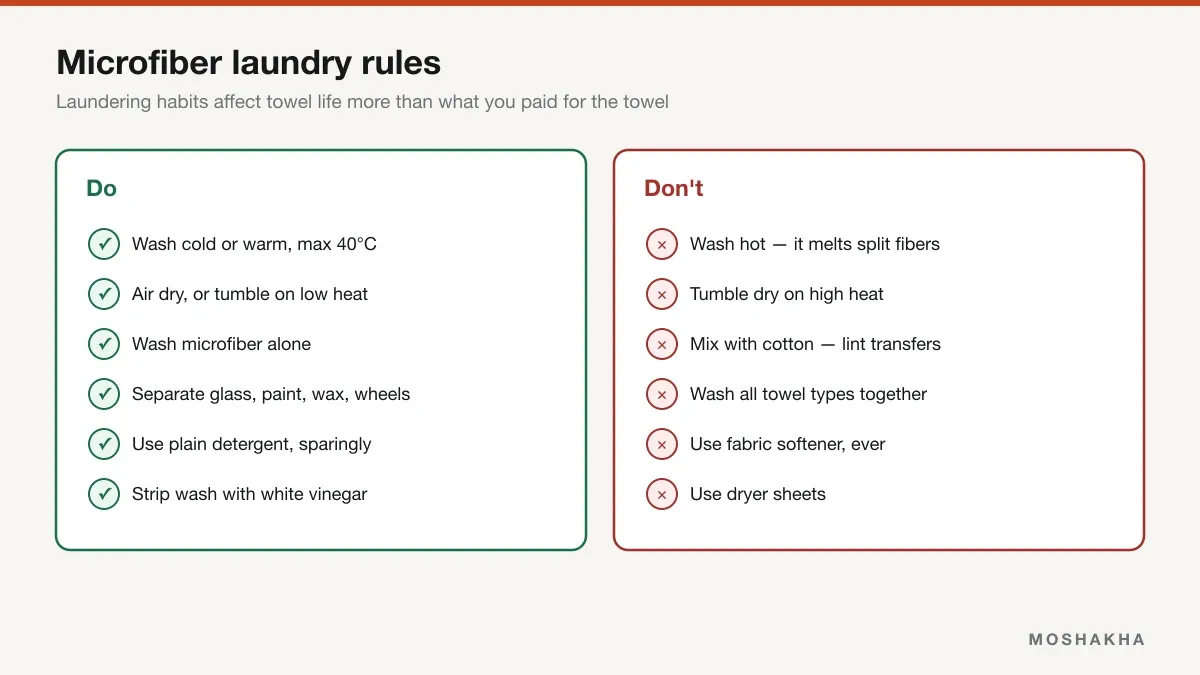
Most microfiber towels don’t wear out. They get ruined — usually in the washing machine, usually within the first few cycles, and usually by someone doing exactly what they’d do with bath towels.
A well-made drying towel should survive several hundred washes. Put it through a hot cycle with fabric softener and it will be measurably worse after one, and close to useless after five. The price you paid makes very little difference to this. Laundering habits are the dominant factor in how long microfiber lasts, and they cost nothing to get right.
How microfiber actually works
This matters, because it explains every rule below.
Microfiber is polyester and polyamide extruded into filaments finer than a human hair, then split — each fiber is divided into many smaller wedge-shaped strands. Those splits create an enormous surface area and thousands of tiny hooks that grab dirt and draw water up by capillary action.
Two things destroy that structure:
- Heat, which melts the split tips and fuses them back together. A fused fiber is just plastic string. This is irreversible.
- Coatings, which fill the gaps between splits so water can’t be drawn in. This is usually reversible — see the strip wash below.
Every rule that follows is one of those two problems.
The rules
1. Never use fabric softener
The most important line on this page. Softener works by depositing a waxy film on fibers to make them feel soft. On cotton that’s pleasant. On microfiber it fills the capillary gaps that do the work.
A softened drying towel pushes water around instead of absorbing it. A softened glass towel smears. People usually blame the towel and buy a new one — which then goes through the same wash.
This includes dryer sheets, which are fabric softener in sheet form.
How to tell if this has already happened to your towels: water beads on the surface instead of soaking straight in, glass or paint streaks after every use rather than occasionally, drying capacity drops off sharply, or the pile feels slick rather than plush. Any of those, alone or together, points at softener contamination rather than a worn-out towel — and it’s usually fixable. See the strip wash below.
2. Keep the heat down
Wash cold to warm, maximum 40°C. Air-dry where you can; tumble dry on low or no heat only.
Hot water and hot dryers fuse split fibers. Unlike softener contamination, there is no recovery from this — the towel is permanently less effective.
Cold water also releases embedded grit more readily than hot, which is what you actually want from a wash.
3. Wash microfiber alone
Microfiber attracts lint aggressively. Wash it with cotton and it will come out coated in fibers that transfer directly onto your paint and glass on the next use.
Microfiber with microfiber. Nothing else, ever.
4. Sort by job, not by color
This is the step most people skip, and it causes more streaking complaints than anything except softener. Wash these categories separately:
- Glass towels — must stay free of any product residue. Wash these alone.
- Wash and drying towels — dirty with road grime, but no chemical residue.
- Wax, sealant and dressing towels — loaded with product that will contaminate anything washed alongside them.
- Wheel and engine towels — brake dust and oil. Wash last, or bin them.
Wash a glass towel with a wax towel and it will streak every window you touch. The towel isn’t faulty; it’s carrying someone else’s product.
5. Use the right detergent, and less of it
A plain liquid detergent with no softeners, no brighteners and no scent works fine — a dedicated microfiber detergent is better but not essential. Avoid powder, which doesn’t fully dissolve at low temperatures and leaves gritty residue in the pile.
Watch heavily scented and “ultra” detergents specifically — they often contain softening agents or optical brighteners even when the label doesn’t say “softener,” and they leave the same residue.
Use less than the bottle says. Excess detergent doesn’t rinse out and becomes exactly the kind of residue that causes streaking.
6. Don’t overload the drum
Towels need room to agitate. A packed drum means grit gets redistributed rather than flushed away. Half-full is about right.
Reviving a towel that’s lost absorbency
If your towels have gone water-repellent, they’re almost certainly coated rather than dead. A strip wash often brings them back:
- Run them alone, with no detergent at all.
- Add about one cup of plain white vinegar to the wash cycle.
- Run a second full rinse with nothing added.
- Air dry.
The vinegar dissolves waxy softener residue and mineral deposits from hard water. Repeat once if the improvement is partial.
What this cannot fix: fibers melted by heat. If a strip wash makes no difference and the pile feels stiff or slightly crunchy rather than plush, the towel is finished.
When to retire a towel
- It touched the ground and you can’t fully launder it before the next use — retire it from paint use immediately. Embedded grit is exactly what you spend the whole wash process avoiding.
- The pile is matted flat and a strip wash doesn’t restore it.
- Edges are fraying, or a stitched border has hardened.
- It has been used on wheels, engine bays or tar removal. These never go back to paint.
Retired towels are still perfectly good for door shuts, exhaust tips, garage spills and wheel arches. Mark them — a snipped corner works — so they can’t drift back into the paint pile by accident.
The short version
| Do | Don’t |
|---|---|
| Wash cold or warm, max 40°C | Wash hot |
| Air dry, or tumble on low/no heat | Tumble on high heat |
| Wash microfiber alone | Mix with cotton |
| Separate by job — glass, paint, wax, wheels | Wash all towels together |
| Use plain detergent, sparingly | Use softener or dryer sheets |
| Strip wash with vinegar to restore | Assume a repellent towel is dead |
Get this right and a good towel lasts years. Get it wrong and it doesn’t matter which towel you bought — which is why this page matters more than any of our buying guides.
If you’re choosing new towels, our drying towel guide covers what to buy, and what GSM actually means explains the spec that most listings lean on hardest.
Frequently asked questions
Can you use fabric softener on microfiber towels?
No. This is the single most damaging thing you can do to microfiber. Softener works by depositing a waxy coating on fibers, which fills the microscopic gaps that make microfiber absorbent. A softened towel repels water instead of drinking it, and smears product instead of lifting it. The damage is cumulative and often permanent.
What temperature should I wash microfiber at?
Cold to warm, up to about 40°C. Microfiber is polyester and polyamide — both plastics. High heat melts and fuses the split fiber tips that do the actual cleaning, and once fused they never recover. Cold water also releases trapped grit better than hot.
Can I tumble dry microfiber towels?
Only on low or no heat, and air-drying is better. High dryer heat causes the same fiber fusion as a hot wash. Never use dryer sheets — they deposit the same waxy coating as fabric softener. Clean the lint trap first, or your microfiber will come out covered in cotton lint.
Why do my microfiber towels leave streaks?
Usually residue, not the towel. The three common causes are fabric softener contamination, product build-up from wax or dressings that was never washed out, and using a high-pile towel on glass. Try a hot-water strip wash first; if streaking persists on glass only, you need a low-pile towel rather than a cleaner one.
How do I restore absorbency to old microfiber towels?
Do a strip wash: run them alone with no detergent, adding a cup of white vinegar to the wash, then a second rinse cycle. Vinegar dissolves the waxy softener and mineral build-up that block the fibers. This recovers towels that are contaminated, but cannot repair fibers already melted by heat.
Should I wash microfiber with other laundry?
Never. Microfiber attracts and holds lint, so washing it with cotton produces towels covered in fibers that transfer straight onto your paint. Wash microfiber only with other microfiber, and keep the categories separated by job.
How long should microfiber towels last?
A quality towel that is laundered correctly should last 200 to 500 wash cycles. The same towel washed with softener and dried on high heat can be functionally dead within five. Laundering habits affect towel life far more than what you paid for it.