Buying Guides
Microfiber GSM Explained: What the Number Actually Means
GSM measures density, not quality. Here's what the number really tells you, the right GSM for each detailing job, and when high GSM is the wrong choice.
Walk through any detailing product listing and GSM is everywhere: 300, 500, 800, 1200, 1600. The number is always presented as a score, with higher implied to be better.
It isn’t a score. GSM measures density, not quality — and once you understand what it does and doesn’t tell you, a lot of detailing marketing stops working on you.
What GSM actually measures
GSM is grams per square meter: take one square meter of the fabric, weigh it, and that’s the number. That’s the whole definition.
More grams means more fiber packed into the same area, which generally means a deeper pile and more water capacity. Useful — but notice what GSM does not describe:
- Fiber quality. Cheap and premium fibers weigh the same.
- Blend ratio. The polyester/polyamide split drives absorbency, and GSM ignores it.
- Weave type. Twisted loop, plush and waffle can all hit the same GSM and behave completely differently.
- Edge construction. A hard stitched border on a 1200 GSM towel can mar paint that an edgeless 500 GSM towel never would.
Two towels at identical GSM can differ enormously. This is why GSM alone is a poor buying signal — and why it’s the number retailers advertise most.
The specs that matter more than GSM
Blend ratio (70/30 vs 80/20)
Microfiber is polyester and polyamide. Polyester does the scrubbing; polyamide does the absorbing, and costs more.
- 80/20 — 20% polyamide. The budget standard. Perfectly serviceable.
- 70/30 — 30% polyamide. Noticeably more absorbent and softer at the same GSM.
A 70/30 towel at 900 GSM will generally out-absorb an 80/20 towel at 1100 GSM. Blend ratio is the single most useful spec on a listing, and it is advertised far less often than GSM — which should tell you something.
Weave
- Twisted loop — long twisted fibers that pull water up into the pile. The correct weave for drying a vehicle.
- Plush / high pile — soft and deep, holds product well. Best for wax and sealant removal.
- Waffle weave — thin, low-lint, gridded. Best for glass.
- Low-pile / flat — dense and short. Best for interiors and final wipe-downs.
Edge construction
Edgeless or silk-banded edges are safest on paint. A thick polyester overlock stitch is harder than your clear coat and is a genuine marring risk on soft paint.
GSM matched to the job
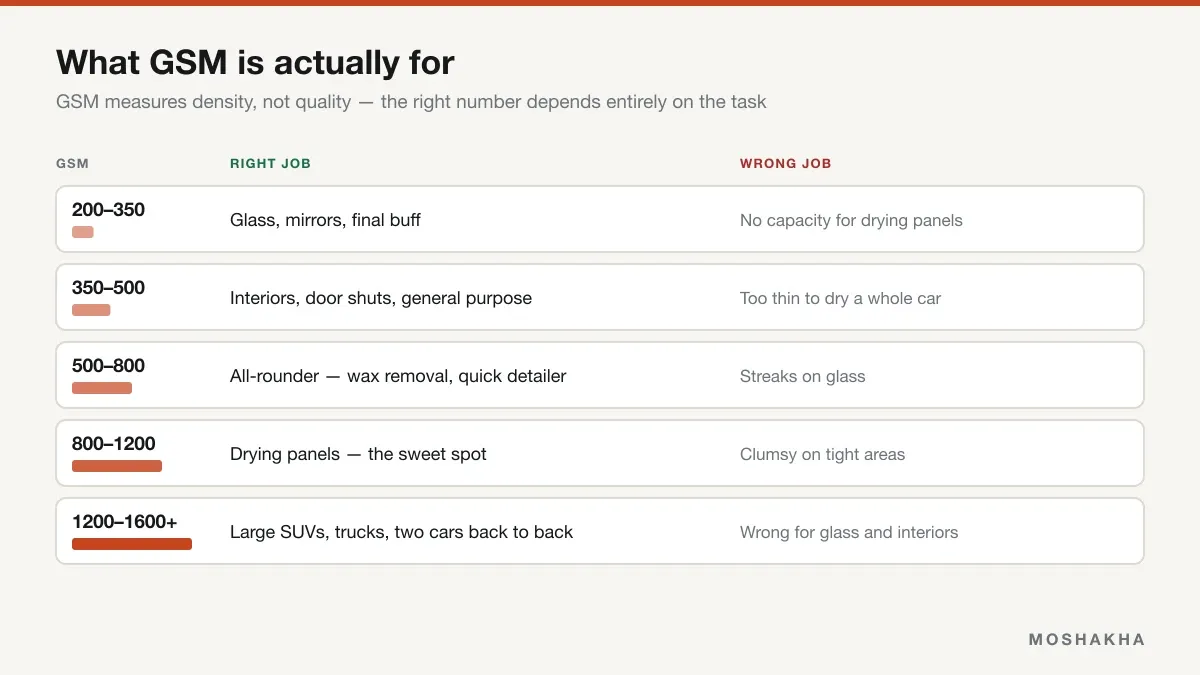
This is the table the “higher is better” crowd never publishes.
| GSM range | Pile | Right job | Wrong job |
|---|---|---|---|
| 200–350 | Very low | Glass, mirrors, final buff, engine bays | Drying panels — no capacity |
| 350–500 | Low | Interiors, door shuts, general purpose, applying product | Drying a whole car |
| 500–800 | Medium | All-rounder: wax removal, quick detailer, light drying | Streaks on glass |
| 800–1200 | High, usually twisted loop | Drying panels — the sweet spot for most vehicles | Anything needing precision |
| 1200–1600+ | Very high | Drying large SUVs, trucks, vans; two cars back to back | Glass, interiors, small cars |
When high GSM is actively the wrong choice
Three cases where reaching for the biggest number makes your results worse:
Glass. A 1200 GSM towel on a windshield is the number one cause of streaking. Deep pile can’t make consistent contact with a perfectly smooth surface, so it smears the last film of moisture rather than lifting it. Drop to 300-400 GSM and the problem disappears — no product change needed.
Interiors. Piano-black trim, screens and switchgear need a low-pile towel with precision. A thick plush towel is clumsy, and its pile carries grit into panel gaps.
Small cars. On a hatchback, a 1600 GSM towel is heavy, slow, and awkward around mirrors and badges. You are fighting the towel for no absorbency benefit you’ll ever use.
The honest summary
GSM is one spec among four that matter, and it is the least informative of them. In rough order of importance for buying:
- Weave — is it built for the job you’re doing?
- Blend ratio — 70/30 beats 80/20 at equal GSM.
- Edge construction — edgeless or silk-banded on paint.
- GSM — matched to the task, not maximised.
The reason you rarely read this is structural. Most detailing content is published by companies that sell towels, and “our 1600 GSM towel is overkill for your Civic” is not a sentence a shop can afford to write.
Where to go from here
- Buying a drying towel? Our best car drying towels guide applies this directly, matched to vehicle size.
- Want a specific head-to-head? 500 GSM vs 800 GSM covers the most common decision point.
- Already own good towels? Microfiber care matters more than GSM — bad laundering ruins a premium towel in about three washes.
Frequently asked questions
What does GSM mean on a microfiber towel?
GSM stands for grams per square meter — the weight of one square meter of the fabric. It tells you how much fiber is packed into the cloth, which correlates with pile depth and water capacity. It says nothing about fiber quality, blend ratio, weave type or edge construction.
Is a higher GSM microfiber towel always better?
No. Higher GSM means more absorbency but also more weight, slower air-drying and less control on tight areas. A 1600 GSM towel is excellent for drying a truck and actively bad for cleaning glass. The right GSM depends entirely on the job — matching GSM to task matters far more than maximising it.
What GSM is best for glass?
300-400 GSM. Low-pile, tightly woven towels leave glass streak-free because they lift the final film of moisture rather than smearing it. High-pile towels above about 800 GSM are the most common cause of streaky windows.
What is the difference between 70/30 and 80/20 microfiber?
That ratio is polyester to polyamide. Polyamide is the more absorbent, more expensive component, so a 70/30 blend absorbs more and feels softer than an 80/20 blend at the same GSM. Blend ratio is often a better quality signal than GSM, and it is far less frequently advertised.
Does GSM tell you how long a towel will last?
Not directly. Longevity depends more on fiber quality, blend ratio, edge construction and how you launder it. A 1200 GSM towel washed with fabric softener will underperform a well-maintained 500 GSM towel within a few cycles.
What GSM should I buy if I can only buy one towel?
Around 500 GSM in an edgeless design is the most versatile single choice — usable for interiors, light drying, product removal and general work. But one towel is a compromise: a 500 GSM towel dries a car slowly, and pairing it with a dedicated drying towel costs little and works far better.