Blog
500 GSM vs 800 GSM Microfiber: Which Should You Buy?
A direct comparison of the two most common microfiber weights — what each is genuinely good at, where each fails, and which one to buy first.
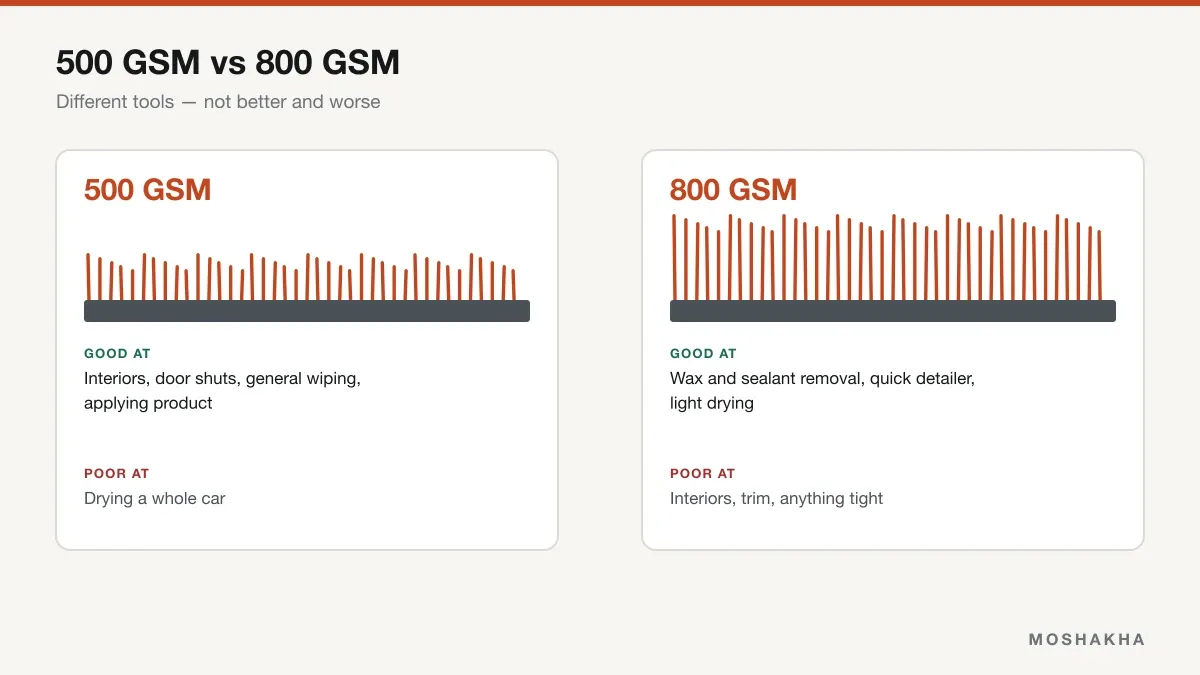
500 GSM and 800 GSM are the two weights you’ll meet most often, and the choice between them is where most people first run into the “higher must be better” assumption.
It isn’t. These are different tools, and the more expensive one is the wrong answer for several common jobs.
The short answer
| 500 GSM | 800 GSM | |
|---|---|---|
| Pile | Medium-low | Medium-high, plush |
| Water capacity | Moderate | High |
| Surface contact | Even, precise | Cushioned, less precise |
| Best at | Interiors, door shuts, general wiping, product application | Wax and sealant removal, quick detailer, light drying |
| Poor at | Drying a whole car | Interiors, trim, anything tight |
| Dries after washing | Quickly | Slowly |
| Buy first? | Yes | Only as a second towel |
Where 500 GSM wins
Interiors and trim. A shorter pile makes flatter, more even contact with hard surfaces. On dashboards, door cards, screens and switchgear, that means it cleans rather than skating over the texture. An 800 GSM towel is clumsy here — the deep pile cushions the contact and carries grit into panel gaps.
Anything needing precision. Badges, vents, door shuts, around emblems. Lower pile means you can feel the surface through the towel.
General-purpose use. If you’re buying a stack of towels for miscellaneous work, 500 GSM is the weight to buy. It dries quickly after laundering, stores flat, and is cheap enough to retire without hesitation.
Applying product. A shorter pile absorbs less of your wax or dressing, so more of it ends up on the car rather than soaked into the towel.
Where 800 GSM wins
Removing wax and sealant. This is the job 800 GSM is genuinely made for. The deeper pile lifts and holds cured residue away from the paint instead of pushing it around, and there’s enough capacity to buff a whole panel without loading up.
Quick detailer and spray wax. Plush pile absorbs the excess and leaves a cleaner finish than a thinner towel.
Light drying on a small car. It will work on a hatchback. It is not a drying towel, and you will be wringing it out — but in a pinch, it’s serviceable.
Soft or delicate paint. The extra cushioning gives a margin of safety on soft clear coats where you’d rather not press.
Where both are the wrong choice
Drying a car properly. Both sit below the practical drying range. You want 900–1200 GSM, and more importantly you want twisted loop rather than plush — the weave matters more than the weight here. Our drying towel guide covers what to buy instead.
Glass. Both are too plush. Deep pile cannot make consistent contact with a perfectly smooth surface, so it smears the last film of moisture into streaks. Glass wants 300–400 GSM. This is the single most common cause of streaky windows, and no change of glass cleaner will fix it.
Which to buy first
Buy 500 GSM first, in a multipack, edgeless. It covers more jobs, it’s cheaper, and it launders better. Add 800 GSM later specifically for wax and sealant removal, when you have a reason to.
The upgrade that will actually change your results isn’t going from 500 to 800. It’s adding a proper drying towel at 900+ GSM in twisted loop, and a low-pile glass towel at 300–400 GSM. Those two fill the gaps that neither weight here covers.
Before you spend anything
GSM is only one of four specs that matter, and it’s the least informative of them — blend ratio, weave and edge construction all affect performance more. Our full breakdown of what microfiber GSM actually means covers how to read a listing properly.
And whichever you buy, how you launder it will affect its performance more than the 300 GSM difference discussed on this page.
Frequently asked questions
Is 800 GSM better than 500 GSM?
Not better — different. 800 GSM holds more water and more product, which suits wax removal and light drying. 500 GSM has a shorter pile that makes better contact with hard surfaces, which suits interiors, glass-adjacent work and general wiping. Buying 800 GSM for interior trim is a downgrade, not an upgrade.
If I can only buy one, which should it be?
500 GSM. It is the more versatile of the two — usable on interiors, door shuts, product removal and light drying. An 800 GSM towel is more specialised, and it is poor at the precision jobs a 500 GSM towel handles comfortably.
Can I use 800 GSM for drying my car?
For a small car, at a push. 800 GSM sits below the practical range for drying panels, so you will be wringing it out repeatedly on anything larger than a hatchback. Proper drying towels start around 900 GSM and are usually twisted loop rather than plush.
Which is better for glass, 500 or 800 GSM?
Neither, really — both are too plush. Glass wants 300 to 400 GSM in a low-pile or waffle weave. Of the two here, 500 GSM is much closer to workable, but a dedicated low-pile glass towel will outperform both and costs very little.