Blog
How Often You Should Actually Wash Your Car
Every-other-week is generic advice. What actually determines the right interval is your parking situation and climate — here's how to work out your own.
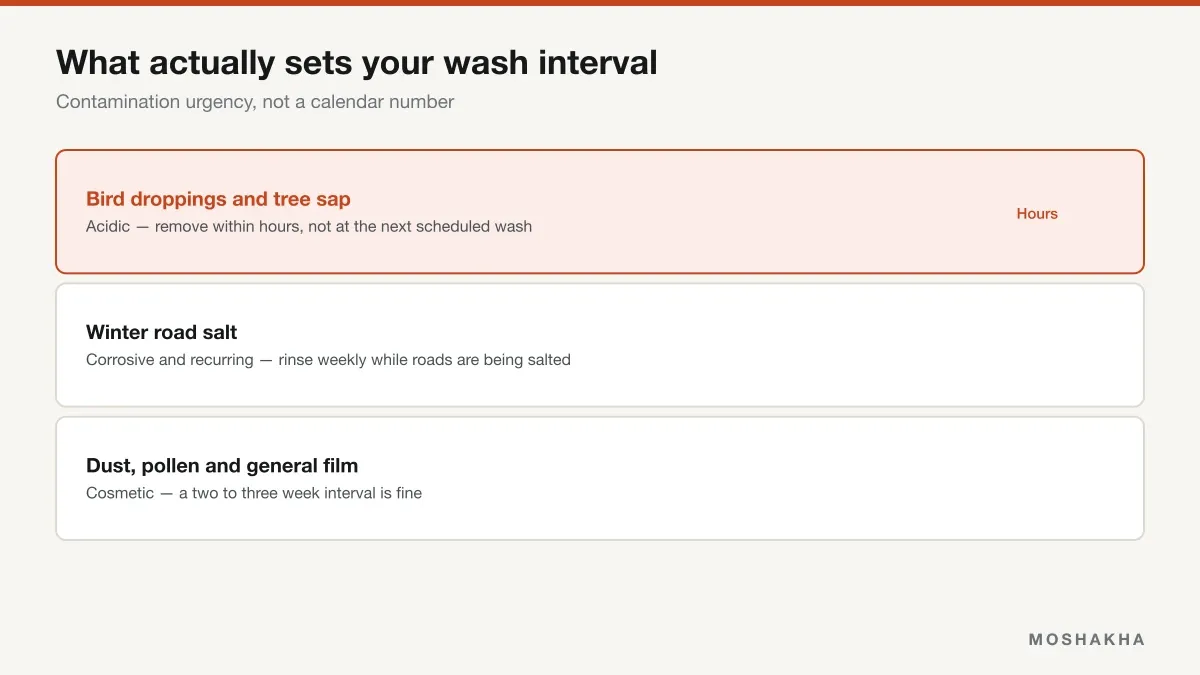
“Every two weeks” is the answer you’ll find in most car care advice, and it’s a reasonable default for exactly one situation: a garage-kept car, mild climate, average road conditions. Outside that description, it’s mostly wrong, and it’s worth understanding why so you can work out your own interval instead of following a generic one.
The real variables
Where the car sleeps. A garage-kept car accumulates far less airborne dust, pollen, tree sap, and bird activity than one parked under trees or on the street. This alone can be the difference between a two-week and a one-week interval.
Climate and coastal proximity. Salt air near the coast accelerates corrosion on unwashed paint and trim. Areas with heavy pollen seasons or frequent dust need more frequent attention during those specific months, not year-round.
Road salt in winter. This is the biggest seasonal swing. Salted roads leave a corrosive film on the underbody and wheel wells that plain rain doesn’t fully clear. Regions that salt roads heavily warrant a noticeably shorter interval — sometimes weekly — during winter months specifically.
What’s actually landed on the car. Bird droppings and tree sap are acidic and can etch clear coat if left for days rather than hours. These aren’t “wait for the next scheduled wash” situations — they’re a rinse-it-now situation regardless of where you are in your normal cycle.
Contamination-based, not calendar-based
The more useful mental model isn’t “every N days” — it’s “how long can this specific contaminant safely sit before it stops being cosmetic and starts being a bonding or etching risk.” Dust is low-urgency. Bird droppings and sap are high-urgency. Road salt in winter is high-urgency and recurring. A fixed calendar interval averages all of that into one number that fits none of the individual cases well.
Does frequent washing damage paint?
Not from frequency itself — from technique. A wash using a pH-neutral soap, clean mitts, and the two-bucket method is safe as often as it’s needed. What actually causes swirl marks and fine scratches is dirty tools and rushed technique repeated over time, not the number of washes themselves — see avoiding swirl marks for the specific technique mistakes that matter more than frequency.
The practical answer
Set a baseline of every two to three weeks for a typically garage-kept car in a mild climate, then override it immediately for anything acidic (bird droppings, sap) or seasonal (winter road salt, heavy pollen). The baseline is a starting point, not a rule — the contamination on the car is the actual signal.
Frequently asked questions
Is every two weeks the right interval for everyone?
No — it's a reasonable default for a garage-kept car in a mild climate with average road conditions, and a poor fit for almost anyone outside that description. Coastal salt air, winter road salt, tree sap, and bird activity can each independently justify washing more often than a fixed calendar interval assumes.
Does washing too often damage a car's paint?
Not from the washing itself, if done with proper technique — a pH-neutral soap, clean tools, and the two-bucket method. What causes damage is poor technique repeated often, not frequency alone. A car washed weekly with correct technique is safer than one washed monthly with a dirty sponge and no rinse bucket.
What's the actual signal that a car needs washing, if not a calendar?
Visible contamination — dust dulling the finish, bird droppings or tree sap sitting on the surface, road salt film, or a rough feel when you run a hand lightly over clean paint. Contaminants left on the surface for extended periods are more likely to etch or bond than the same contaminants removed promptly, so the real driver is how quickly they need to come off, not a fixed schedule.
Should I wash more often in winter?
In regions that salt roads, yes, considerably more often than a summer schedule. Road salt is corrosive and accelerates rust, particularly in wheel wells and the underbody. A weekly or even more frequent rinse during heavy salting periods is a reasonable response, separate from the wash frequency you'd use the rest of the year.
Does a ceramic coating change how often I should wash?
It changes how easily contaminants come off, not really how often they land on the car. A coated car often looks cleaner for longer and grime rinses off more easily, which can make washing feel less urgent — but bird droppings, sap, and salt still benefit from prompt removal regardless of coating.