Blog
Interior Detailer vs All-Purpose Cleaner: What Ruins Dashboards
Diluted APC is the usual cause of a hazed, dried-out dashboard. Which surfaces each product belongs on, and where full-strength cleaner is genuinely fine.
Most ruined dashboards weren’t neglected. They were cleaned — repeatedly, with the wrong product, by someone being conscientious.
Why APC damages interior plastics
All-purpose cleaner is alkaline. That’s not a flaw; it’s the mechanism. Alkalinity is what breaks down grease and heavy soil, and it’s why APC is genuinely excellent at what it’s for.
The problem is that alkaline chemistry doesn’t distinguish between road grime and the plasticizers in a soft-touch dashboard. Used repeatedly, it strips those out. The result is a surface that first looks slightly hazy, then dries out, then in extreme cases cracks — and because the damage accumulates over months, almost nobody connects it to the bottle.
Diluting APC lowers the concentration, not the chemistry. It’s still alkaline at 10:1.
What an interior detailer does differently
It’s formulated pH-neutral or close to it, with much weaker surfactants and usually some UV inhibitor content. It lifts light soil off a sealed surface without attacking the seal. That’s a narrower job than APC does — and on a dashboard, the narrower job is the correct one.
See the interior cleaner from our guideMatch the product to the surface
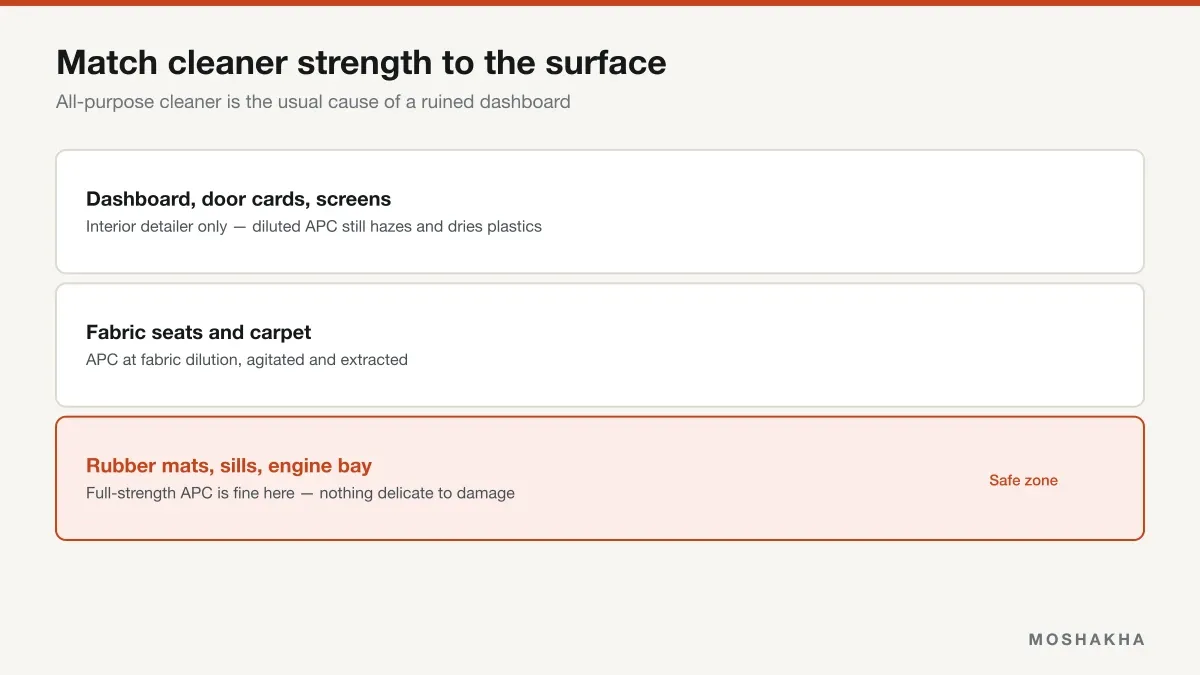
Interior detailer only: dashboard, door cards, center console, soft-touch plastics, steering wheel, any painted or coated trim.
APC at fabric dilution: fabric seats and carpet, agitated and extracted rather than soaked. The routine for that is in cleaning fabric car seats.
Full-strength APC is genuinely fine: rubber floor mats, door sills, plastic arch liners, engine bay plastics. Robust, unprotected surfaces where aggressive chemistry has nothing delicate to damage.
Screens are their own category
Infotainment displays and instrument clusters carry anti-glare and oleophobic coatings that both APC and many interior detailers will degrade. A dedicated screen cleaner, or a barely-damp plain microfiber, is the safe answer — and the liquid goes on the towel, never directly on the screen, so nothing runs into the bezel.
The practical rule
If the surface is sealed, coated, or soft-touch, use the gentler product. If it’s rubber, bare plastic, or fabric, the stronger one is appropriate and will save you time.
Getting this wrong doesn’t produce an obvious mistake on the day. It produces a dashboard that looks a few years older than the car — which is exactly why it’s worth getting right from the start. The full interior sequence is in the interior detailing guide.
Frequently asked questions
Can I use all-purpose cleaner on my dashboard?
You can, and it's the most common cause of a hazed or dried-out dash. APC is alkaline by design — that's how it cuts grease — and repeated use on soft-touch plastics and vinyl strips plasticizers and degrades the factory finish. The damage is cumulative rather than immediate, which is why people don't connect the product to the result.
What's actually in an interior detailer that APC doesn't have?
An interior detailer is formulated pH-neutral or close to it, with much lower surfactant strength and usually some UV protection. It's designed to lift light soil off a sealed surface without attacking the surface itself. APC is designed to break down grease and heavy soil, which requires chemistry that doesn't distinguish between grime and the plasticizers in your dashboard.
Is diluted APC safe on interior plastics?
Safer than full strength, but dilution reduces the concentration rather than changing the chemistry — it's still alkaline. For occasional use on hard, non-porous plastics it's usually fine. As a regular routine on a dashboard, door cards or a soft-touch surface, it will still shorten the life of the finish.
Where is full-strength APC actually appropriate in a car?
Rubber floor mats, door sills, plastic wheel arch liners, engine bay plastics, and heavily soiled carpet at a fabric-appropriate dilution. These surfaces are either robust or already unprotected, so the aggressive chemistry does its job without damaging anything delicate.
What should I use on screens and infotainment displays?
Neither product at full strength. Screens have anti-glare and oleophobic coatings that both APC and many interior detailers can degrade. A dedicated screen cleaner or a barely-damp plain microfiber is the safe option, and the spray should always go on the towel rather than on the screen.