How-To Guides
Cleaning Fabric Car Seats Without Soaking the Foam
Over-wetting is why cleaned seats stay damp for days and start to smell. Spray the brush, not the seat — and extract immediately.
There are two ways to clean a fabric seat. One leaves it clean and dry in an hour. The other leaves it clean, damp for a week, and smelling musty by the following weekend.
The difference isn’t the product. It’s how much water gets into the foam.
The foam is the problem
Fabric seating sits on open-cell foam, which absorbs water readily and releases it slowly. Inside a closed car there’s no airflow underneath and very little above. A seat that gets genuinely soaked can stay damp internally for days.
Warm, dark, enclosed, and damp is precisely the condition that produces a musty interior. So the goal isn’t only to clean the fabric — it’s to clean it while introducing as little liquid as possible.
Spray the brush, not the seat
This one change does most of the work.
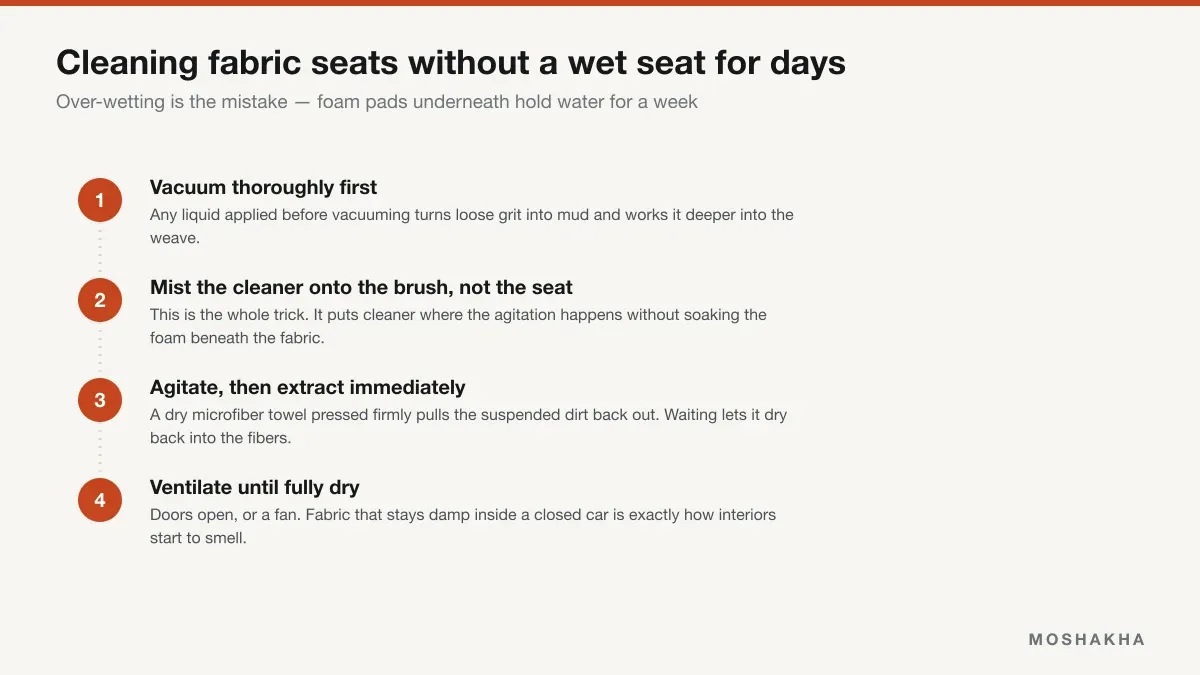
Spraying the seat directly saturates the fabric and pushes cleaner straight through into the foam. Spraying the brush puts the cleaner exactly where the agitation happens — at the fiber surface, where the dirt actually is — and almost nothing reaches the foam.
Vacuum first, always
Cleaner applied over loose grit makes mud and drives it deeper into the weave. Vacuum everything first, including the seam where the backrest meets the base, and under the rails where debris collects.
See the car vacuum we reviewedPress to extract — don’t wipe
After agitating a small section, press a folded dry microfiber firmly into it and hold. Wiping smears suspended dirt around; pressing draws it up into the towel. Refold to a clean face each time and repeat until the towel comes away only lightly marked.
Work in sections about the size of a dinner plate, so nothing dries back into the fabric before you extract it.
Get the dilution right, and err weak
Use the product’s fabric dilution, not its general-purpose one. Excess surfactant that doesn’t get extracted stays behind, attracts dirt faster afterwards, and can leave the fabric feeling stiff. Weaker cleaner with more agitation beats stronger cleaner with less.
Which product belongs on which interior surface — and why full-strength APC ruins dashboards — is covered in interior detailer vs all-purpose cleaner.
Then ventilate properly
Doors open, or a fan pointed into the cabin, until the fabric is dry to the touch throughout. Closing the car up on a seat that’s still damp inside undoes an otherwise good job.
If your seats turn out to be coated rather than fabric, the routine is different — see cleaning leather car seats.
Frequently asked questions
Why do my car seats smell after I clean them?
Almost always because the foam underneath the fabric is still wet. Car seat foam is open-cell and holds a surprising amount of water, and inside a closed car it dries very slowly. Damp foam in a warm, dark, enclosed space is exactly the condition that produces a musty smell — which is why controlling how much liquid you introduce matters more than which cleaner you pick.
Can I use a household carpet cleaner on car seats?
The chemistry is usually similar enough, but the application method is the problem. Household carpet machines inject far more water than a car seat can afford, and unlike a home carpet, a car seat has no airflow underneath and no ability to dry quickly. If you use a machine, use one with strong extraction and make multiple dry passes.
How do I get a stain out without leaving a water ring?
Water rings form when a wet area dries with a hard edge. Feather the damp area outward rather than treating a sharply defined spot, so there's no abrupt transition between wet and dry fabric. Extracting thoroughly also helps, because a ring is partly dissolved soil migrating to the edge as it dries.
Is a wet/dry vacuum or extractor worth buying?
If you clean interiors regularly or have kids or pets, yes — mechanical extraction removes far more moisture and suspended soil than towel blotting, which directly addresses the drying-time problem. For occasional cleaning, the towel extraction method above achieves a good result without the equipment.
What dilution should I use for all-purpose cleaner on fabric?
Follow the product's fabric dilution rather than its general-purpose one — typically much weaker. Stronger isn't better here; excess surfactant that isn't fully extracted stays in the fabric, attracts dirt faster afterwards, and can leave a stiff feel. If in doubt, dilute more and agitate more.