How-To Guides
Cleaning Leather Car Seats (Most 'Leather' Is Vinyl)
Nearly every modern car seat is coated, not raw leather — which changes what you should use. The water-drop test, and the routine that follows from it.
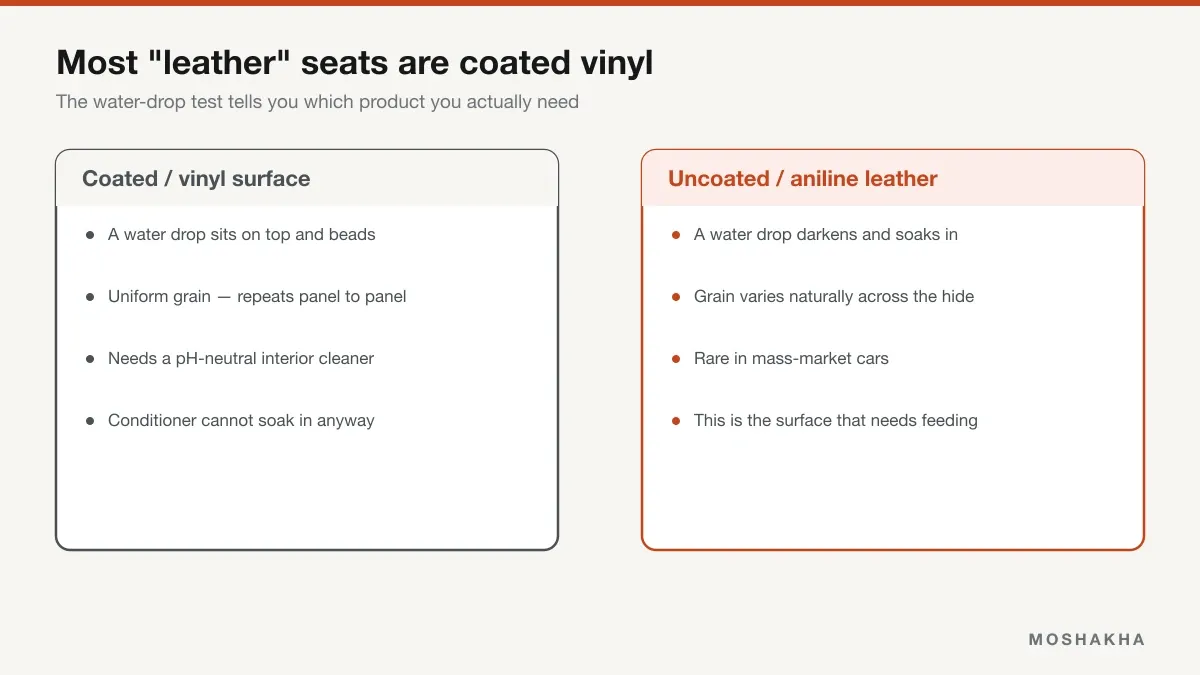
Most advice about leather car seats assumes you have leather. Usually you do not — at least not in the sense the advice means.
Start with the water-drop test
Put one drop of water somewhere inconspicuous. If it beads and sits on top, the surface is coated — a polymer layer over either leather or vinyl. If it darkens and soaks in, it is uncoated leather.
Almost every mass-market car built in the last two decades uses a coated surface. That is not a downside; the coating is what makes the seat survive sunlight, denim dye, and years of people sliding across it. But it does change what you should put on it.
Why this changes the product
A conditioner exists to feed oils into porous leather. A coating has no pores to feed. Applied to a coated seat, conditioner sits on the surface, feels slick, and collects dust — which is why people who diligently condition their seats often find them dirtier faster.
What a coated seat actually needs is a pH-neutral cleaner to lift dirt off the coating, and a protectant with UV inhibitors to slow the coating’s own degradation.
See the leather cleaner from our interior guideSpray the brush, not the seat
This is the technique detail that matters most, and it applies to both surface types.
Spraying directly onto a seat drives liquid into perforations and stitch lines, where it soaks into the foam underneath. Foam holds water for days, and a seat that stays damp inside is how an interior starts to smell. Spraying onto the brush puts the cleaner exactly where the agitation happens and nowhere else.
Vacuum before you introduce any liquid
Grit collects along seams and in perforations. Wiping cleaner across it turns that grit into an abrasive slurry and grinds it into the coating — the same mechanism that puts swirl marks in paint, on a surface that cannot be polished afterwards.
Vacuum every seam with a crevice tool first. The full interior order of operations is in the interior detailing guide.
Where coatings actually fail
The driver’s side bolster, almost every time. It takes the most contact, the most abrasion from clothing, and the most repeated flexing. Once the coating wears through there, no cleaner or conditioner restores it — that is a re-dye or a re-trim job.
Keeping abrasive grit off that bolster does more for the seat’s lifespan than anything you apply after the fact.
For fabric seats, which fail in an entirely different way, see cleaning fabric car seats.
Frequently asked questions
How do I know if my car seats are real leather or vinyl?
Use the water-drop test: a drop that beads and sits on the surface indicates a coated surface, whether that coating is over leather or over vinyl. A drop that darkens and absorbs indicates uncoated leather. Practically speaking, almost every mass-market car built in the last twenty years uses a coated surface, and the correct care routine is the same either way.
Does coated leather need conditioner?
No, and this is the most common misconception in interior care. A conditioner is designed to feed oils into porous leather. A coated surface has a polymer layer on top, so the conditioner cannot penetrate — it sits on the surface, feels slick or greasy, and attracts dust. A protectant with UV inhibitors is the useful product for coated seating.
Can I use all-purpose cleaner on leather seats?
Not at full strength, and generally not at all on seating surfaces. APC is alkaline and, used repeatedly on a coated seat, degrades the coating that is doing the protecting. A pH-neutral interior or leather cleaner does the same job on the dirt without attacking the surface underneath.
Why does my leather seat still look dull after cleaning?
Almost always cleaner residue left to dry on the surface. It dries to a faint film that scatters light and attracts dust. Wiping with a clean damp towel and then drying immediately removes it. Dullness that survives that is usually a worn coating rather than a cleaning problem.
How often should leather seats be cleaned?
Every couple of months for a daily driver is reasonable, and more often for the driver's bolster, which takes the most contact and wear. The bolster is where coatings fail first, so keeping abrasive grit off it does more for the seat's lifespan than any product you apply afterwards.