How-To Guides
How to Clean a Steering Wheel (And Why It Goes Shiny)
That gloss on a worn wheel is skin oil and sunscreen, not dirt. Why it's a grip problem before a cosmetic one, and why dressings make it worse.
A steering wheel is the surface you touch more than any other in the car, and it’s usually the last thing anyone cleans.
The shine isn’t dirt
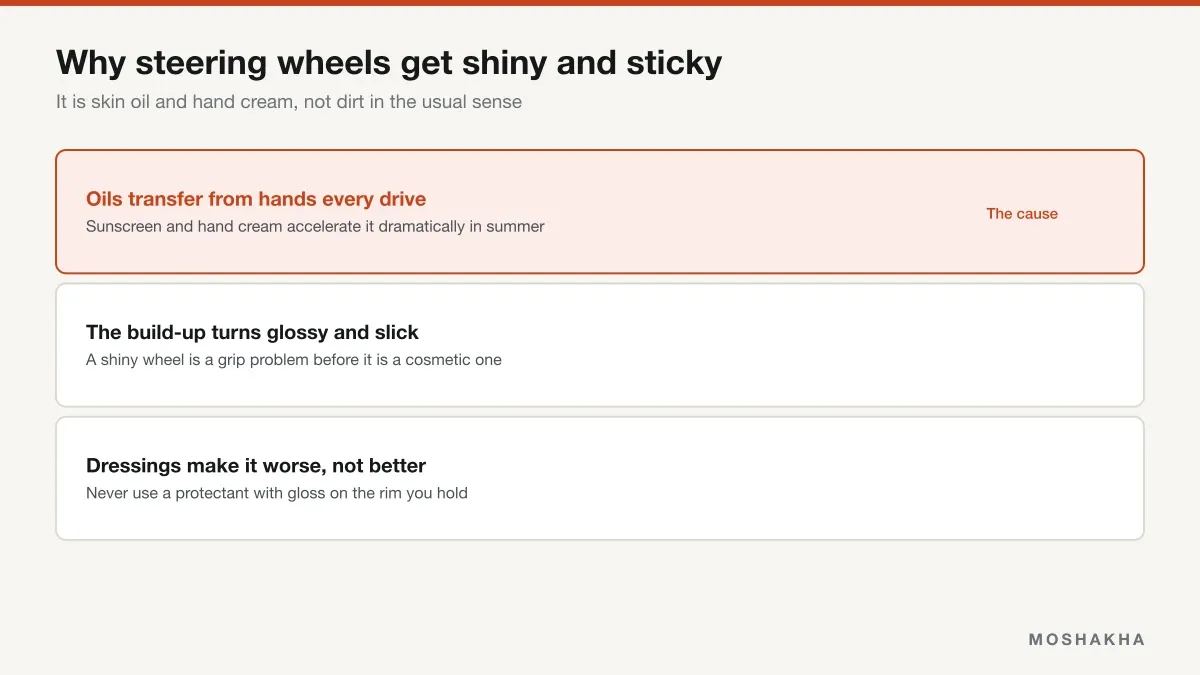
That glossy patch at ten and two is skin oil, sunscreen and hand cream, transferred over thousands of contacts and compressed into a smooth layer.
It isn’t dirt in the ordinary sense, which is why wiping with a dry cloth achieves nothing. Summer makes it dramatically worse — sunscreen and hand lotion transfer far more readily than skin oil alone, which is why wheels look worst at the end of a hot season.
It’s a grip problem first
Worth being clear about, because it’s usually framed as cosmetic.
The glossy layer is genuinely more slippery than the original surface texture. That matters with wet hands or in a sudden manoeuvre. On a leather wheel it also traps moisture and grit against the material, which is what eventually wears the coating through at the contact points.
Work out what the rim is
Most wheels are coated leather or polyurethane — both behave like a sealed surface and want a pH-neutral cleaner. Genuine uncoated leather is rare.
The same water-drop test that settles this on seats works here: beading means coated, absorbing means bare leather. The full reasoning is in cleaning leather car seats.
Spray the towel, not the wheel
Overspray from a steering wheel lands on the instrument cluster lens, the stalks, and the airbag cover — all surfaces you’d rather not coat in cleaner.
See the interior cleaner from our guideDamp the towel, work a section at a time, and use a soft brush on the stitching and the seam where the rim halves meet — that’s where residue concentrates and where a towel simply bridges across.
Never put gloss on the rim
This is the one interior surface where the usual aesthetic argument doesn’t apply.
A glossy dressing on a steering wheel makes it slippery, and it reflects sunlight up at you from a surface directly in your field of view. If the rim needs protection at all, use a matte protectant, applied thinly and buffed off properly.
The same finish argument applies across the dashboard, for a related reason — that’s in dashboard dressing and windshield glare.
Do it monthly
Build-up is far easier to remove early than after months of being polished in by your own hands. Monthly on a daily driver keeps it from ever reaching the glossy stage.
Frequently asked questions
Why does my steering wheel get shiny?
It's oil from your hands, plus sunscreen and hand cream, transferring onto the rim over thousands of contacts and building into a smooth glossy layer. It isn't dirt in the ordinary sense, which is why a dry wipe does nothing. Summer accelerates it noticeably because sunscreen and hand lotion transfer far more readily than skin oil alone.
Is a shiny steering wheel a problem?
It's a grip problem before it's a cosmetic one. The glossy layer is genuinely more slippery than the original surface texture, which matters in an emergency manoeuvre or with wet hands. It also degrades the material underneath over time on leather wheels, because the build-up holds moisture and grit against the surface.
Can I use disinfectant wipes on a steering wheel?
Occasionally, yes — but not as a routine. Most disinfectant wipes contain alcohol or quaternary compounds that dry out leather and, used repeatedly, degrade the polyurethane coating on a synthetic rim. For regular cleaning, a pH-neutral interior cleaner does the same job without stripping the surface.
Should I use leather conditioner on a leather steering wheel?
Only if it's uncoated leather, which is rare — do the water-drop test first. On a coated wheel, conditioner can't penetrate and sits on top, which makes the rim slick. Even on genuine uncoated leather, use it sparingly on a steering wheel specifically, because anything that reduces grip on the rim is a poor trade.
How often should a steering wheel be cleaned?
More often than most people do — monthly is reasonable for a daily driver. It's the surface you have the most physical contact with in the car, it accumulates continuously, and the build-up is far easier to remove early than once it's polished into a glossy layer over months.