Buying Guides
Best Jump Starters 2026: Peak Amps Are Not the Spec
Peak amp claims are close to meaningless. What actually matters in a lithium jump pack, our picks by engine size, and why safety protection is non-negotiable.
Moshakha is reader-supported. When you buy through links on our site, we may earn an affiliate commission at no extra cost to you. How we make money.
At a glance
Rated by real-world usability rather than the peak-amp number on the box.
| Product | Award | Best for | Rating | Jump to review |
|---|---|---|---|---|
| NOCO Boost GB40 (1000A) | Best overall | Petrol engines up to about 6.0L, and anyone who wants the safety engineering | Details | |
| GOOLOO GP4000 (4000A Peak) | Best for large engines | Big petrol engines and diesels up to around 10L | Details | |
| GOOLOO GT4000S with 100W Two-Way Charging | Best dual-purpose | Doubling as a serious power bank for laptops and camping | Details | |
| GOOLOO GP4000 (alternative listing) | Budget pick | Covering the failure mode without spending premium money | Details |
A jump starter is insurance. The right way to buy it is to work out what failure you’re covering, then buy the cheapest thing that covers it properly — not the biggest number on a box.
Peak amps are close to meaningless
This is the number every listing leads with, and it’s the least useful spec in the category.
There is no consistent standard for how brands measure “peak amps”. One manufacturer’s 4000A and another’s 2000A may be measured under completely different conditions for wildly different durations. Comparing them across brands tells you almost nothing.
What actually matters:
- Engine size and fuel type. Diesels need substantially more cranking current than petrol engines of the same capacity, because of higher compression.
- Cold performance. Batteries fail on cold mornings. That’s when the pack works hardest, and lithium packs also deliver less when cold.
- Protection circuitry. See below.
- Whether it’s charged. By a wide margin the most important factor, and entirely down to you.
Use peak amps as a rough tier — small petrol, large petrol, diesel — and ignore the precision the numbers imply.
The safety features are the product
Jump starting is the one routine car maintenance task with a genuine injury risk. A discharged lead-acid battery vents hydrogen. A spark at the terminal is the ignition source. That is a real, if uncommon, way people get hurt.
Spark-proof connection means the pack delivers no current until it detects a correct connection. Reverse-polarity protection means clamping backwards does nothing rather than damaging the car, the pack, or the battery.
Cheap packs without these still work. They also remove the margin for a mistake made in the dark, in the rain, by someone who does this once every three years.
This is what the NOCO premium buys, and it’s the reason it ranks first despite the lowest amp figure here.
How we chose
Specification analysis — protection circuitry, capacity, charge retention, clamp and cable quality — plus aggregated long-term owner feedback, weighted toward cold-weather performance and charge retention after long storage. No lab testing, no paid placement.
The failure nobody plans for
A jump starter you didn’t charge is a brick.
Lithium packs self-discharge slowly. A pack put in the trunk two years ago and forgotten will be flat on the morning you need it, and you’ll conclude the product was bad. It wasn’t.
Recharge every three to six months. Set a recurring reminder. This is why pick three’s dual-purpose design is genuinely useful — a pack you also use as a power bank gets charged as a side effect of normal life.
Sizing, roughly
| Vehicle | Look for |
|---|---|
| Small–mid petrol (up to ~3.0L) | 500–1000A peak class |
| Large petrol (up to ~6.0L) | 1000A peak class |
| Diesel up to ~3.0L | 1000–2000A peak class |
| Large diesel (up to ~10L) | 3000A+ peak class |
Buying more headroom than you need costs weight and money but does no harm. Buying less means it won’t crank on the cold morning it’s needed.
The procedure itself, in the correct order, is in how to jump start a car.
The picks in detail
Best overall
1. NOCO Boost GB40 (1000A)
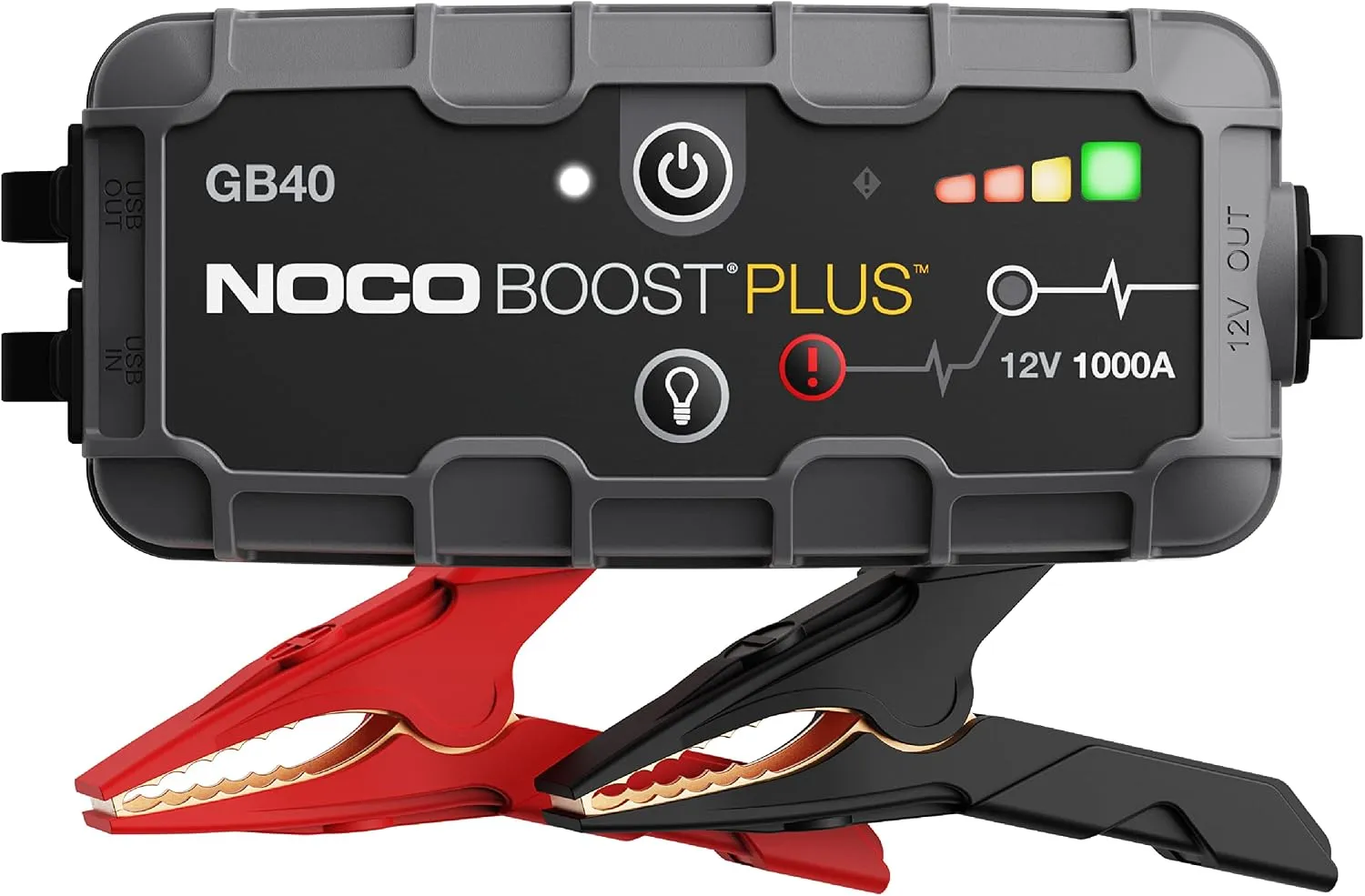
Best for: Petrol engines up to about 6.0L, and anyone who wants the safety engineering
1000A is modest against packs claiming four times that, and it starts cars all day. What you're paying for is the protection circuitry — spark-proof connection and reverse-polarity protection — which turns the genuinely dangerous part of jump starting into a non-event. Clamps that spark near a venting battery are how people get hurt.
Pros
- Spark-proof and reverse-polarity protected — hard to get wrong
- Holds charge well over months in a glovebox
- Compact enough to actually keep in the car
- Clamps and build quality are clearly above the budget tier
Cons
- Expensive relative to no-name packs with bigger claimed numbers
- 1000A is not enough for large diesels — size up to a GB50 or GB70
- No air compressor built in
Best for large engines
2. GOOLOO GP4000 (4000A Peak)
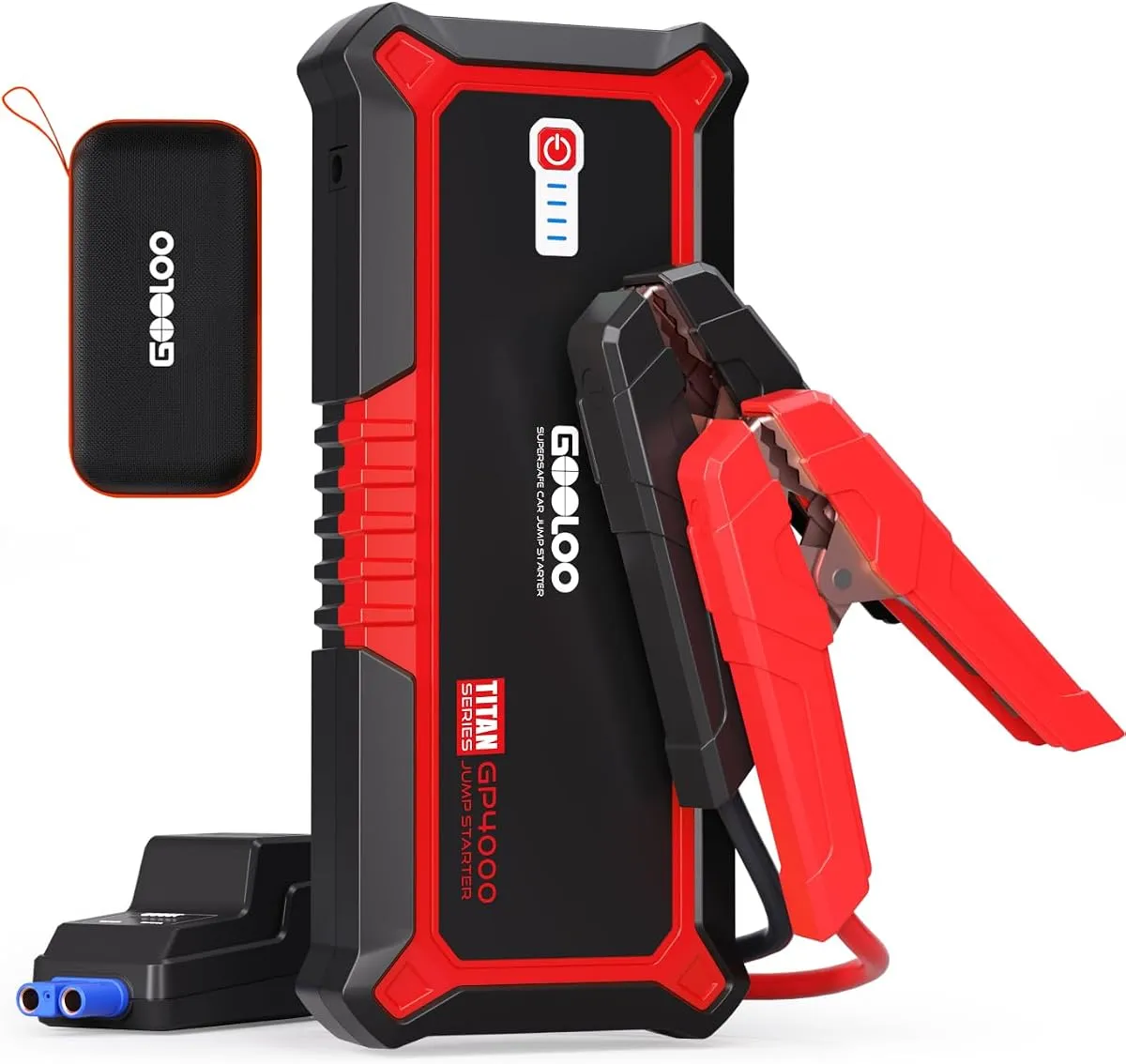
Best for: Big petrol engines and diesels up to around 10L
Considerably more headroom than the GB40, which genuinely matters on a cold diesel — those need far more cranking current than a small petrol engine. Peak amp figures across brands are not measured consistently, so treat 4000A as 'a lot of headroom' rather than a number you can compare directly.
Pros
- Real headroom for diesels and large-capacity petrol engines
- USB output doubles it as a sizeable power bank
- Good value for the capacity
Cons
- Peak amp figure is not comparable between brands — don't buy on it
- Bulkier and heavier than the GB40
- Protection circuitry is good but less proven than NOCO's
Best dual-purpose
3. GOOLOO GT4000S with 100W Two-Way Charging
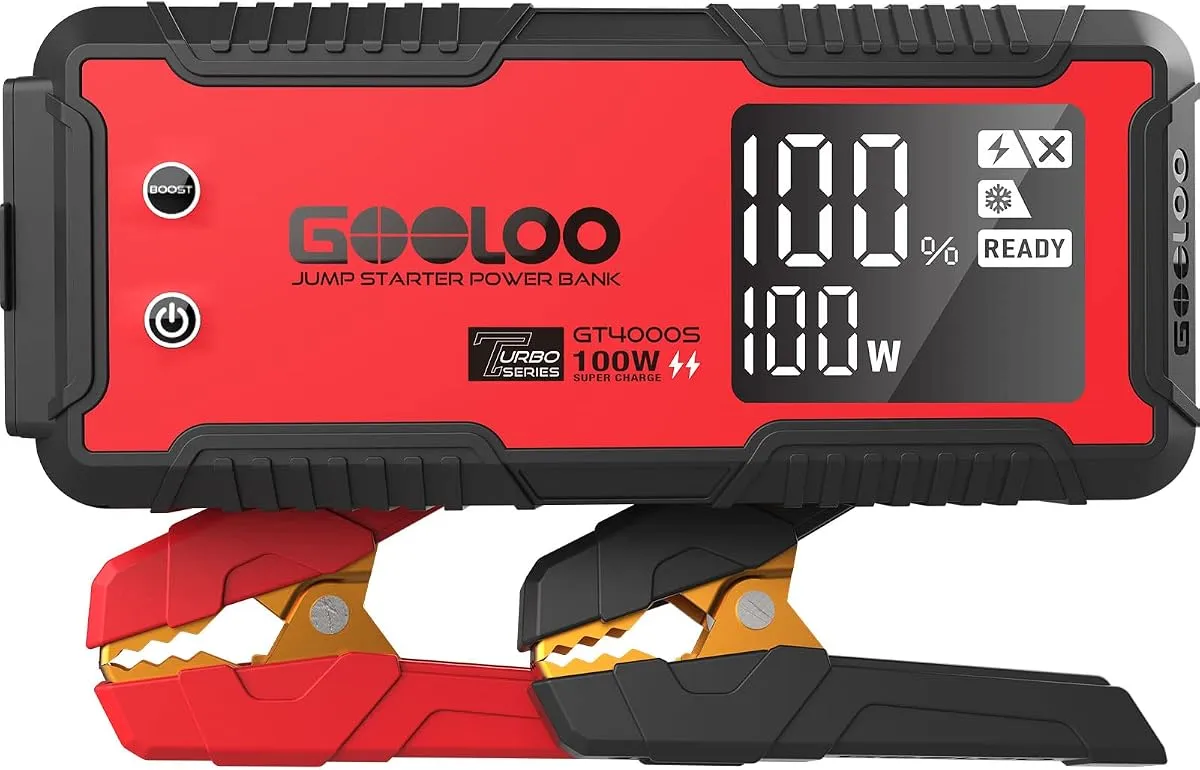
Best for: Doubling as a serious power bank for laptops and camping
20,000mAh with 100W two-way fast charging, so it recharges quickly and can run a laptop. That matters more than it sounds: a jump pack you also use for something else gets checked and recharged regularly, whereas a single-purpose pack sits in the trunk slowly self-discharging until the day it's flat.
Pros
- 100W two-way charging recharges the pack quickly
- Genuinely useful as a laptop-capable power bank
- Dual use means you'll actually keep it charged
Cons
- Heaviest of the picks here
- More expensive, and the extra is for the power-bank side
Budget pick
4. GOOLOO GP4000 (alternative listing)
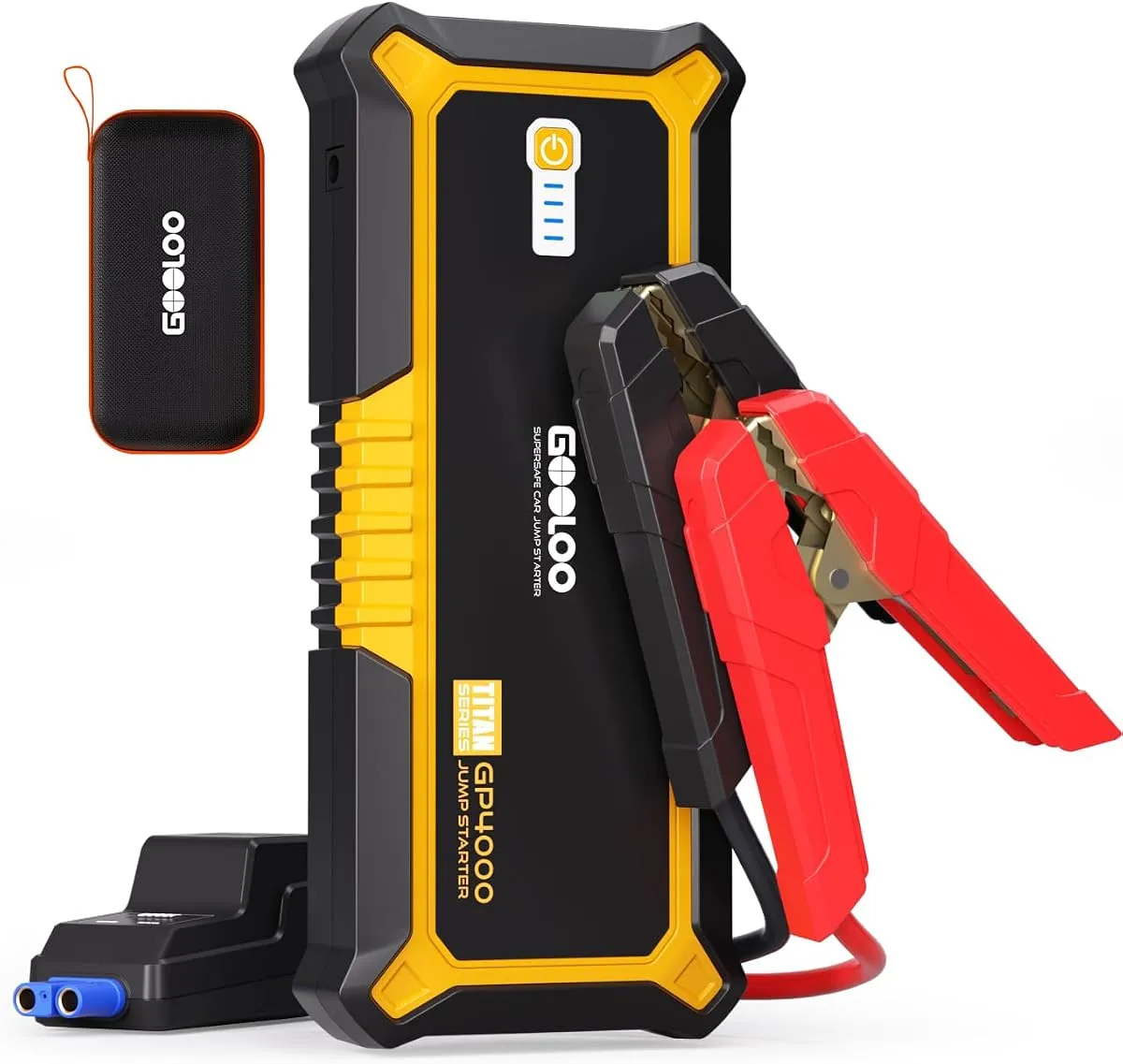
Best for: Covering the failure mode without spending premium money
Functionally the same class of pack as pick two, frequently at a lower price. A jump starter is insurance — the cheapest one with genuine reverse-polarity protection beats not owning one at all, and beats a premium one you didn't buy because it was too expensive.
Pros
- Same capacity class at a lower typical price
- Spark-proof clamps and LED light included
- Often discounted
Cons
- Listing variants make it easy to buy the wrong configuration
- Long-term reliability less established than NOCO
Frequently asked questions
How many amps do I need in a jump starter?
Far fewer than the marketing suggests. A small petrol engine typically needs a few hundred cranking amps; 1000A peak is comfortable for most cars up to about 6.0L. Diesels need substantially more because of their higher compression. Peak amp figures are not measured consistently between brands, so use them as a rough tier, not a comparison.
Is a lithium jump starter better than jumper cables?
For most people, yes — it works without a second car, which is the entire problem cables have. Cables are cheaper and never go flat, so carrying both is not unreasonable. The jump pack's real advantage is being able to help yourself in an empty car park at night.
How often should I recharge a jump starter?
Every three to six months, even unused. Lithium packs self-discharge, and a pack sitting in a trunk for two years will be flat exactly when you need it. Set a calendar reminder — this is the single reason jump starters fail their owners, and it has nothing to do with the product.
What does reverse polarity protection actually do?
It stops the unit delivering current if you connect the clamps the wrong way round. Without it, reversing the clamps can damage the pack, the car's electronics, or cause the battery to vent. Combined with spark-proof design, it removes most of the genuine risk from the procedure.
Can a jump starter damage my car's electronics?
A quality pack with proper protection is safe on modern vehicles. The risks come from cheap units without voltage regulation, reversed connections, or disconnecting under load. Follow the sequence — pack off, clamps on, pack on, start, pack off, clamps off — and modern electronics are not at risk.
Should I get one with a built-in air compressor?
Only if trunk space is tight. Combination units compromise on both functions and, because they are heavier and bulkier, tend to get left at home. Two dedicated devices generally work better, and a failure in one doesn't cost you the other.