How-To Guides
How to Jump Start a Car Safely (Pack or Cables)
The connection order exists for a reason — a discharged battery vents hydrogen. The correct sequence for jump packs and cables, and what to do if it fails.
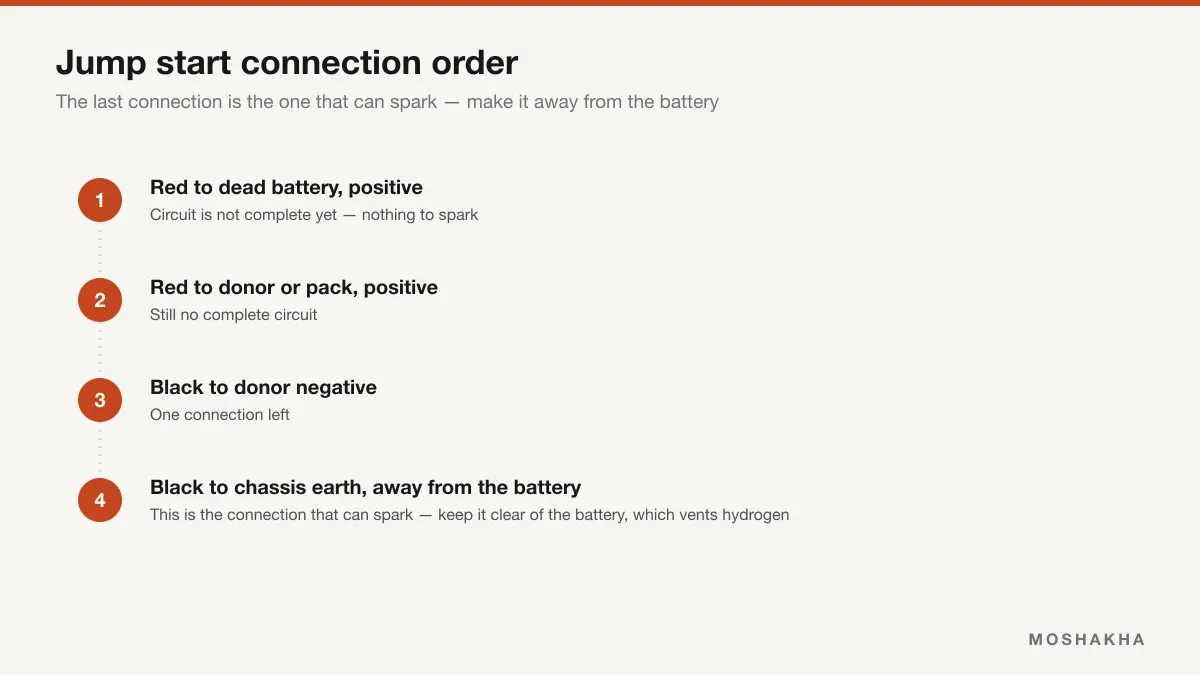
Jump starting is routine, and it is also the one common car task with a genuine injury risk. The connection order is not superstition — it exists because of what a flat battery is doing chemically.
Why the order matters
A discharged lead-acid battery vents hydrogen gas. Hydrogen ignites readily, and the ignition source is a spark.
The last connection you make is the one that completes the circuit, and completing a circuit under load produces a small arc. So you make that final connection on an unpainted chassis or engine point, deliberately away from the battery — the spark happens several inches from the gas rather than directly above it.
That’s the whole logic. Positive connections first while the circuit is incomplete; final negative furthest from the battery.
The sequence, compressed
Connecting: red to dead + · red to donor + · black to donor − · black to dead car’s chassis earth
Disconnecting: exactly the reverse.
With a lithium jump pack it’s the same order — pack switched off while you clamp, switched on once connected, switched off before you unclamp.
Stop if the battery looks wrong
Cracked case, bulging sides, visible leakage, or a frozen battery in winter: do not jump it. A damaged or frozen battery can rupture under charging current.
This is the one scenario in this whole procedure where the caution is not box-ticking. Replace the battery instead.
Modern cars often have designated jump points
If the battery is in the trunk or under a seat — increasingly common — the manufacturer has provided a remote positive terminal under the hood and a specific earth point.
Use them. They exist because the manufacturer has decided where it is safe to introduce current, and on some vehicles connecting elsewhere can trip protection circuitry.
Two minutes with the manual beats guessing.
Short cranks, not long ones
Five seconds maximum, then thirty seconds’ rest.
Starter motors are not rated for continuous use and overheat quickly. Long cranks also drain whatever charge the donor has managed to transfer.
If it hasn’t started after three or four attempts, stop. The problem is not simply a flat battery, and continuing risks the starter. A strong crank that won’t catch is fuel or ignition, not charge.
Afterwards
Drive for at least twenty minutes. Idling barely charges a modern car, because alternator output at idle is low and standing electrical loads are high.
If it won’t restart after that drive, the battery is no longer holding charge. Repeated jump starting a failed battery just postpones the same morning.
Carry the pack, and keep it charged
A jump pack means not needing a second car and a stranger, which is the actual advantage over cables. Its one failure mode is being flat itself — recharge every three to six months.
The other common roadside failure is a slow puncture, which a portable inflator covers. Those two together handle most of what actually strands people.
Frequently asked questions
Why connect the negative clamp to the chassis instead of the battery?
Because the final connection is the one that sparks, and a discharged lead-acid battery vents hydrogen gas. Making that spark on a chassis earth point several inches away keeps the ignition source away from the gas. It is the entire reason the connection order exists.
Can jump starting damage my car's electronics?
It can if done wrong — reversed polarity, or disconnecting while the engine runs, can produce voltage spikes. Following the sequence, with everything switched off in both cars, makes it safe on modern vehicles. A quality jump pack with reverse-polarity protection removes most of the remaining risk.
How long should I drive after a jump start?
At least twenty minutes, driving rather than idling. Alternator output at idle is low, and modern cars have substantial standing electrical loads. If the car fails to start again after a proper drive, the battery is not holding charge and needs replacing rather than another jump.
Can I jump start a completely dead battery?
Usually yes, though a deeply discharged battery may need a few minutes on charge from the donor before it will crank. Some lithium jump packs refuse to engage below a voltage threshold because they cannot detect a battery — most have a manual override for exactly this, described in the manual.
Is it safe to jump start a frozen battery?
No. Do not attempt it. A frozen battery can rupture under charging current. If the case is visibly bulging, cracked or leaking, or the electrolyte is frozen, the battery needs replacing rather than jump starting. This is the one scenario worth being genuinely cautious about.
Do I still need jumper cables if I have a jump pack?
Not strictly, but they are cheap, weigh little and never go flat — which is the one failure mode a lithium pack has. Carrying both means a discharged pack does not leave you stranded, provided there is another vehicle around to help.