Blog
When to Replace a Car Battery (It Warns You First)
Slow cranking on cold mornings is the early signal, and most people ignore it until the battery fails somewhere inconvenient. What each symptom actually means.
Batteries rarely fail without warning. They fail after several weeks of warning that gets rationalised away, usually in a car park on the first properly cold morning.
The signals, in the order they appear
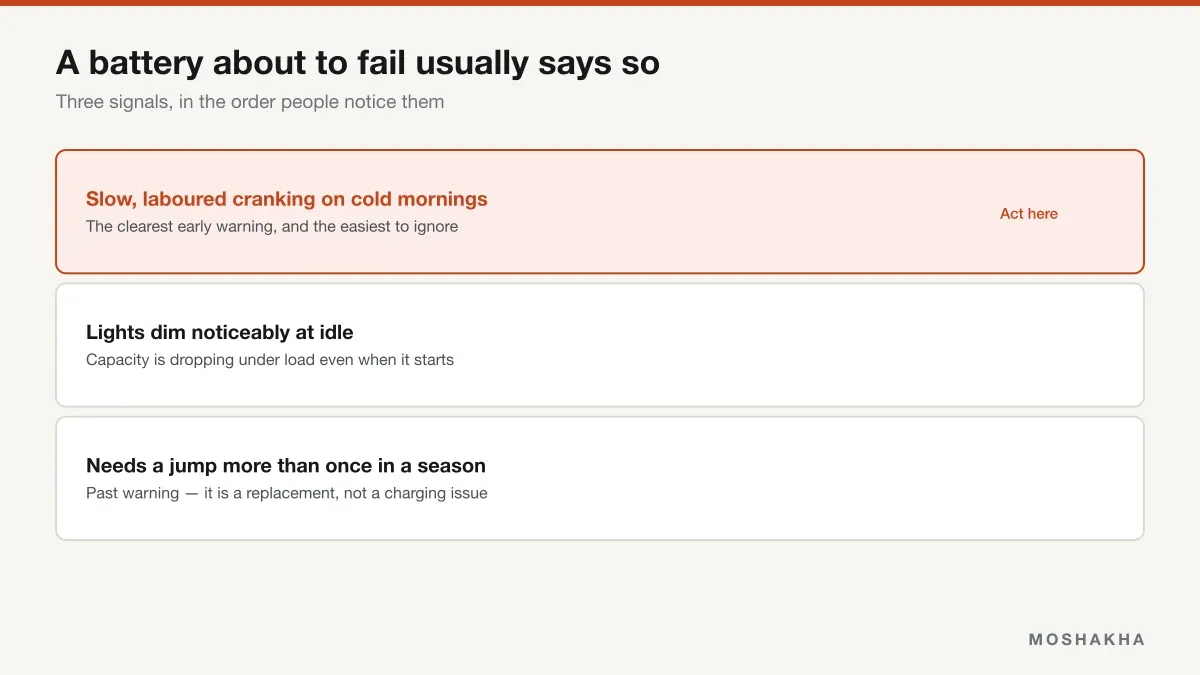
Slow, laboured cranking on cold mornings. The clearest early warning and the most ignored — the car still starts, so it doesn’t feel like a problem. Cold is when the battery must deliver the most current and can deliver the least, which is why marginal batteries show themselves there first.
Headlights dimming noticeably at idle. Capacity is dropping under load. The charging system is compensating while running but there’s less reserve behind it.
Needing a jump more than once in a season. That’s past warning. That’s a replacement.
Why repeat jumps make it worse
The jump itself doesn’t damage a healthy battery. What does the damage is the deep discharge that made the jump necessary.
Running a lead-acid battery flat permanently reduces its capacity, and each time it happens the remaining capacity is smaller. So a car being jump started regularly is on a declining curve, not a stable workaround.
See the jump starter we reviewedCarrying a jump pack is sensible insurance regardless of battery age — the sizing and safety-circuitry argument is in best jump starters, and the correct sequence is in how to jump start a car.
Get it tested before buying
This matters because the symptoms overlap with two other faults that a new battery won’t fix:
- A failing alternator produces very similar behavior — the battery never gets properly recharged, so it presents as a weak battery.
- Corroded terminals restrict current flow and mimic low capacity exactly.
Most auto parts stores test batteries and charging systems free in a few minutes. Worth doing before spending money on the wrong part.
Heat is harder on batteries than cold
This surprises people, because failures happen in winter.
Sustained heat accelerates the internal degradation that reduces capacity. Cold doesn’t cause that damage — it exposes it, by demanding peak current from a battery that’s already diminished.
So a hot summer is what wears the battery out, and the first cold morning is what tells you.
Short journeys shorten life
A battery that’s never fully recharged sits in a partial state of charge, which accelerates sulphation and permanent capacity loss.
If most of your driving is short trips, that’s a genuine factor in why batteries don’t last as long as the numbers suggest — and an occasional longer run, or a maintainer, addresses it.
The same logic applies to a car that sits unused for months, covered in how to prepare a car for storage.
Frequently asked questions
How long does a car battery last?
Commonly three to five years, but climate moves that range a long way in both directions. Sustained heat is harder on a battery than cold — it accelerates internal degradation — so hot climates often see shorter life, while cold merely exposes a battery that's already weak. Short journeys that never fully recharge it also shorten life significantly.
What are the signs a car battery is failing?
Slow, laboured cranking on cold mornings is the earliest and clearest, and it's the one most people ignore. Headlights dimming noticeably at idle suggests capacity is dropping under load. Needing a jump more than once in a season is past the warning stage. Electrical oddities — flickering dash lights, erratic infotainment behavior — can also point at a battery that can't hold voltage.
Can a battery fail suddenly with no warning at all?
It can, particularly from an internal short or after a deep discharge from leaving something on. But the common pattern is gradual capacity loss that shows up first on the coldest mornings, when the battery has to deliver the most current and can deliver the least. A battery that's marginal all autumn usually fails on the first genuinely cold day.
Does jump starting damage a battery?
The jump itself doesn't, when done correctly with a quality pack. What damages the battery is the deep discharge that made the jump necessary — repeatedly running a lead-acid battery flat permanently reduces its capacity. So a car that needs jumping regularly is getting worse each time, which is why repeat jumps signal replacement rather than a workable routine.
Should I get the battery tested before replacing it?
Yes, because the symptoms overlap with two other faults. A failing alternator produces very similar behavior, and so does heavy corrosion on the terminals — and replacing a healthy battery fixes neither. Most auto parts stores test batteries and charging systems free, which settles it in a few minutes.