Blog
Can You Leave a Jump Starter in a Hot Car?
Heat is hard on lithium jump starters. What summer and winter temperatures do to one, where to store it, and what to check in the manual.
A jump starter lives in the car for one reason: the day your car won’t start, it needs to be there. That makes it tempting to simply leave it in the trunk all year.
The trouble is that a modern jump starter is a lithium battery, and lithium batteries have opinions about temperature.
What heat does
The inside of a closed car in summer sun can be dramatically hotter than the outside air. Sustained heat:
- Accelerates ageing, so the unit holds less charge and delivers less current each year.
- Can trigger protection circuits that stop the unit working until it cools.
- Is outside the published storage range on many units, which is something to check in your own manual.
It isn’t usually dramatic on a single hot afternoon. It’s the repeated summers that shorten a battery’s life.
What cold does
Cold is a different problem. A chilled lithium pack can’t deliver current as easily, and an engine in winter wants more of it, not less. A unit that would start a warm car happily may struggle when everything is frozen.
Where to keep it
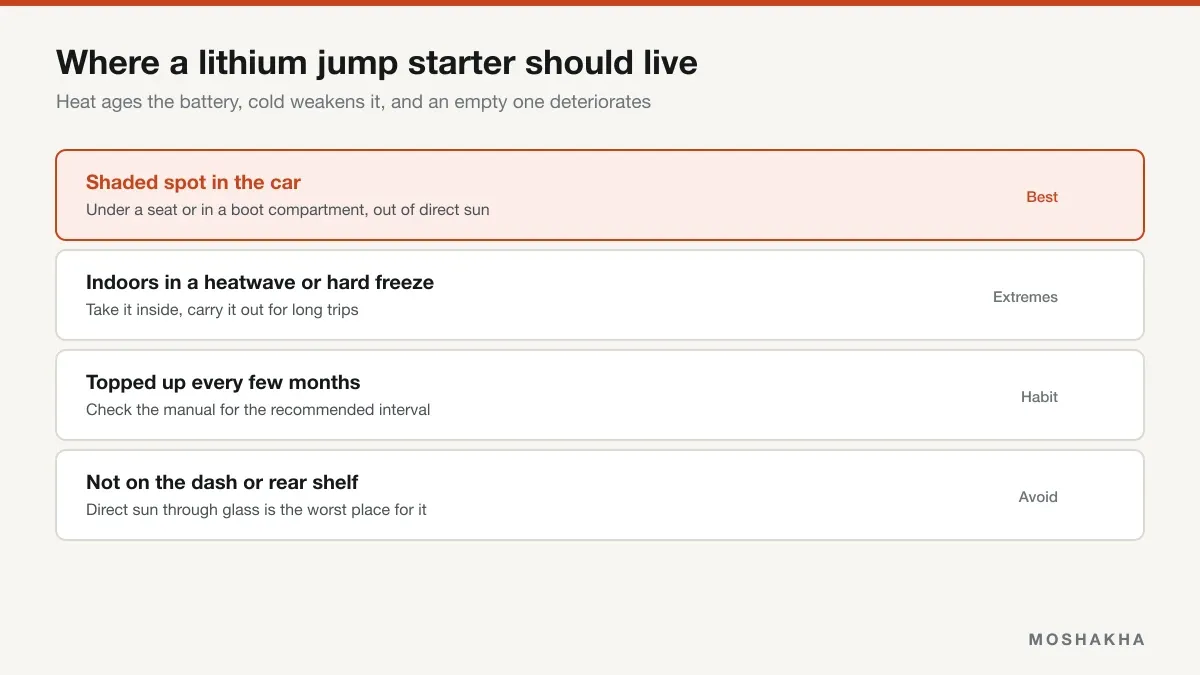
- Out of direct sun. Under a seat or in a shaded trunk compartment, not on the dash or rear parcel shelf.
- Indoors in extremes. In a heatwave or hard freeze, take it inside and carry it out when you head off on a long trip.
- Charged, not empty. A deeply discharged lithium pack deteriorates. Top up every few months; check the manual for the recommended interval.
Check the manual
The temperature range differs by model and the manual is the authority. Our NOCO GB40 review covers one popular unit, and the jump starter guide explains why peak amps are a misleading number.
A jump starter is also a reason to know your battery’s age. If yours is over four or five years old, see when to replace a car battery before you rely on a rescue device for a failing one.
Bottom line
Don’t cook it, don’t freeze it, and don’t forget about it. Shade in summer, indoors in extremes, topped up all year.
Frequently asked questions
Is it safe to leave a lithium jump starter in a hot car?
Not for long periods. A parked car in summer can get far hotter inside than the air outside, and lithium batteries age faster and lose capacity in sustained heat. Every manufacturer publishes storage and operating temperature limits, and a closed car in full sun can exceed them.
What about leaving it in the car in winter?
Cold reduces the battery's ability to deliver current, which is exactly when a cold engine needs the most. Many owners bring it indoors in severe cold and put it back in the car when needed.
Where in the car is best to store a jump starter?
Somewhere shaded and out of direct sun, such as under a seat or in a trunk compartment, rather than on the dash or rear shelf. The trunk is often a little cooler than the cabin but still gets hot in summer.
Can a hot jump starter be charged?
Better to let it cool first. Charging a hot lithium battery isn't ideal, and some units include protection that refuses to charge outside a safe temperature range. Follow the manual.