Reviews
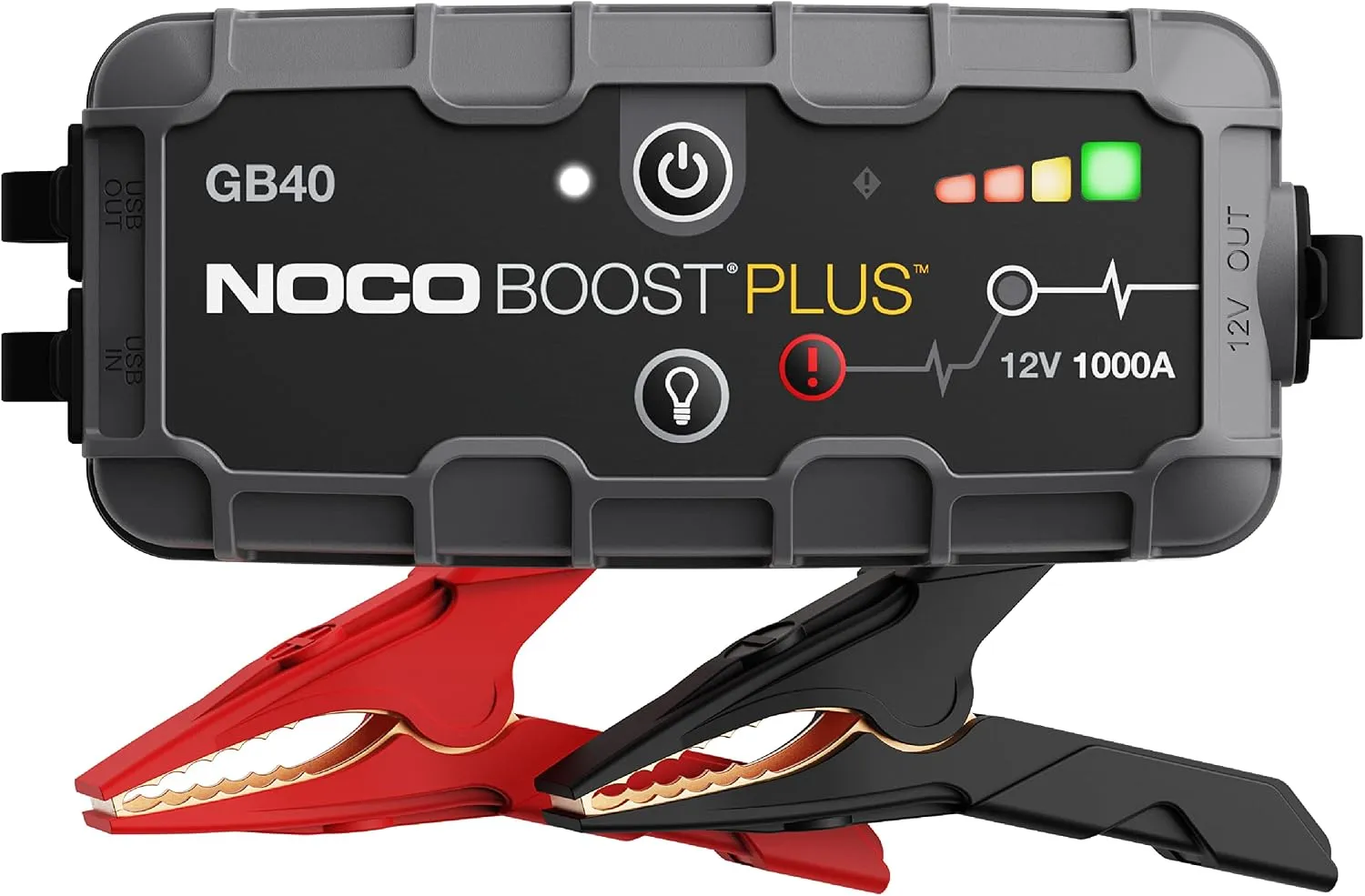
NOCO Boost GB40 Review: The 1000A Number Undersells It
The GB40 has one of the lowest peak-amp claims in its price bracket. Here's why it's still our top jump starter pick, and who should size up instead.
Moshakha is reader-supported. When you buy through links on our site, we may earn an affiliate commission at no extra cost to you. How we make money.
Pros
- Spark-proof and reverse-polarity protected — hard to get wrong in the dark or the rain
- Holds charge well over months sitting in a glovebox
- Compact enough that people actually keep it in the car instead of the garage
- Clamps and build quality are clearly a step above the budget tier
Cons
- Expensive relative to no-name packs advertising bigger peak-amp claims
- 1000A is not enough for large diesels — that's a GB50 or GB70 job
- No built-in air compressor, so pair it with a separate inflator
The Boost GB40 is our top overall pick in best jump starters, and it gets there with the lowest peak-amp claim of any pack on that list. That’s worth explaining, because on paper it looks like the weakest option.
The spec that doesn’t matter, and the one that does
Every jump-starter listing leads with a peak-amp number, and there’s no consistent standard for how brands measure it. One manufacturer’s 4000A and another’s 1000A can be measured under completely different conditions — comparing them across brands tells you almost nothing.
What actually determines whether a jump starter is safe to use is the protection circuitry, and this is where the GB40 earns its rank.
Spark-proof connection means the pack delivers no current until it detects a correct clamp connection. Reverse-polarity protection means clamping backwards does nothing, rather than damaging the car’s electronics, the pack, or the battery. Jump starting is the one routine car task with a genuine injury risk — a discharged lead-acid battery vents hydrogen, and a spark at the terminal is the ignition source. Protection circuitry is what turns that from a real hazard into a non-event.
Cheap packs without this protection still start cars. They just remove the margin for error made in the dark, in the rain, by someone who does this once every three years.
Where it actually falls short
It won’t crank a large diesel. 1000A peak is comfortable for petrol engines up to roughly 6.0L. Diesels need substantially more cranking current because of higher compression, and this is a genuine limit, not marketing caution — buy a GB50 or GB70 instead if that’s your vehicle.
No air compressor. Some competitors bundle one in. NOCO doesn’t, and on balance that’s the right call: combination units compromise both functions and are heavier, so they get left at home. A dedicated GB40 plus a separate unit from best tire inflators covers both failure modes without either one being a compromise — and the two together are most of what our car emergency kit guide actually recommends carrying.
It costs more than no-name packs with bigger claimed numbers. That premium buys the protection circuitry above, plus clamps and build quality that are visibly better than the budget tier. Whether that’s worth it depends on how much you value not thinking about it again for years.
The failure that isn’t the product’s fault
A jump starter that isn’t charged is a brick, and lithium packs self-discharge slowly enough that a forgotten one goes flat over a year or two sitting in a trunk. Recharge the GB40 every three to six months on a calendar reminder — this is the single most common reason jump starters disappoint their owners, and it has nothing to do with build quality.
Should you buy it?
Yes, if your car is a small-to-mid petrol engine and you want protection circuitry that removes the actual risk from jump starting, in a pack small enough to actually keep in the car.
No, if you drive a diesel or a large-capacity petrol engine — size up to a GB50 or GB70 — or if you want a combination jump-starter/inflator and are willing to accept the compromises that comes with.
The correct jump-starting sequence, regardless of which pack you own, is in how to jump start a car.
Frequently asked questions
Is 1000A enough for my car?
For most petrol engines up to about 6.0L, yes. Diesels need substantially more cranking current because of higher compression, so a 1000A-class pack is undersized for a diesel — NOCO's own GB50 or GB70 are the right size there. Peak-amp figures aren't measured consistently across brands, so don't compare the GB40's 1000A directly against a competitor's larger claimed number.
Why does the GB40 rank above packs with higher peak-amp claims?
Because the number that actually prevents injury is whether the clamps are spark-proof and reverse-polarity protected, not how big the peak-amp figure printed on the box is. A discharged battery can vent hydrogen, and a spark at the terminal is the ignition source — that's the real risk in jump starting, and it's what the GB40's protection circuitry is built to remove.
How long does the GB40 hold its charge?
Well, by lithium jump-starter standards — but not indefinitely. Every lithium pack self-discharges, and one left untouched in a trunk for a year or two will be flat exactly when it's needed. Recharge it every three to six months regardless of use; that single habit is what determines whether it works on the day that matters.
Does the GB40 include an air compressor?
No. NOCO sells the GB40 as a dedicated jump starter, not a combination unit. Combination jump-starter/inflator devices compromise on both functions and tend to get left at home because they're bulkier — a dedicated GB40 plus a separate corded inflator generally serves better, and a failure in one doesn't take out the other.
What size NOCO should I buy instead of the GB40?
If you drive a diesel, or a large-capacity petrol engine, size up. NOCO's GB50 and GB70 carry the same protection circuitry with more headroom. The GB40 is sized for small-to-mid petrol engines, not as a universal pick.