How-To Guides
Removing Bugs and Tar Without Scrubbing the Paint
Both are bonded deposits, and pressure is what causes the damage. Soften first, let dwell time work, and reprotect the area afterward.
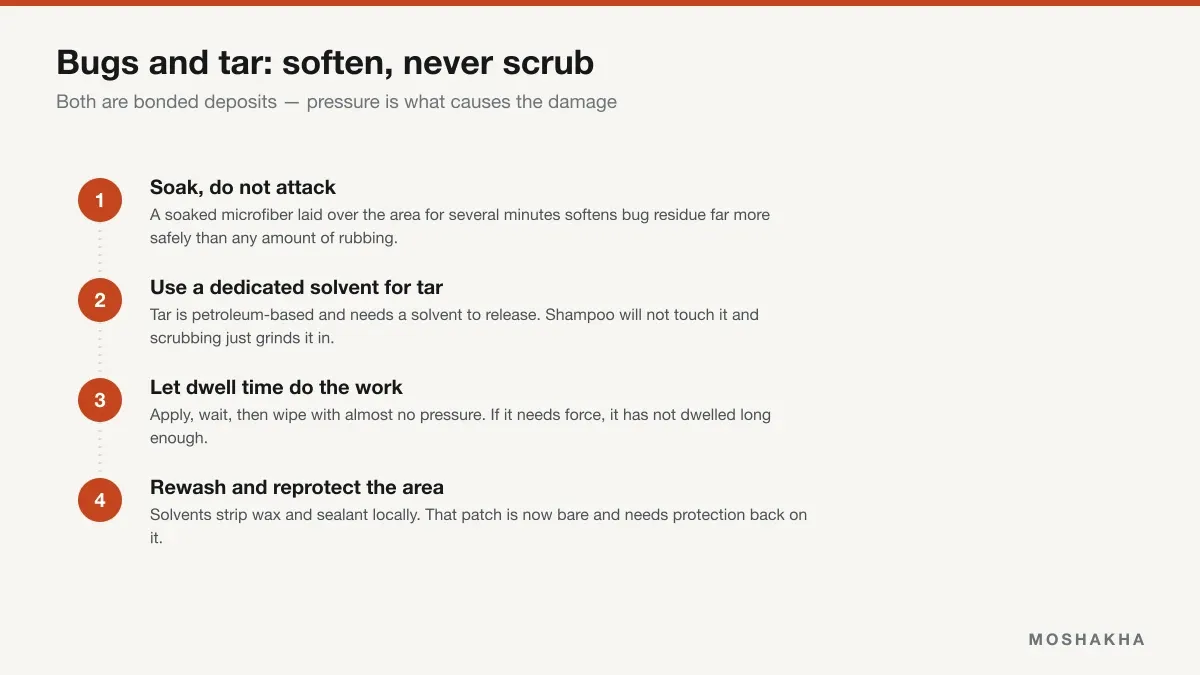
Bugs and tar get grouped together because they show up in the same place — the front bumper and lower panels — and because both tempt you into the one thing that actually causes damage: scrubbing.
Both are bonded, so pressure is the enemy
Neither is loose dirt sitting on the surface. Bug residue dries and adheres. Tar is a sticky petroleum deposit that has bonded to the clear coat.
Applying force to a hard, bonded deposit means dragging it across the paint. That’s how a careful owner ends up with a scratched bumper while trying to clean it.
The technique for both is the same in principle: soften first, then remove with almost no pressure.
Bugs: time matters more than technique
Bug residue is acidic. Left through a hot week, it etches into the clear coat, and once it has etched, removal reveals a dull mark that only polishing levels out.
So the highest-value action isn’t a better product — it’s removing them sooner. A soaked microfiber laid over the area for a few minutes rehydrates dried residue far more effectively and safely than rubbing does. Re-soak and repeat instead of pressing harder.
Skip mesh bug sponges on paint. They work by abrasion, which is the exact mechanism you’re avoiding.
See the wash-and-wax from our soap guideTar needs a solvent, not effort
Shampoo won’t touch tar — it’s petroleum-based and needs a solvent to release. A dedicated tar remover dissolves it chemically.
Apply out of direct sun, let it dwell for the labeled time, and wipe gently. If it still resists, reapply and wait longer rather than increasing pressure. Dwell time is doing the work; your hand isn’t supposed to.
The step almost everyone skips
Reprotect the treated areas.
Tar removers strip wax and sealant locally. Every spot you treated is now bare clear coat, and it’s on the lowest, most exposed part of the car — the area that gets hit hardest by road spray and fresh contamination.
Wash the panels normally to clear solvent residue, then reapply wax or sealant to those spots. Otherwise the areas you just cleaned will recontaminate faster than the paint around them.
When claying is the better tool
If the contamination is widespread and gritty rather than a few discrete deposits, that’s a decontamination job rather than a spot-removal one — see how to use a clay bar for the lubrication rules that keep claying from marring the paint.
For sap specifically, which hardens on a different timeline, see removing tree sap.
Frequently asked questions
Do bugs actually damage car paint?
Yes, given time. Bug residue is acidic and, left on paint through hot weather, etches into the clear coat within days. Once it has etched, removal reveals a dull mark that only polishing can level. This is why removing bugs promptly matters more than the technique you use to remove them.
Can I use a bug sponge or mesh pad on paint?
Not on paint. Mesh and textured bug pads work by abrasion, which is acceptable on glass and arguably on a plastic bumper you don't care about, but on clear coat it produces exactly the fine scratching you're trying to avoid. Softening with a soaked towel achieves the same result without abrading anything.
What removes road tar without damaging paint?
A dedicated tar remover, which is solvent-based and dissolves the deposit chemically rather than mechanically. Applied out of direct sun, given proper dwell time, and wiped with minimal pressure, it's safe on healthy clear coat. The important part is following it with a wash and reapplying protection to the treated area.
Will WD-40 or bug spray work as a tar remover?
Petroleum-based products do dissolve tar, which is why the suggestion circulates. The problem is that they're not formulated for automotive clear coat, leave heavy residue that must be washed off thoroughly, and offer no guidance on safe dwell time. A dedicated tar remover costs little and removes that uncertainty.
Why does the paint look dull after removing tar?
Usually because the solvent stripped the wax or sealant from that spot, leaving bare clear coat with a different reflectivity than the protected paint around it. Reapplying protection to the treated area restores an even appearance. If dullness persists after that, the tar may have sat long enough to etch.