How-To Guides
Removing Tree Sap: How Long It's Been There Decides the Fix
Fresh sap lifts with warm soapy water. Hardened sap needs a solvent. Etched sap needs polishing — and telling them apart takes seconds.
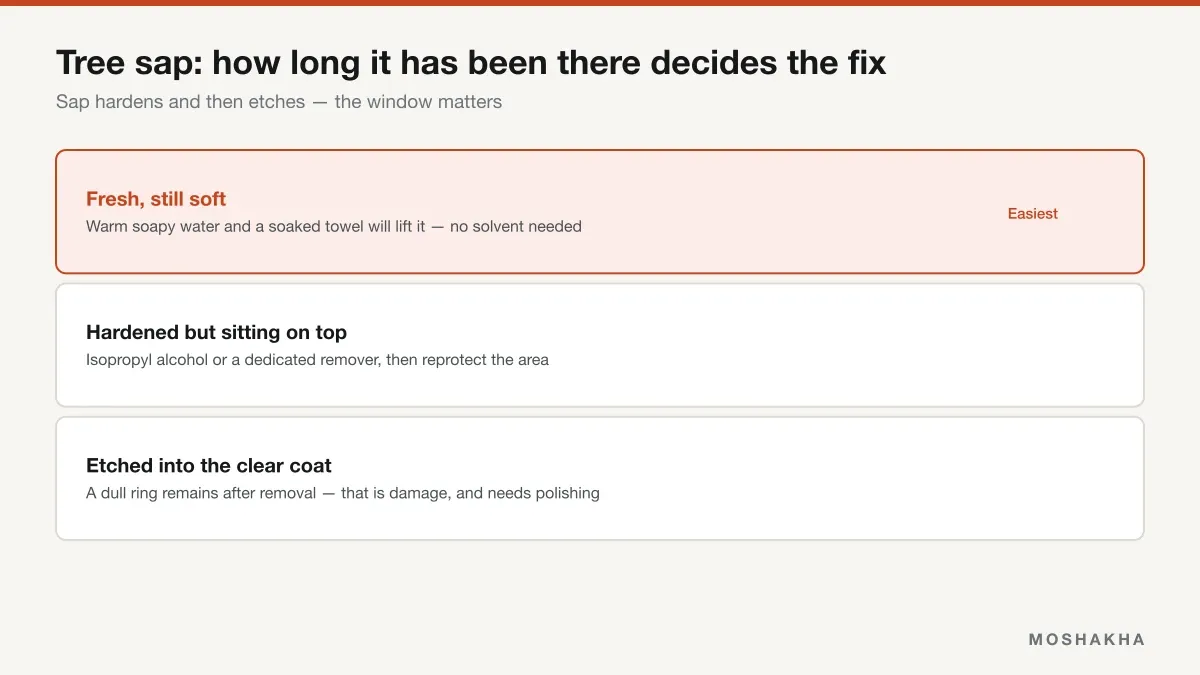
Tree sap gets treated as a single problem with a single solution. It’s really three problems, and the only thing that separates them is how long the sap has been sitting there.
Work out which one you have
Fresh and still soft — a fingernail pressed at the edge gives slightly. Warm soapy water will lift it.
Hardened but sitting on top — glassy and firm, but the paint underneath is still smooth. Needs a solvent.
Etched — after removal, you can feel a ring or see a dull patch. The sap has damaged the clear coat. Only polishing fixes this.
Checking takes seconds and determines everything that follows.
Always try water first
A microfiber soaked in warm soapy water, laid over the deposit for a few minutes, softens fresh sap completely. No solvent, no risk, no stripped wax.
This works often enough that skipping it is a mistake — people reach straight for chemicals on sap that would have surrendered to a wet towel.
See the microfiber towels from our guideKeep dedicated towels for solvent work. A towel that’s absorbed alcohol and dissolved sap shouldn’t go back into your general wash rotation.
For cured sap, dwell time replaces force
Isopropyl alcohol on a towel, held against the deposit for thirty seconds, then wiped gently. Repeat as needed.
Apply it to the towel rather than the panel, and work out of direct sun — alcohol evaporates fast, and a spray that flashes off before it softens anything has done nothing except strip your wax.
Never scrape
Cured sap is harder than clear coat. A fingernail, a plastic scraper, a credit card — all of them put a scratch precisely where the sap was, which is a worse outcome than the sap.
If it isn’t releasing, it needs more dwell time. That is always the answer.
Reprotect afterward
Alcohol and sap removers strip wax and sealant from every spot they touch. Wash the panel normally to clear residue, then reapply protection to the treated areas.
Skipping this leaves small patches of bare clear coat scattered across the roof and hood — usually under the same tree that caused the problem in the first place.
If the mark that’s left won’t come out and you can feel it, that’s etching, and the fix is the same as for etched water spots — see removing water spots.
Frequently asked questions
Does tree sap damage car paint permanently?
It can, if left long enough. Sap hardens and contracts as it cures, and in sunlight and heat it can etch into the clear coat beneath it. Removed within days, it usually leaves no trace. Left through a hot summer month, it frequently leaves a dull ring that only polishing can level out.
Will isopropyl alcohol damage my paint?
On healthy clear coat, used briefly and rinsed, it's safe — it's the standard panel-wipe before applying coatings for exactly that reason. What it definitely does is strip wax and sealant from wherever it touches, so treated spots need protection reapplied afterwards.
Can I use hand sanitizer on tree sap?
It works in a pinch because it's largely alcohol, but it also contains gels, fragrances and moisturizers that leave residue on the paint. If you use it as a roadside fix, wash the area properly afterwards rather than leaving the additives sitting on the clear coat.
Why is there a dull mark where the sap was?
Two possibilities. Most often the solvent stripped the wax from that spot, so it reflects light differently than the protected paint around it — reapplying protection evens it out. If the mark survives that and you can feel a ring with a fingernail, the sap etched the clear coat and needs polishing.
How do I stop sap landing on the car in the first place?
Parking position is the only real prevention, and it's worth taking seriously in spring when sap fall is heaviest. If you have no choice, a cover helps, and washing more frequently through sap season means deposits get removed while they're still fresh and easy rather than after they've cured.