How-To Guides
Removing Water Spots: Fresh vs Etched, and When to Polish
Fresh mineral deposits wipe off with the right product. Etched water spots have already damaged the clear coat and need polishing. Here's how to tell which you have.
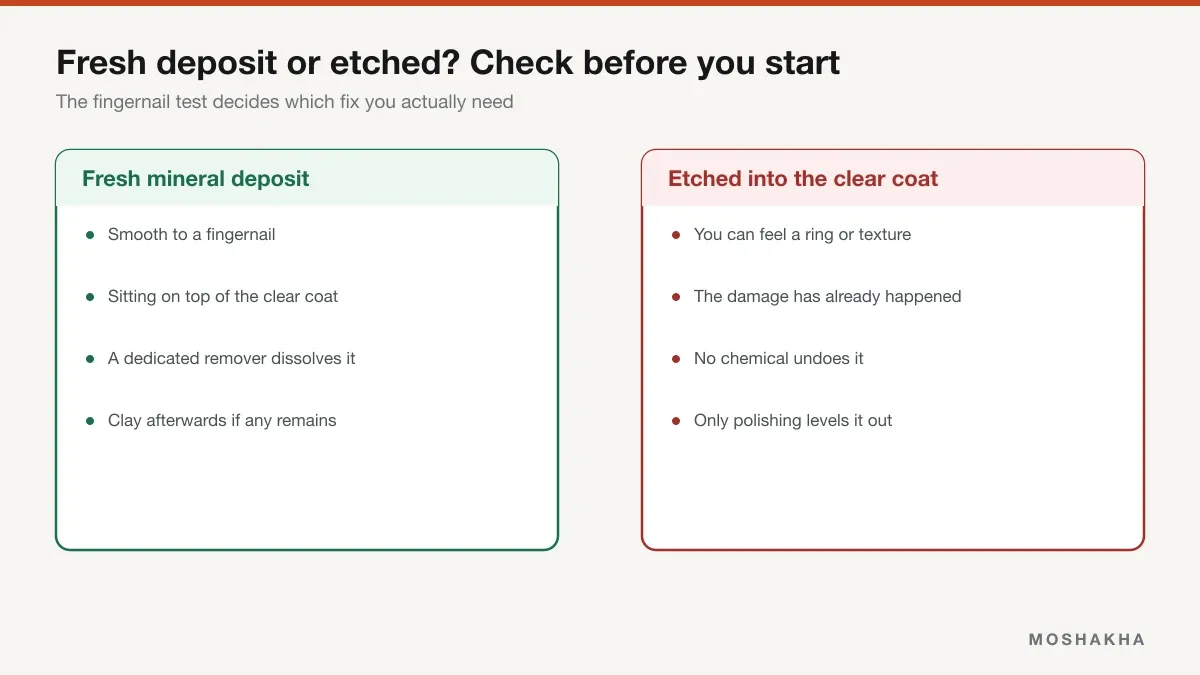
Two different problems get called “water spots,” and they need different fixes. Fresh mineral deposits sitting on the surface come off with the right product. Etched water spots are already physical damage to the clear coat, and no amount of chemical remover fixes damage that’s already happened.
Tell them apart before you start
Run a fingernail lightly across a dry spot. Smooth, with only a visible mark — that’s a fresh deposit sitting on top of the clear coat. A slight roughness or a ring you can feel — the mineral content has already etched into the clear coat itself. This distinction determines everything that follows; treating an etched spot like a fresh one just wastes product and time.
Fresh deposits: dissolve, don’t wipe
A dedicated water spot remover is formulated to dissolve mineral content specifically — plain water, glass cleaner, or a general all-purpose cleaner often just relocates the deposit rather than removing it. Apply on a cool panel out of direct sun, follow the dwell time, and buff with a separate, clean microfiber towel — reusing the applicator towel for buffing can redeposit the mineral content you just dissolved.
If spots persist after that, a clay bar pass afterward — not instead of the chemical step — can lift deposits sitting slightly proud of the surface that the remover alone didn’t fully clear.
Etched spots: only polish fixes this
If the fingernail test showed texture, you’re looking at actual clear coat damage, and the fix is leveling the surrounding clear coat with a fine cutting polish until the etched ring is gone. This removes a very thin layer of clear coat in the process, which is normal for light correction work but not something to repeat indiscriminately. Comfortable with polishing? Do it by hand or machine. Not comfortable? This is a reasonable point to hand off to a professional rather than risk uneven correction.
The prevention that actually works
Water spots form because mineral-laden water was left to evaporate on the surface instead of being wiped off while still wet — heat accelerates this, which is why spots form fastest on a hot panel in direct sun. Prompt, thorough drying after every wash or rain exposure is the real prevention, more reliable than any spot-resistant product applied after the fact. See best car drying towels for tools built specifically to dry quickly and completely.
A hydrophobic wax or ceramic coating helps water bead and run off faster, reducing how long it sits — but it doesn’t eliminate the risk on its own if water is still left to stand and evaporate.
Frequently asked questions
How do I know if a water spot is fresh or etched?
Run a fingernail lightly across the dry spot. Smooth with only a visible mark means it's likely a fresh mineral deposit sitting on the surface. Any textured feel or a slight ring you can detect by touch means the clear coat has likely already been etched — a fundamentally different, harder-to-fix problem than surface residue.
Will a normal car wash remove water spots?
It can remove very fresh, light deposits, but established water spots usually need a dedicated water spot remover formulated to dissolve mineral content — regular car shampoo isn't designed for that specific job and often just moves the deposit around rather than removing it.
Can I polish out etched water spots myself?
With a fine cutting polish and either hand or machine application, yes, for most cases — polishing levels the clear coat around the etched area to remove the visible ring. This does remove a very thin layer of clear coat, so it's not something to do repeatedly without reason, and heavier etching may be a job better handed to a professional detailer.
Why do water spots form in direct sunlight faster?
Heat accelerates evaporation, which concentrates the mineral content in the remaining water faster and leaves a more pronounced deposit. This is also why washing or rinsing a car in direct sun is generally poor practice — the water evaporates before you can dry it manually, forming spots as you work.
Does waxing or a ceramic coating prevent water spots?
It helps, but doesn't eliminate the risk. A hydrophobic coating causes water to bead and sheet off more readily, reducing how much sits and evaporates on the surface — but standing water left long enough, especially in heat, can still leave mineral deposits even on a coated car. Prompt drying remains the more reliable prevention.