Blog
Drying Aid: Why Professionals Spray Before Drying
Drying is the last contact step and the one where marring shows most. A drying aid turns a dragging towel into a gliding one for the cost of ten seconds.
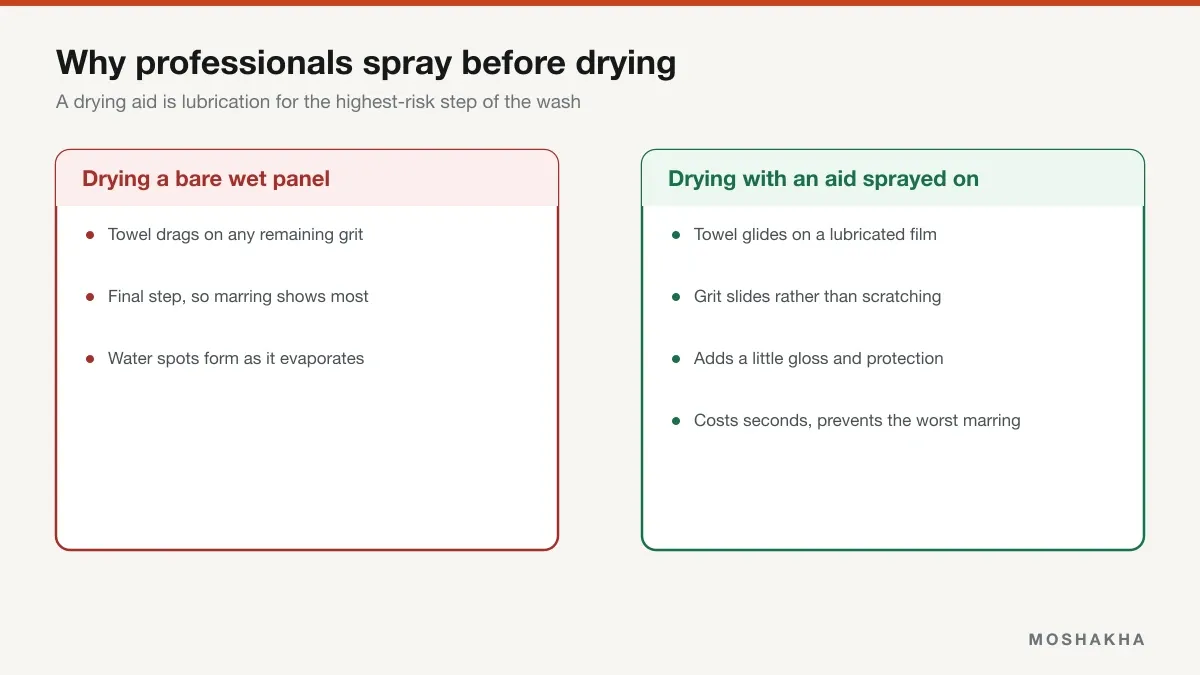
Drying gets treated as the boring part of the wash — the bit after the real work. It’s actually the step most likely to put marks in your paint, and the one where those marks show up most clearly.
Why drying is the risky step
By the time you’re drying, the paint is clean and the lubrication is gone. The shampoo that was keeping grit floating has been rinsed away.
Anything left on the panel — a particle that survived the wash, dust that settled while you rinsed the other side — is now sitting on bare wet paint with a towel about to be pressed onto it and dragged.
That’s the same mechanism as washing without lubrication, and it happens at the end, on a car you’ve just cleaned, where any marring is immediately visible.
What a drying aid does
It restores the lubricating film for the final contact step.
Spray it onto the wet panel, and the towel glides instead of dragging. Grit slides rather than grinding. Most aids also leave a small amount of gloss and short-term protection behind, which is a genuine bonus but not the reason to use one.
The cost is about ten seconds per panel.
Use enough, and use a clean towel
Both failure modes here are self-inflicted:
Too little product — the film isn’t continuous, so you’re back to dragging in patches.
A contaminated towel — one previously used for wax or sealant will streak no matter how much aid you spray. Sort drying towels by job and launder them by category, without fabric softener, which is the other common reason a towel smears rather than absorbs.
Spray a section, dry that section, move on. Letting the aid dry on the panel before you wipe is the third way to get streaks.
See the drying towel from our guideQuick detailer works, at the right dilution
Most people use a quick detailer as their drying aid, and that’s entirely legitimate — plenty of them list the use on the label.
One thing to note: because the panel is already wet, the product spreads much further than it does on a dry car, so you need less than instinct suggests. That’s the opposite of normal quick detailer use, where under-applying is the classic mistake — the dry-panel warning is in quick detailer: the dry-panel warning.
On a coated car
Less necessary, because water sheets off and there’s far less left to dry. Still useful for lubrication on the remainder, and coating-specific hydrophobic sprays will top up the water behavior.
Avoid heavy wax-based aids on a coated car — they can sit on top and mask the coating’s own hydrophobic performance, which tends to get misread as the coating failing.
It doesn’t fix water spots
A drying aid helps you dry faster and more completely, which is the real prevention for water spots. It doesn’t dissolve mineral deposits that have already formed — that needs a dedicated remover, and etched spots need polishing. The distinction is in removing water spots.
Frequently asked questions
What exactly is a drying aid?
A spray applied to a wet panel immediately before drying, usually a diluted quick detailer or a dedicated hydrophobic spray. Its job is lubrication — it puts a slick film between the drying towel and the paint so any remaining grit slides rather than being dragged. Most also leave a little gloss and some short-term protection behind.
Can I just use quick detailer as a drying aid?
Yes, and that's the most common approach. Many detailers explicitly list drying-aid use on the label, sometimes at a dilution. The important difference from normal quick detailer use is that the panel is wet, which spreads the product further and provides some lubrication already — so you generally need less than you'd expect.
Doesn't a drying aid leave streaks?
Not if you use enough of it and a clean towel. Streaking comes from too little product, a contaminated towel, or letting it dry on the panel before you wipe. Spraying a section, drying that section immediately, and moving on avoids all three. A towel previously used for wax will streak regardless of technique.
Is a drying aid necessary on a ceramic-coated car?
Less necessary, because water sheets off a coated panel and there's much less to dry. It's still useful for lubrication on whatever remains, and coating-safe hydrophobic sprays exist specifically to top up the coating's water behavior. Avoid heavy wax-based aids on a coated car — they can mask its hydrophobic performance.
Does a drying aid help with water spots?
Indirectly, by helping you dry faster and more completely, which is the actual prevention. Some also contain surfactants that reduce mineral deposition. But a drying aid doesn't dissolve minerals — established water spots need a dedicated remover, and etched ones need polishing.