Blog
Quick Detailer: The Dry-Panel Warning
Quick detailer is safe on a clean panel and abrasive on a dirty one. The same spray, opposite outcomes — here's where the line actually falls.
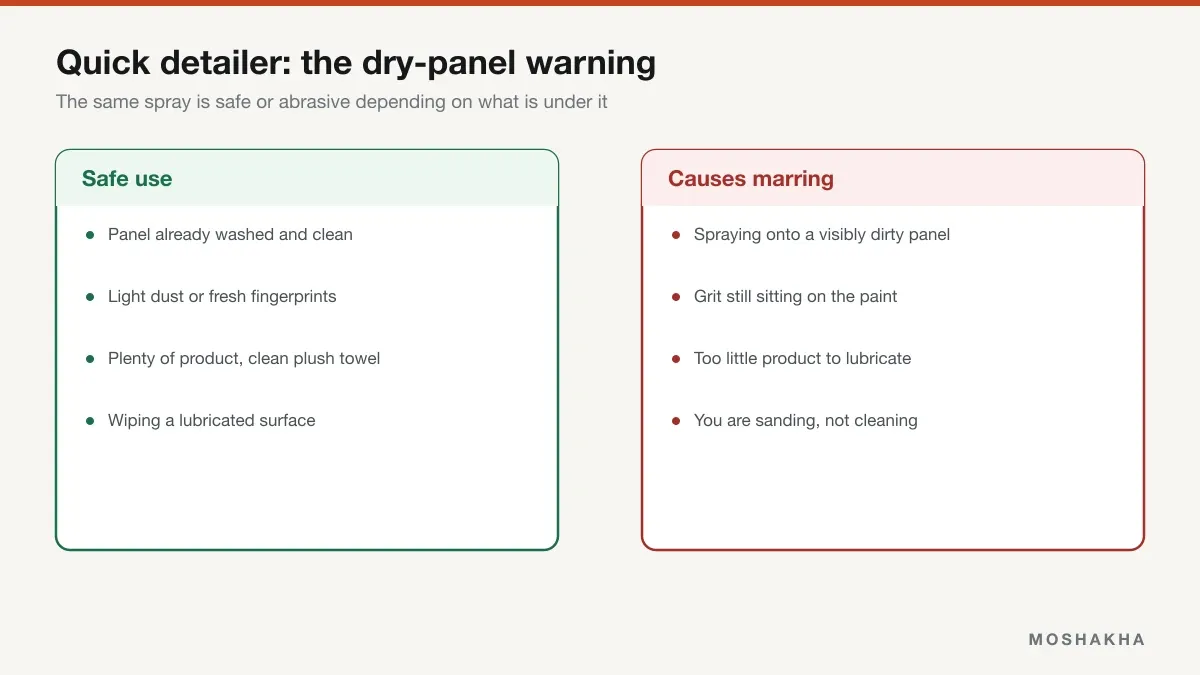
Quick detailer is one of the few car care products that is genuinely safe and genuinely harmful depending entirely on what’s underneath it when you spray.
The mechanism, plainly
Quick detailer works by putting a lubricating film between your towel and the paint. Wipe a clean panel with that film in place, and the towel glides — you’re removing light dust and adding a little gloss.
Wipe a dirty panel and the same film isn’t nearly enough to encapsulate the grit sitting there. The towel presses that grit against the clear coat and drags it. That is not cleaning; that is fine-grit sanding, and it’s the single most common way people put swirl marks into their own paint while trying to be careful.
Where the line falls
Safe: light dust settled on a washed car, fresh fingerprints around the handle, a few bird-dropping-free days of indoor dust, finishing after a wash.
Not safe: a car that’s been driven through rain, anything with visible road film, sap or bug residue, and — the classic one — the car in the parking lot that “only looks a bit dusty” after a week outside.
If you can see dirt rather than dust, you need a wash or a waterless wash, not a detailer. The difference between those two products is covered in the waterless wash guide.
Use more product than feels necessary
The lubrication is the safety mechanism, so under-applying removes the safety. If the towel is grabbing rather than gliding, there isn’t enough on the panel — stop and spray more rather than pressing harder.
The towel matters just as much. A plush, clean microfiber with enough pile to lift dust away from the surface is doing half the work here; a thin, matted, or previously-used-for- wax towel undoes the whole point.
See the plush towels from our guideOne towel, one job
A detailer towel that previously applied wax or sealant carries residue that will streak the moment it’s used on a clean panel with a light spray. Keep detailing towels sorted by job and launder them by category — the reasoning, and the diagnostic for streaks that appear anyway, is in why microfiber towels leave streaks.
The honest summary
Quick detailer is a finishing product. It makes a clean car look better and costs seconds. It is not a shortcut past washing, and treating it as one is how a well-intentioned owner ends up with a swirled hood and no idea where the marks came from.
Frequently asked questions
Can I use quick detailer instead of washing the car?
No — and this is the mistake that damages paint. Quick detailer carries very little cleaning capacity and is designed for light dust on an already-clean panel. Using it on a genuinely dirty car means wiping grit across paint with minimal lubrication, which is the exact mechanism that creates swirl marks. A waterless wash product, which carries far more lubricant and encapsulating agents, is the right tool for that job.
What's the difference between quick detailer and waterless wash?
Concentration and purpose. A waterless wash is formulated with enough lubricant and polymer content to encapsulate and lift a meaningful amount of dirt, so the towel slides over it rather than dragging it. A quick detailer is a much lighter product intended for finishing touches — light dust, fresh fingerprints, water spots caught early — on a panel that's already clean.
Is quick detailer safe on ceramic coatings?
Generally yes, provided it's a pH-neutral formula without heavy waxes or fillers. Some detailers designed to add gloss leave a layer that can mask a coating's hydrophobic behavior temporarily. Coating-specific detail sprays exist for this reason, and they're the safer choice on a coated car.
How much quick detailer should I use?
Considerably more than most people do. Under-applying is what turns a safe product into an abrasive one — the lubrication is the entire safety mechanism. If the towel is dragging rather than gliding, there isn't enough product on the panel. Spray generously and use a clean, plush towel.
Can quick detailer remove water spots?
Fresh ones, sometimes — if the mineral deposit hasn't dried and bonded yet. Established or etched water spots need a dedicated mineral-dissolving remover, and etched spots need polishing. Quick detailer has no meaningful acid or chelating content, so it can't dissolve a deposit that has already set.