How-To Guides
Why Microfiber Towels Leave Streaks (And How to Fix It)
Streaking is almost never the towel being faulty. The three real causes are residue, pile depth and technique — here's how to diagnose which one you have.
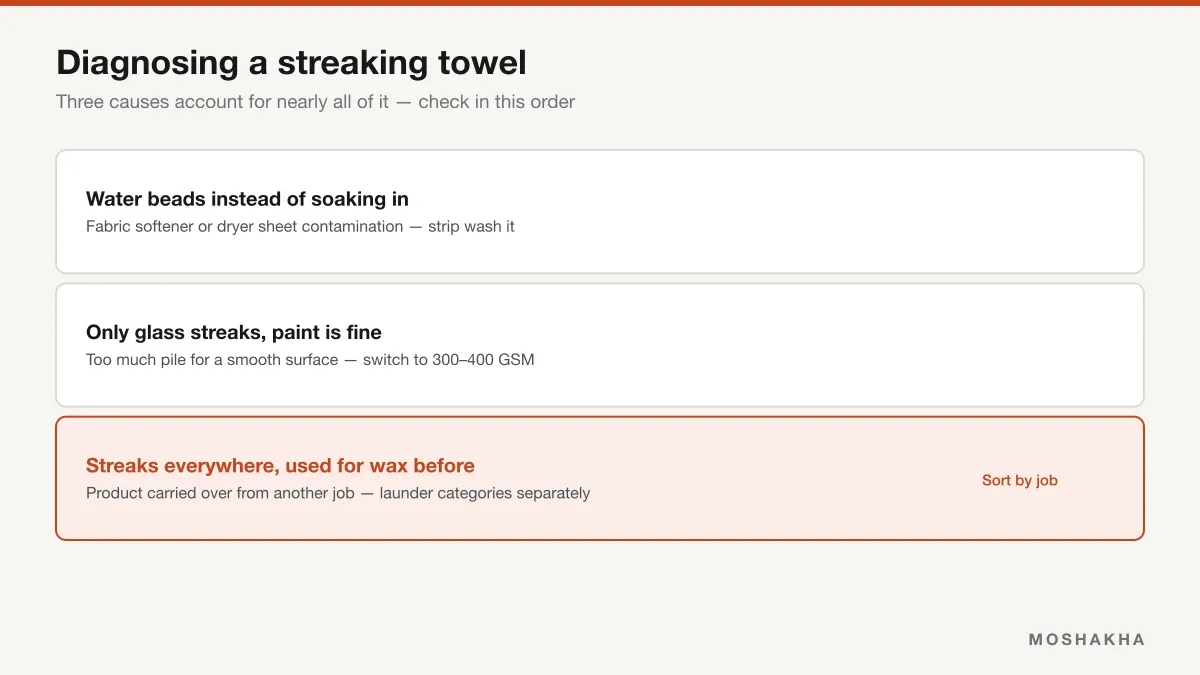
A streaking microfiber towel is one of the most common complaints in detailing, and it’s almost never a faulty towel. It’s one of three things, and they’re easy to tell apart.
Diagnose it first
Does water bead on the towel instead of soaking in? → Contamination. The fibers are coated. Go to the strip wash.
Is it only glass that streaks, while paint is fine? → Pile depth. You’re using too plush a towel on a smooth surface.
Does it streak on everything, and the towel has been used for wax or dressings? → Product contamination. That towel is carrying product in its pile.
Cause 1: fabric softener
The most common cause, and the most preventable.
Softener works by depositing a waxy film on fibers. On a bath towel that feels pleasant. On microfiber it fills the microscopic gaps that draw water in — so the towel stops absorbing and starts pushing water around. Worse, that waxy film transfers onto whatever you’re wiping, which is the streak you’re seeing.
Dryer sheets do exactly the same thing.
Fix: strip wash. Towels alone, no detergent, a cup of white vinegar in the wash, then a second full rinse. Repeat once if the improvement is partial. Then never use softener on microfiber again — full routine in our microfiber care guide.
Cause 2: too much pile for the surface
Glass is perfectly smooth. A deep, plush pile can’t make even contact with it — the fibers bridge across the surface rather than pressing flat against it, so the last thin film of moisture gets moved around rather than lifted.
This is why a 1200 GSM drying towel streaks windows no matter how clean it is. It isn’t faulty; it’s the wrong tool.
Fix: a 300-400 GSM low-pile or waffle weave towel for glass. This single purchase resolves more streaking complaints than any glass cleaner, and it costs a few dollars. See what GSM actually means for why the ranges work this way.
Cause 3: product contamination
A towel used to buff off wax, sealant or trim dressing holds that product deep in its pile. Washing helps but rarely removes it completely — and if you wash that towel alongside your glass towels, you’ve now contaminated those too.
Fix: launder microfiber in separate categories — glass, paint, wax, wheels — and never mix them. Color-coding by job is the simplest way to keep this honest.
The technique that fixes the rest
Even with a clean, correct towel, glass benefits from two towels:
- One slightly damp low-pile towel to clean.
- A second, completely dry low-pile towel to buff immediately after.
The first removes the dirt; the second removes what the first left behind. Nearly all residual streaking disappears here.
Two other things worth checking:
- Use less product. Spray onto the towel, not the glass, and use less than feels right. Excess cleaner is itself a streak source.
- Never do glass in direct sun. The cleaner evaporates before you can buff it, leaving its dissolved solids behind as streaks.
If nothing works
If a strip wash makes no difference and the towel feels stiff or slightly crunchy rather than plush, the fibers have been melted by heat at some point — a hot wash or a hot dryer. Fused fibers can’t be recovered. Retire it to door shuts and wheel arches and start again, laundering the replacement properly from day one.
Frequently asked questions
Why does my microfiber towel leave streaks on glass?
Three causes account for nearly all of it: fabric softener residue coating the fibers, product contamination from towels washed with wax or dressing towels, and using a towel with too much pile. Glass wants 300-400 GSM low pile; anything plush will smear.
Will a new towel fix streaking?
Only if the old one was contaminated or too plush. If you buy a new towel and wash it with fabric softener, it will streak exactly the same way within a few cycles. Fix the laundering first or you will keep replacing towels.
Does a strip wash actually work?
For contamination, yes — vinegar dissolves the waxy coating from softener and mineral build-up from hard water, and towels often recover fully. It cannot repair fibers already melted by high heat. If a strip wash makes no difference and the pile feels stiff rather than plush, the towel is finished.
Should I use vinegar every wash?
No. Use it as an occasional restorative strip wash, not routine maintenance. Regular washing with a plain, softener-free detergent is what keeps towels in good condition day to day.
Why does my car streak after drying even with a good towel?
Usually saturation. Once a drying towel is holding as much water as it can, it stops lifting and starts smearing. Swap to a dry towel partway through, or use a larger one. Drying in direct sun causes the same effect because water evaporates and leaves minerals before you reach it.