Blog
Streak-Free Car Glass: The Two-Towel Method That Works
Streaky windows are almost always the towel, not the cleaner. The two-towel technique, the right pile depth, and why you should never do glass in the sun.
Glass is where good detailing work most visibly falls apart. The paint looks perfect and then the sun hits the windshield and shows every pass you made.
The fix is almost never a different cleaner.
It’s the towel
The single most common cause of streaky glass is using too much pile.
Glass is perfectly smooth. A deep, plush towel can’t press evenly against it — the fibers bridge across the surface rather than making flat contact, so the last thin film of moisture and cleaner gets moved around instead of lifted off.
That’s why your 1200 GSM drying towel streaks windows even when it’s spotlessly clean. It isn’t faulty. It’s the wrong tool, and no glass cleaner compensates for it.
What you want: 300–400 GSM, low pile or waffle weave, edgeless. Cheap, and it fixes the problem outright.
The two-towel method
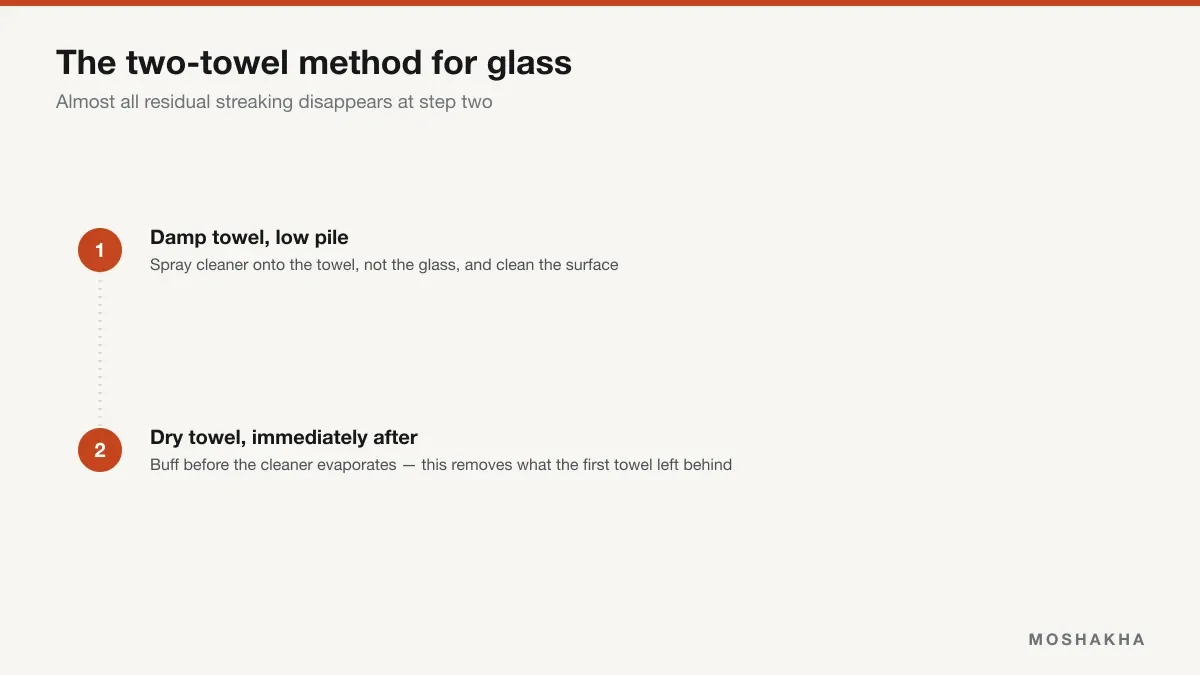
Even with the right towel, glass benefits from two:
- Towel one, slightly damp — spray your cleaner onto the towel, not the glass, and clean the surface.
- Towel two, completely dry — buff immediately, before the cleaner starts to evaporate.
The first towel removes the dirt. The second removes what the first one left behind. This is the step that separates “mostly clean” from genuinely streak-free.
Never in direct sun
If the glass is warm, the cleaner evaporates before you can buff it — and evaporation leaves behind every dissolved solid that was in the product and the dirt. Those deposits are the streaks.
Work in shade, on cool glass. If the windshield is hot, wait.
Technique details that matter
- Spray the towel, not the glass. Less overspray onto trim and paint, and it discourages using too much product.
- Use less than feels right. Excess cleaner leaves more residue than the towel can lift.
- Work in one direction per side. Horizontal on the outside, vertical on the inside. If a streak shows up later, you know instantly which side it’s on.
- Do the top edge last. Lower the window an inch and clean the strip that hides in the seal — it’s the bit that reappears as a dirty line the first time you open it.
The inside of the windshield
The hardest glass on the car, because it collects an oily film from interior plastics off-gassing in the heat. Ordinary cleaner smears it around rather than cutting it.
Two passes: one to break down the film, one to finish. Keep a dedicated interior glass towel that has never touched wax, sealant or trim dressing — a contaminated towel will deposit product onto the screen and make it worse than when you started.
Tint and ammonia
Ammonia-based household glass cleaner damages window tint over time and degrades rubber seals and some interior plastics. If the car has aftermarket tint, ammonia will eventually cause it to bubble and discolor.
Use an ammonia-free automotive formula. It’s not a meaningful price difference.
If it still streaks
The towel itself may be contaminated — fabric softener residue or product carried over from wax towels. Our guide to why microfiber towels leave streaks covers the strip wash that fixes it, and microfiber care covers keeping it from happening again.
Frequently asked questions
Why does my car glass streak no matter what cleaner I use?
Because it is usually the towel, not the cleaner. A high-pile towel cannot make even contact with glass and smears the last film of moisture instead of lifting it. Switch to a 300-400 GSM low-pile or waffle weave towel and most streaking disappears without changing product.
What is the two-towel method for glass?
Clean with one slightly damp low-pile towel, then immediately buff dry with a second completely dry low-pile towel. The first removes dirt, the second removes what the first left behind. It resolves almost all residual streaking.
Should I spray cleaner on the glass or the towel?
On the towel. Spraying directly onto glass causes overspray onto trim and paint, and encourages using far more product than needed. Excess cleaner is itself a common cause of streaking, because there is more residue to remove than the towel can lift.
Why is the inside of the windshield so hard to clean?
Because it accumulates an oily film from plastics off-gassing in heat, which ordinary glass cleaner struggles with. Clean it in two passes — one to cut the film, one to finish — and use a dedicated interior glass towel that has never touched wax or dressing.
Can I use household glass cleaner on car windows?
Avoid anything containing ammonia. It damages window tint over time and degrades rubber seals and some interior plastics. Use an ammonia-free automotive glass cleaner, or a dedicated interior-safe formula for tinted windows.