Blog
Rain Repellent on Glass: Where It Helps and Where It Doesn't
Above about 40mph it genuinely clears the screen without wipers. Below that it does very little — and applied over dirty glass it causes juddering.
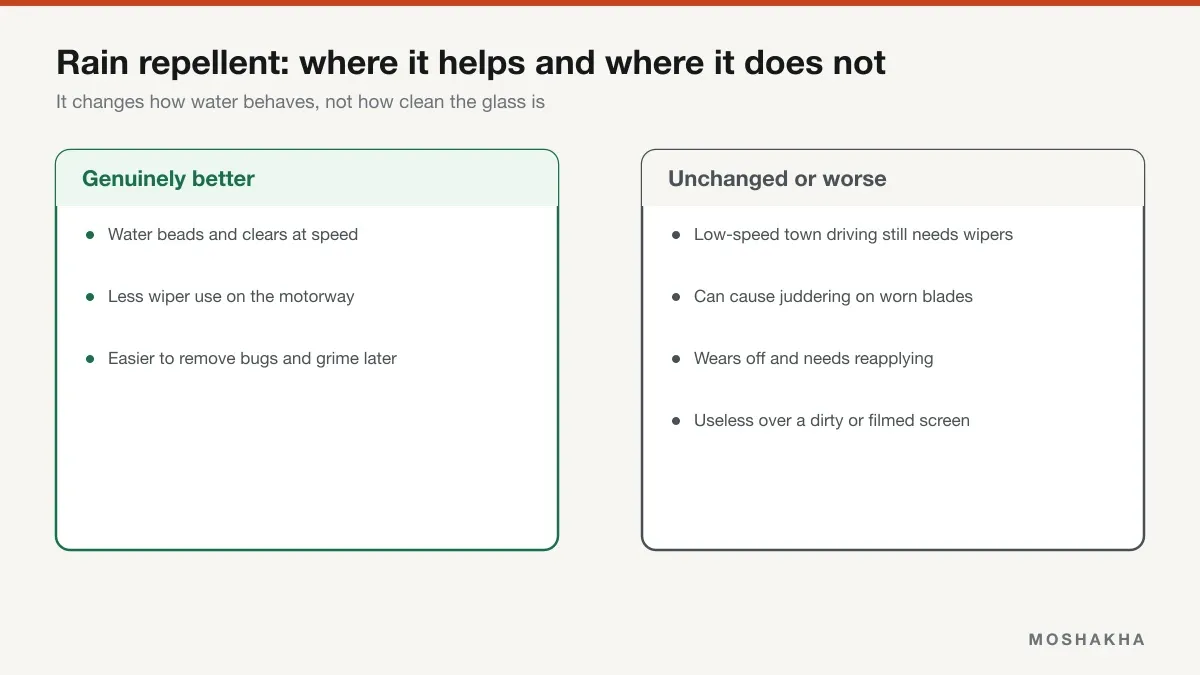
Rain repellent produces unusually polarised opinions — people either swear by it or say it does nothing. Both groups are describing accurate experiences of different driving.
Speed is the whole variable
These products work by making the glass hydrophobic, so water beads instead of sheeting.
Above roughly 40mph, airflow across the screen carries those beads away. In steady motorway rain you can often drive with the wipers off entirely, and the improvement in night visibility — no smearing, no wiper streaks through oncoming headlights — is genuinely significant.
At town speeds there isn’t enough airflow to move the beads. They sit there, and you wipe as normal.
That’s the entire disagreement. It’s a motorway product, and people who mostly drive in town accurately report that it changed nothing.
Clean glass first, or it causes problems
The most common complaint after applying rain repellent is juddering wipers. That’s almost always an application problem rather than the product.
Glass that looks clean usually carries road film, old repellent residue and bonded contamination. Coating over that gives you a surface with inconsistent friction, which is exactly what makes a wiper skip and chatter.
See the glass cleaner from our interior guideDecontaminate properly first — a clay pass on the glass, or a dedicated glass polish, then a clean wipe-down. The two-towel technique is in glass cleaning mastery.
Remove the old coating before reapplying
This is the step almost nobody does, and it’s why second applications disappoint more than first ones.
A partially worn coating leaves patchy friction. Applying fresh product over it doesn’t reset that — you’re layering onto an uneven base. The wiped arc degrades far faster than the edges, so coverage goes blotchy rather than fading evenly.
Use a glass polish or fine abrasive cleaner to take the old one back off first.
Sound blades or don’t bother
Rain repellent doesn’t damage wipers, but it exposes blades that are already marginal. Juddering that appears with a coating often means the blades were on their way out anyway.
The diagnostic for whether a blade is genuinely finished is in when to replace windshield wipers.
Spray or ceramic glass coating?
A spray lasts weeks to a few months and costs very little. A ceramic glass coating lasts a year or more with stronger water behavior.
The trade-off is the same one that applies to paint: prep is most of the job, and a durable coating bonded to contaminated glass locks in the problem. The same reasoning that makes coating wheels a good return is in ceramic coating wheels.
Where it earns its money
Night motorway driving in rain. That’s the case where it’s genuinely transformative rather than marginal — the combination of beading, no wiper smear, and no oncoming-headlight glare through a wiped arc.
If that’s not your driving, it’s a nice-to-have rather than an upgrade.
Frequently asked questions
Does rain repellent actually work?
At speed, clearly yes — above roughly 40mph airflow carries beaded water off the screen and you can often drive with the wipers off entirely in steady rain. At town speeds there isn't enough airflow to move the beads, so you still wipe as normal. It's a motorway and night-driving benefit rather than a general one, which is why opinions on it differ so sharply.
How long does windshield rain repellent last?
Typically weeks to a few months for spray-on consumer products, depending on wiper use, washer fluid and weather. The wiped area degrades much faster than the edges, which is why coverage goes patchy rather than fading evenly. Longer-lasting professional coatings exist and cost considerably more.
Why do my wipers judder after applying rain repellent?
Usually because it was applied over glass that wasn't properly decontaminated, or because it's wearing unevenly as it ages. Juddering is the wiper skipping over a surface with inconsistent friction. Worn blades make it much more likely — a coating on clean glass with sound blades rarely causes it.
Do I need to remove old rain repellent before reapplying?
Yes, and skipping it is the main reason people conclude these products don't work. A partially worn coating leaves patchy friction that the new layer simply sits on top of. Remove the old one with a dedicated glass polish or a fine abrasive cleaner before applying fresh, so you're coating clean glass rather than old coating.
Is a ceramic glass coating better than a spray?
It lasts considerably longer — often a year or more against weeks for a spray — and the water behavior is usually stronger. The trade-off is the same one that applies to paint coatings: preparation is most of the job, and the glass must be genuinely decontaminated and polished first or you're bonding a durable layer to a dirty surface.