Blog
When to Replace Windshield Wipers (Not by Age)
Judge a blade by the pattern it leaves, not by how long it's been fitted. Two of the three common symptoms are usually the glass, not the wiper.
Wiper blades get replaced on a schedule, which is odd for a part whose condition is visible every time it rains. The useful question isn’t how old it is — it’s what pattern it leaves.
Read the symptom before buying anything
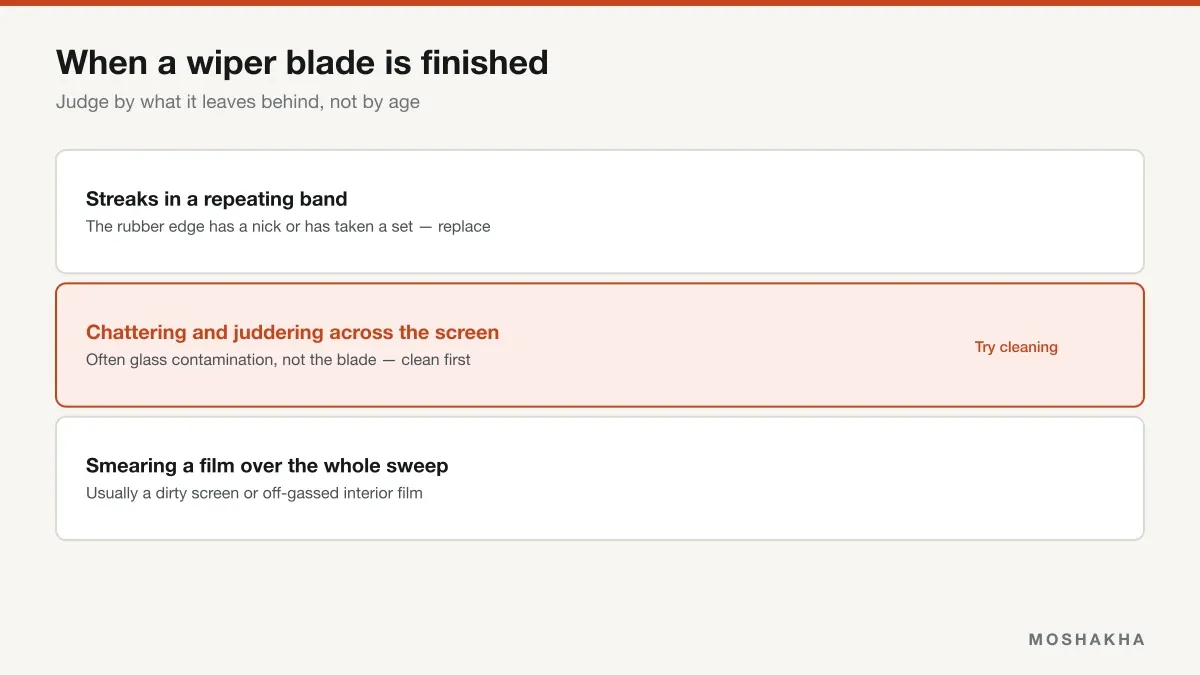
Streaks in a repeating band, appearing in the same place on every sweep — that’s a physical defect in the rubber edge. A nick, or a section that’s taken a permanent set. Replace the blade.
Juddering and chattering across the screen — usually not the blade. Most often it’s glass contamination, particularly road film or an old rain repellent breaking down unevenly. Clean the screen properly first.
A general smear over the whole sweep with no repeating pattern — also usually the glass. Frequently it’s the interior film, which people don’t think to check because the wipers are outside.
Two of the three common complaints are a cleaning problem. Replacing blades fixes neither.
Clean the glass properly first
This is the cheapest diagnostic available, and it resolves a meaningful share of wiper complaints outright.
Road film builds a layer that wipers skip across rather than glide over. Old rain repellent wears patchily and does the same. Neither comes off with a casual wipe — it needs a proper decontamination of the glass surface.
See the glass cleaner from our interior guideThe two-towel method that removes film rather than redistributing it is in glass cleaning mastery — and interior film matters here too, because a smeary inside surface reads as a wiper problem from the driver’s seat.
Age matters less than exposure
UV degrades wiper rubber faster than use does.
A blade on a garaged car in a mild climate can stay good well beyond a year. One on a car parked outside in strong sun can be finished in six months having barely been used. The six-to-twelve-month advice averages those two cases and describes neither.
Check the edge: rubber that’s hardened, gone shiny, or split along its length is finished regardless of the calendar.
The winter damage people inflict themselves
Running wipers over a frozen screen tears the rubber edge where it’s stuck to the glass, and that damage is permanent.
It’s the most common cause of a blade that streaks from one specific morning onward. Free them by hand first — covered in de-icing a windshield safely.
Lifting the arms off the glass overnight in freezing weather avoids it entirely, though it’s worth checking the arms don’t spring back hard enough to chip the screen.
Beam blades versus frame blades
On modern curved screens, beam blades generally do better. A tensioned spring along the length applies even pressure across the curve, where a traditional frame applies it at a few contact points.
They also have no exposed hinges to pack with ice, which is a genuine winter advantage rather than a marketing one.
Frequently asked questions
How often should windshield wipers be replaced?
The common advice is every six to twelve months, but condition beats any interval. A blade on a garaged car in a mild climate can stay good for well over a year, while one on a car parked outside in strong sun can be finished in six months — UV degrades the rubber faster than use does. Judge by the pattern it leaves on the glass.
Why are my wipers streaking?
Streaks in a repeating band that appears in the same place each sweep usually mean a nick in the rubber edge or a section that has taken a permanent set — that's a blade replacement. A general smear across the whole sweep, with no repeating pattern, is usually contaminated glass rather than a bad blade, and cleaning the screen properly fixes it.
What causes wipers to judder and chatter?
Most often glass contamination rather than the blade, particularly a layer of road film or old rain repellent breaking down. It can also be a blade whose rubber has hardened with age, or arm geometry that isn't holding the blade square to the glass. Clean the screen thoroughly first — juddering that survives a proper clean points at the blade or the arm.
Does rain repellent damage wiper blades?
It doesn't damage them, but it can cause juddering on blades that are already worn, and it wears unevenly as it ages, which can produce patchy behavior that reads as a wiper fault. Applied to clean glass with sound blades it's fine; applied over an old, partially worn coating it tends to cause the complaints people blame on the wipers.
Are beam blades better than traditional frame wipers?
Generally yes on modern curved screens. A beam blade uses a tensioned spring along its length to apply even pressure across the whole curve, where a traditional frame applies pressure at a handful of contact points. Beam blades also have no exposed hinges to clog with ice, which is a real advantage in winter.