Blog
Waterless and Rinseless Washing: When They're Safe to Use
Waterless washing is safe on light dust and risky on real dirt. The difference between waterless and rinseless, and the technique that avoids swirls.
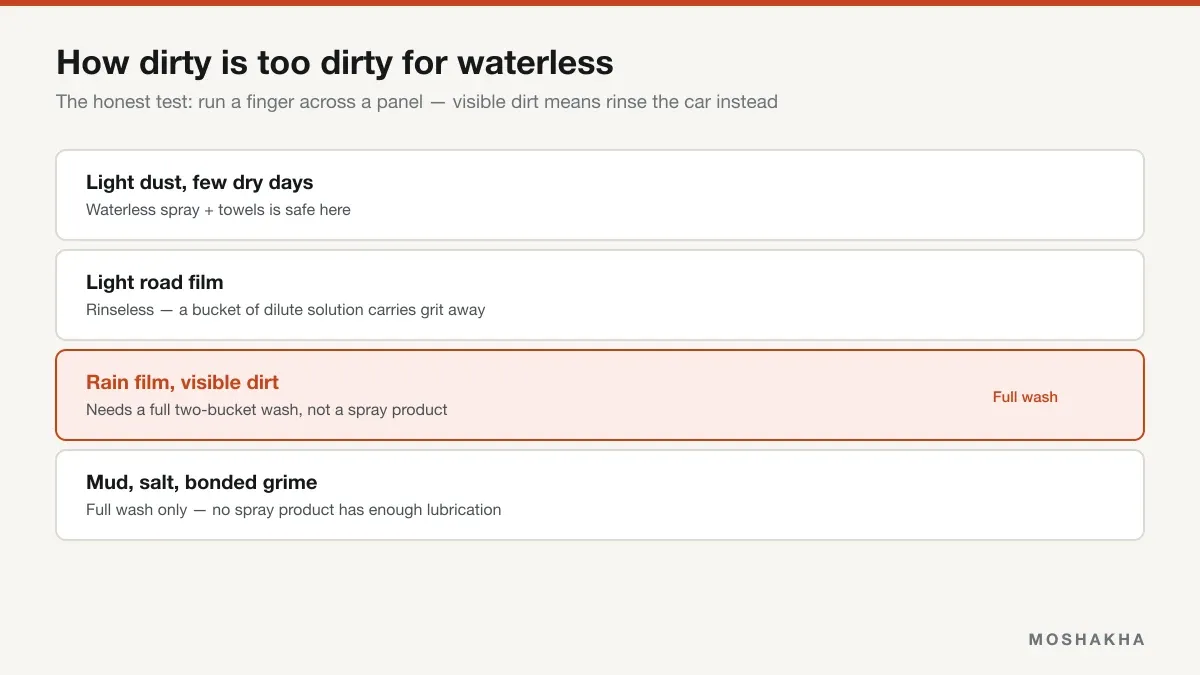
Waterless washing is genuinely useful and frequently misused. The difference is entirely about how dirty the car is, and that judgement is the whole skill.
Waterless vs rinseless
Two different things, often confused:
Waterless — a spray product plus towels. No buckets, no hose. The product encapsulates light dirt so it can be wiped away. For dust and light road film only.
Rinseless — a bucket of heavily diluted solution plus a mitt or towels. No final rinse. Handles noticeably more dirt than waterless, because the solution carries grit off the paint and into the bucket rather than relying on a towel to hold all of it.
If you have access to a bucket and a tap, rinseless is the safer of the two for anything beyond dust.
When waterless is safe
- Light dust after a few dry days
- Interior glass and door shuts
- A quick tidy before an event on an already-clean car
- Apartment or flat living where a hose genuinely isn’t an option
When it isn’t
- After rain, where road film is heavy
- Winter roads — salt and grit are exactly what this can’t handle
- Mud, sand, or anything visible in texture
- After a long motorway drive — bonded insects and film
The honest test: run a finger across a panel. If it comes away with visible dirt rather than a light dust, waterless washing is the wrong choice today. Rinse the car instead.
Technique, if you’re doing it
The technique carries the entire safety margin here:
- Use far more product than feels necessary. Lubrication is the only thing between grit and your clear coat. Being frugal is what causes damage.
- One panel at a time, top down as always.
- Spray generously, let it dwell for a few seconds so the product can encapsulate the dirt before you touch it.
- A fresh towel face for every panel. Fold a towel into quarters — that’s four faces — and turn to a clean one constantly.
- Straight lines, no pressure. Let the product do the work.
- Buff with a second, dry towel immediately.
Never go back over a section with a used towel face. Everything the towel picked up is now on it, and reusing that face drags it back across the paint.
The towel count
This is where most people fail. A full waterless wash needs six to eight towels minimum, and more if the car is at the dirty end of acceptable.
Running out mid-job is the moment people start reusing contaminated faces — which is exactly the thing the technique depends on not doing. Count your towels before you start, not halfway through.
Our towel count guide goes into this properly.
The honest summary
Waterless washing is a maintenance tool, not a replacement for washing. Used on a lightly dusty car with plenty of product and plenty of towels, it’s safe and convenient. Used on a genuinely dirty car, it’s one of the more reliable ways to install swirl marks.
When the car is properly dirty, it needs a proper wash.
Frequently asked questions
Is waterless car wash safe for paint?
On a lightly dusty car, yes, if you use plenty of product and a fresh towel face for every panel. On a genuinely dirty car it is not — there is not enough lubrication to carry that much grit safely, and you will be dragging it across the paint.
What is the difference between waterless and rinseless washing?
Waterless uses a spray product and towels only, with no buckets. Rinseless uses a bucket of dilute solution and a mitt or towels, with no final rinse. Rinseless handles more dirt because the solution carries grit away from the paint into the bucket.
How many towels do I need for a waterless wash?
Far more than people expect — at least six to eight for a whole car, and more if it is dirty. The technique depends on never reusing a contaminated towel face, so running out means either stopping or scratching your paint.
Can I use a waterless wash in winter on a salted road car?
No. Road salt and winter grit are exactly the heavy contamination waterless washing cannot handle safely. The car needs a proper rinse to remove that material before anything touches the paint.
Does waterless washing scratch paint?
It can, if used on the wrong car or with too few towels. The product provides lubrication, but there is a limit to how much grit it can encapsulate. Used correctly on light dust it is safe; used on heavy dirt it is one of the more reliable ways to add swirl marks.