How-To Guides
How to Use a Clay Bar Without Marring Your Paint
Claying removes bonded contamination a wash can't. The lubrication rule, how to fold and inspect the bar, and the one mistake that scratches paint.
Claying is the step between washing and protecting, and it is the one most people either skip entirely or do badly enough to cause damage.
What claying actually does
A wash removes what is sitting on the paint. Claying removes what has bonded to it: brake dust that arrived hot and welded itself in, industrial fallout, rail dust, tree sap, overspray.
You can feel it. Run your fingertips over a clean panel and it feels smooth. Put your hand in a thin plastic bag first and the bag amplifies texture — suddenly you can feel every bonded particle as fine grit.
That grit is what clay pulls out. The bar is a soft resin that grips the protruding part of each particle and lifts it free as the clay slides past.
Do the bag test first
If the paint feels smooth through the bag, do not clay it. There is nothing to remove, and claying is a mildly abrasive process. Doing it on schedule rather than on need is just abrading your clear coat for no reason.
Once or twice a year is right for most cars. A garaged car may go longer; a car parked under trees or near industry will need it sooner.
The lubrication rule
This is the entire safety margin of the process.
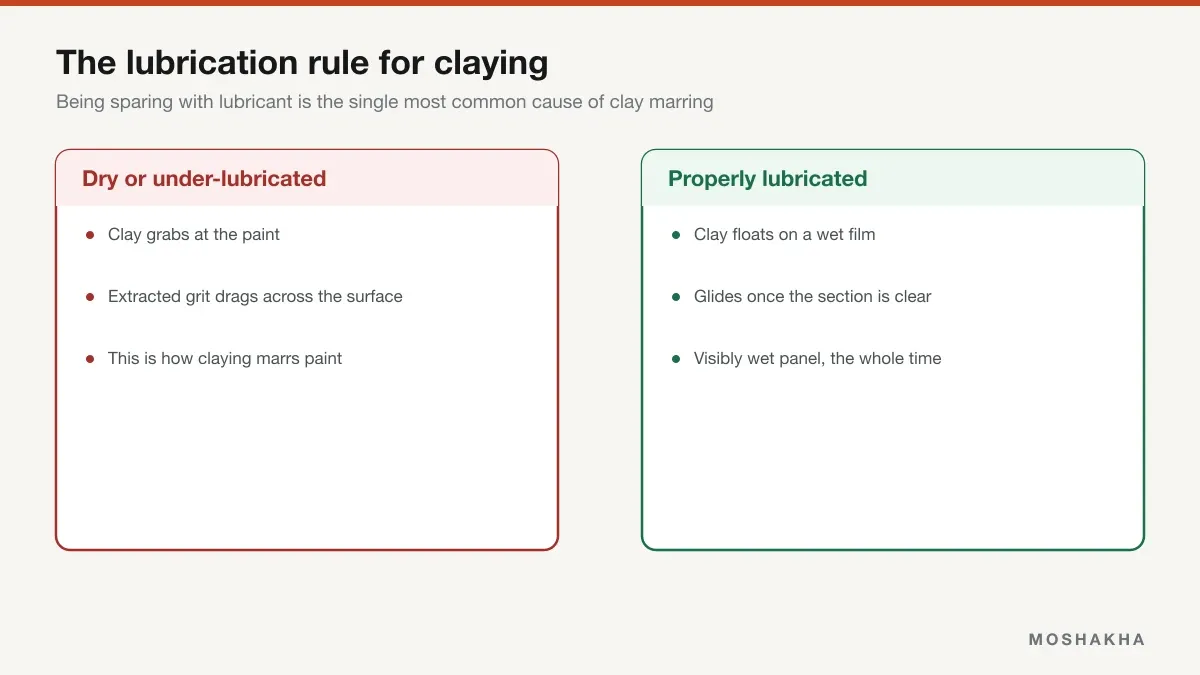
The clay must never touch dry paint. It floats on a film of lubricant, and that film is what stops the extracted grit from being dragged across the surface. Being sparing with lubricant is the single most common cause of clay marring.
Use noticeably more than feels necessary. The panel should be visibly wet. If the clay starts grabbing or squeaking, stop and add more lubricant rather than pushing through.
Plain water does not work — it has almost no lubricity. Use a dedicated clay lube or a quick detailer.
Folding, and the dropped-clay rule
The contamination the clay removes does not vanish. It sits embedded in the face of the bar. Keep working with a loaded face and you are dragging that same grit back across your paint.
Fold the patty in on itself every couple of sections and flatten it again. Look at it — visible dark specks mean fold now.
And the absolute rule: if the clay hits the ground, it is finished. It has picked up sharp grit that you will never fully see or remove. Tear off a fresh piece. This is why you only ever use a third of the bar at a time — dropping it costs you very little.
Chemical first, mechanical second
An iron fallout remover dissolves bonded brake dust chemically, with no contact at all. Doing that before you clay means the bar has far less to pick up, so fewer passes and less marring risk.
It is optional. It also makes the whole job faster and safer, which is a good trade for the price of a bottle.
What comes after
Claying strips whatever protection was on the paint. The car is now bare clear coat, which spots easily and re-bonds contamination fast.
Protect it the same day. A wax, sealant, or — if you are going further — a ceramic coating, which specifically requires decontaminated paint to bond properly. Claying is a prerequisite for coating, not an alternative to it.
If you are correcting paint as well, the order is: wash → decontaminate → clay → polish → protect. Claying comes before polishing, never after.
Frequently asked questions
How often should I clay bar my car?
Once or twice a year for most cars, and only when the paint actually needs it. Use the plastic bag test rather than a schedule — if the paint feels smooth through the bag, claying achieves nothing and only adds unnecessary abrasion. Cars parked outdoors or near industry need it more often.
Can a clay bar scratch paint?
Yes, in three situations: insufficient lubricant, a bar loaded with contamination that has not been folded, or a bar that has been dropped and picked up grit. Used correctly on a well-lubricated panel, clay causes only very light marring that a finishing polish removes.
Can I use water instead of clay lubricant?
No. Plain water has almost no lubricity and lets the clay grab at the paint, which is how marring happens. A dedicated clay lubricant or a quick detailer is inexpensive, and it is the component actually protecting your clear coat during the process.
Do I need to polish after claying?
Not always, but often. Claying leaves very light marring that is visible under direct sun on dark paint. A light finishing polish removes it. On lighter colors, or if you are not chasing perfection, you can go straight to protection.
What grade of clay should I use?
Fine or medium for a maintained car. Aggressive or heavy-grade clay removes more contamination faster and marrs correspondingly more, so it is for neglected paint that you intend to machine polish afterwards. When unsure, start fine — you can always step up.
Do I have to wax after claying?
Yes, the same day. Clay strips wax and sealant along with the contamination, leaving bare clear coat exposed. Unprotected paint water-spots easily and re-bonds contamination quickly, so plan the protection step as part of the same job rather than a separate afternoon.