Blog
Car Wash Soap vs Dish Soap: What Actually Happens
Dish soap does clean a car. It also strips protection and offers almost no lubrication — which is the part that keeps grit from scratching paint.
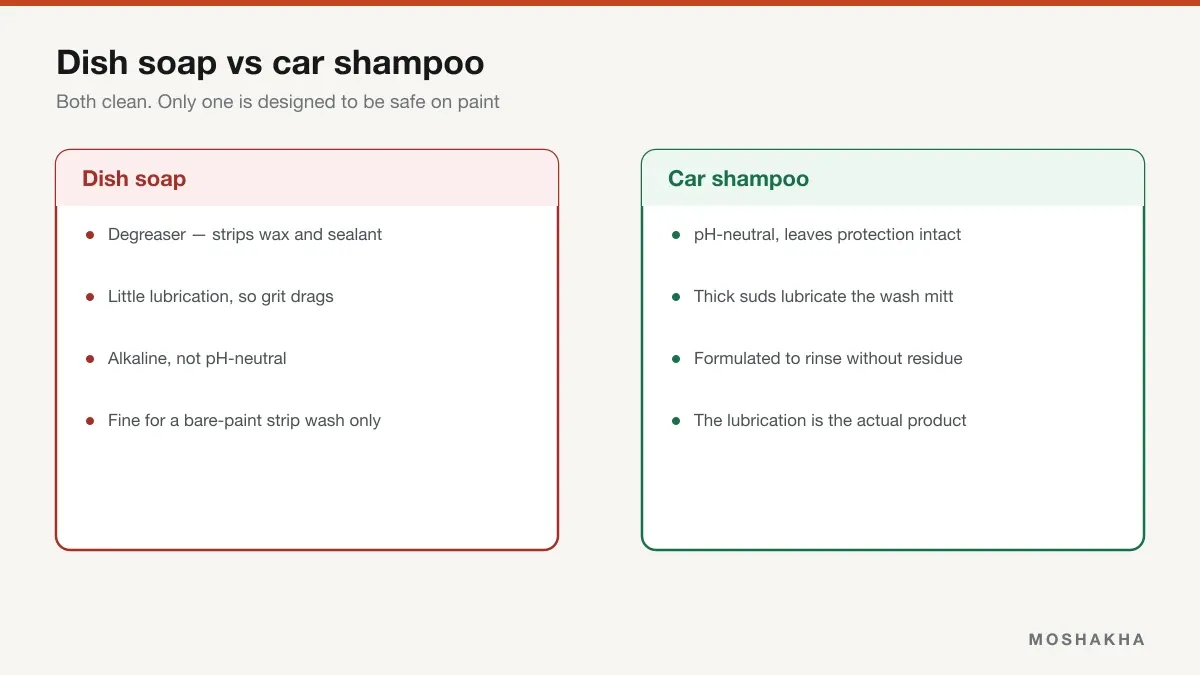
The dish soap question comes up constantly, and it usually gets answered badly in both directions — either “it’ll destroy your paint” or “soap is soap.” Neither is right.
What dish soap actually does
It strips wax and sealant. That isn’t a side effect — it’s the product working correctly. Dish soap is engineered to break down grease and lift it away, and wax is, chemically speaking, exactly the sort of thing it’s designed to remove.
It’s alkaline, not pH-neutral. Car shampoos are deliberately formulated near neutral so they don’t attack the protection layer.
It offers little lubrication. This is the part almost nobody mentions, and it’s the one that matters most.
Lubrication is the actual product
Most scratches in most cars’ paint were put there during washing, not by the road.
Here’s the mechanism: your mitt picks up grit. What decides whether that grit slides harmlessly off the panel or gets dragged across the clear coat is the lubricating film between the mitt and the paint. A thick, slick suds layer lets it float. A thin one lets it grind.
Car shampoo’s primary engineering target is that film. The cleaning is close to secondary — road film comes off easily; it’s the grit that needs managing. Dish soap produces suds that look plentiful but don’t provide the same slickness under a loaded mitt.
See the shampoo from our soap guideThe one time dish soap is correct
A strip wash, before applying new protection.
If you’re about to lay down a fresh wax, sealant or coating, you want the paint genuinely bare so the new product bonds properly rather than sitting on top of degraded old protection. Dish soap removes everything, cheaply and thoroughly. That’s the right job for it.
Do it, then apply the new protection promptly — bare paint has nothing defending it.
What about ceramic coatings?
A cured ceramic coating won’t wash off the way wax does. But repeated aggressive degreasing degrades its hydrophobic behavior faster than a neutral shampoo would. Coatings are durable, not immune, and it’s an odd economy to protect an expensive coating with the harshest thing under the sink.
The honest summary
Dish soap cleans a car. It also removes the protection you paid for and gives you less margin during the step where paint damage actually happens.
Given that a bottle of proper shampoo is inexpensive and lasts dozens of washes at correct dilution, the calculation isn’t close for regular washing — and the technique that shampoo enables is covered in the two-bucket method.
Frequently asked questions
Will dish soap ruin my car's paint?
Not in a single wash, and that's why the myth persists in both directions. What it reliably does is strip wax and sealant, because degreasing is exactly what it's formulated to do. The subtler issue is lubrication: dish soap produces suds that look substantial but offer far less lubricating film than car shampoo, so grit on the paint is more likely to be dragged than floated away.
Is there ever a good reason to use dish soap on a car?
Yes — a deliberate strip wash. If you're about to apply a new wax, sealant or coating, you want every trace of old protection gone so the new product bonds to bare paint. Dish soap does that job well and cheaply. It's the right tool for that specific preparation step, and the wrong tool for a maintenance wash.
Why does lubrication matter more than cleaning power?
Because the scratches in most people's paint come from the wash itself, not from the road. A wash mitt picks up grit, and what determines whether that grit slides off or gets dragged across the clear coat is the lubricating film between mitt and paint. Car shampoo is formulated primarily to provide that film — the cleaning is almost the secondary function.
Is dish soap bad for a ceramic coating?
It won't remove a properly cured ceramic coating the way it removes wax, but repeated use degrades the coating's hydrophobic performance faster than a pH-neutral shampoo would. Coatings are chemically durable but not immune, and using an aggressive degreaser every wash shortens the useful life of something expensive.
What about the 'car shampoo is just dish soap' claim?
The surfactant families overlap, but the formulations are built for different outcomes. Dish soap is optimized to break down grease and rinse clean off dishes. Car shampoo is optimized to be pH-neutral and to produce a thick, slick film that survives being dragged across paint. Same broad chemistry, different engineering targets.