Blog
Drying a Car in Freezing Weather (Seals, Not Just Paint)
The water that causes trouble in winter isn't on your paint — it's in the door seals, locks and handles. What to dry first when it's below freezing.
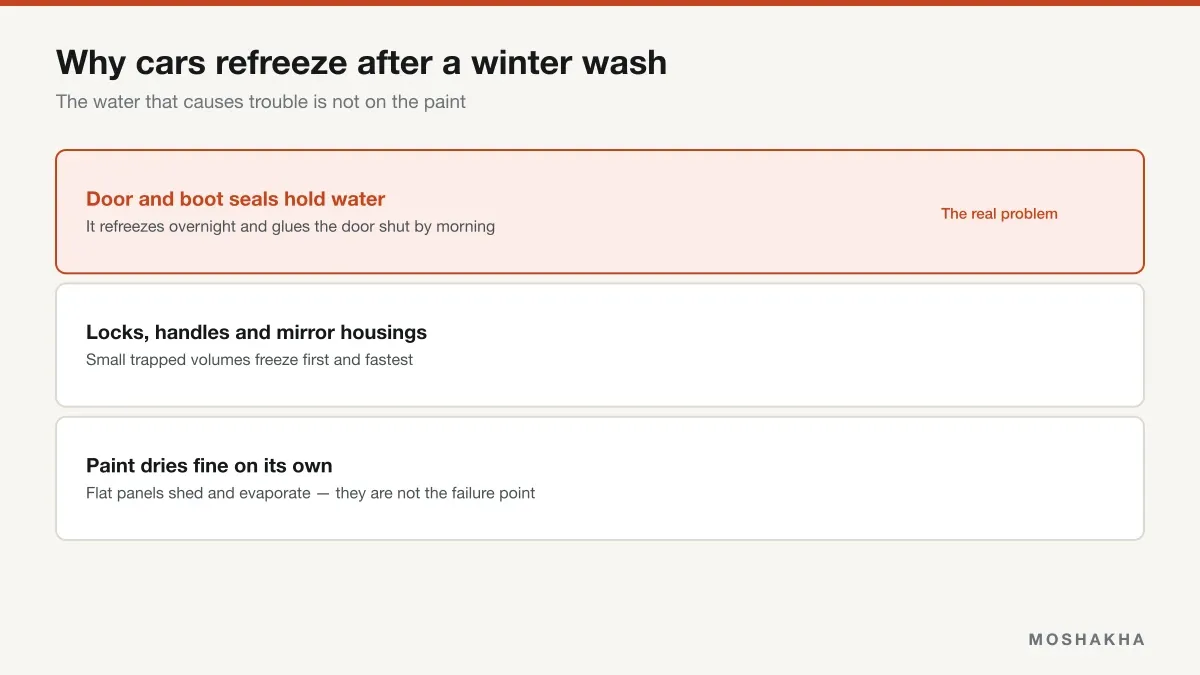
Winter drying advice tends to focus on getting the paint dry fast so water spots don’t form. That’s a summer problem wearing a winter coat. In freezing conditions, the water that actually causes trouble isn’t on your paint at all.
The paint was never the problem
Flat panels shed most of their water and evaporate the rest reasonably quickly, even in the cold. Nobody’s morning is ruined by a slightly damp hood.
Water trapped in door and trunk seals is a different matter. A rubber seal holds a thin film of water in a shaded, enclosed channel, where it sits until the temperature drops and freezes — bonding the seal to the door frame. The result is a door that either won’t open, or opens and tears the seal.
The same applies to locks, handles, mirror housings, and the gaps behind badges: small trapped volumes, sheltered from airflow, that freeze first and fastest.
Dry in this order when it’s cold
Seals first. Open each door and wipe the rubber seal and the frame it presses against. This is the single highest-value minute of a winter dry.
Then handles, locks and mirror housings. Small volumes, quick to do, and the ones that strand you at the worst moment.
Then the panels. They were going to be fine anyway, but a fast pass with a high-capacity towel gets you out of the cold sooner — which matters more than usual when water is actively freezing as you work.
See the drying towel from our guideWhy finishing fast matters more in winter
In mild weather, taking your time drying is harmless. Below freezing, every minute the car stands wet is a minute water is migrating into gaps and starting to freeze. A large, high-capacity towel that covers panels in fewer passes isn’t about luxury here — it shortens the window in which things can freeze. Sizing and capacity are covered in best car drying towels.
Forced air genuinely helps here
This is the one case where a leaf blower or dedicated air dryer earns its keep for reasons beyond convenience. Air reaches into seals, lock barrels, badge edges and mirror housings — exactly the places a towel physically cannot reach, and exactly where winter failures originate.
And drive it briefly afterward
A short drive after washing warms the car, moves air through the panel gaps, and helps clear water a towel never reached. It’s a small habit that prevents the frozen-door morning more reliably than a more thorough drying session in the driveway.
The broader winter routine — including why rinsing frequency matters more than waxing — is in protecting car paint in winter.
Frequently asked questions
Why does my car door freeze shut after washing?
Water left in the rubber door seal refreezes and bonds the seal to the door frame. The paint dries quickly on its own, but a seal holds a thin film of water in a shaded, enclosed channel where it lingers. Wiping the seals and the frame they meet is what prevents it — not drying the panels more thoroughly.
Should I avoid washing my car when it's below freezing?
It's manageable rather than forbidden, but the margin for error is smaller. If you can wash when temperatures are above freezing and the car has a few hours to fully dry, that's clearly better. If you're washing in the cold because road salt needs to come off, dry the seals, locks and handles immediately and drive briefly afterward to help clear trapped water.
Does a bigger drying towel help in winter?
It helps you finish faster, which matters when water is freezing as you work. A large, high-capacity towel lets you cover panels in fewer passes rather than repeatedly wringing a small one. But the winter-specific problem is trapped water in seals and gaps, which no towel size solves on its own.
Will a leaf blower or air dryer work better in the cold?
For trapped water specifically, yes — forced air reaches into seals, mirror housings, badge edges and lock barrels that a towel physically cannot. That's exactly where winter trouble comes from, so air drying addresses the actual failure point rather than the panels that were going to dry anyway.
What about water freezing in the door locks?
Lock barrels hold a small volume of water that freezes readily, and most modern cars still have at least one physical lock even with keyless entry. Forced air or a quick shot of a displacement spray clears it. Never force a key into a frozen lock — that's how the key or the barrel gets damaged.