How-To Guides
Removing Winter Salt Stains From Car Carpet
Salt dissolves in water, so the fix isn't scrubbing — it's dissolving and extracting. Skip the extraction and the white ring comes back within a day.
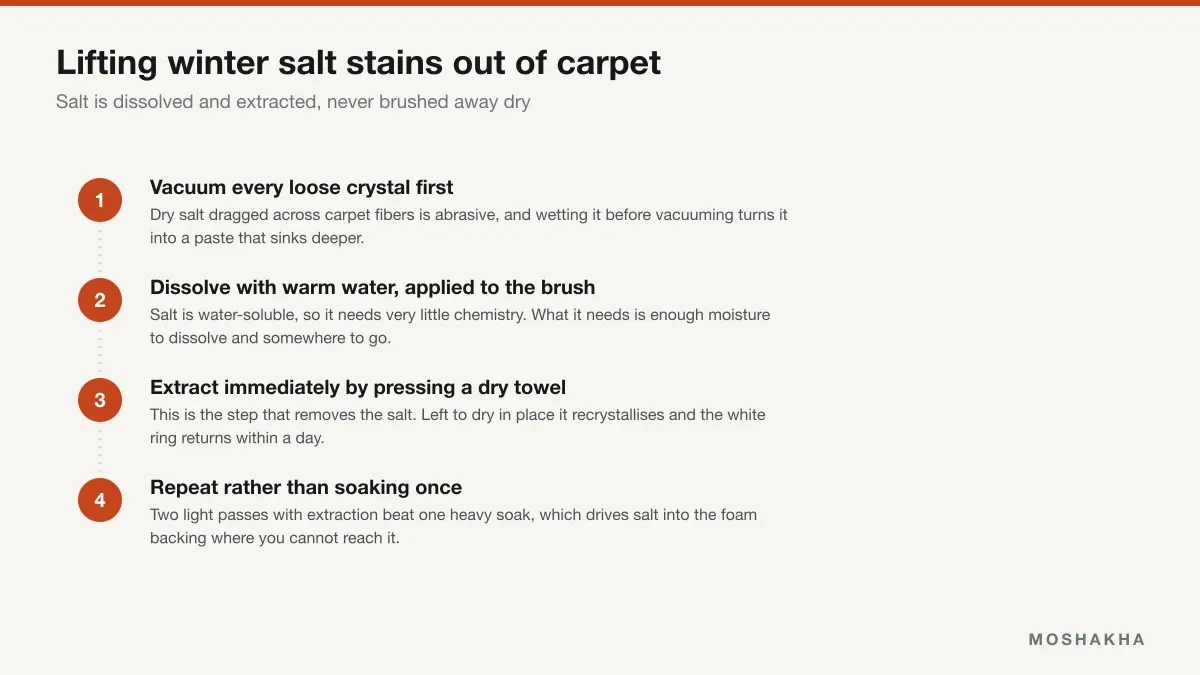
Winter salt stains are the one interior cleaning problem that needs almost no chemistry and almost always gets the wrong technique.
Salt dissolves — so scrubbing isn’t the answer
Road salt is water-soluble. That’s the whole mechanism.
The failure people run into is dissolving it without ever removing it. Wetting a salt stain spreads dissolved salt through the damp area; if that moisture then dries in place, the salt recrystallises and the white ring comes back, often larger than it started.
Extraction is the step that actually removes salt from the carpet. Everything else is preparation for it.
Vacuum before any moisture
Dry salt crystals are abrasive, and feet grind them into the pile.
Wetting them before vacuuming turns loose crystals into a paste that sinks deeper. Vacuum first — including along the sill and under the seat rails, where it collects out of sight.
See the car vacuum we reviewedWarm water on the brush, not the carpet
Damp the brush rather than soaking the footwell. That puts moisture exactly where the agitation is happening without driving salt down into the foam backing.
A little white vinegar helps with stubborn residue. A strong carpet cleaner doesn’t — it just adds surfactant that also needs extracting afterwards.
Press to extract, don’t wipe
Fold a dry microfiber, press it firmly into the agitated area, and hold. Refold to a clean face and repeat.
Wiping smears dissolved salt around. Pressing draws it up into the towel. Same technique as fabric seats, and for the same reason — cleaning fabric car seats covers the over-wetting trap in more detail.
Two light passes beat one soak
Over-wetting pushes salt into the underlay where nothing you do at the surface will reach it, and leaves a footwell that takes days to dry.
Dry thoroughly afterwards — doors open or a fan into the footwell until it’s dry to the touch throughout.
The real fix is next winter
Cleaning carpet repeatedly is treating the symptom. All-weather mats with a raised lip contain slush instead of letting it soak through, and shaking them out regularly beats any amount of extraction work.
That also addresses the quieter problem: salt held against the floor pan in permanently damp carpet is how rust starts from the inside. Mat options are in best car floor mats, and the wider winter routine is in protecting car paint in winter.
Frequently asked questions
Why do salt stains keep coming back after I clean them?
Because the salt was dissolved but never removed. Wetting a salt stain dissolves the crystals and spreads them through the damp area; if that moisture then dries in place, the salt recrystallises and the white ring reappears — often larger than before. Extraction with a dry towel is the step that takes the salt out of the carpet rather than redistributing it.
Do I need a special cleaner for road salt?
No. Salt is water-soluble, which makes it one of the few car cleaning problems that genuinely needs no chemistry. Warm water and proper extraction does it. A small amount of white vinegar in the water can help with stubborn residue, but an aggressive carpet cleaner adds surfactant that then also needs extracting.
Can I just use a wet vacuum instead?
Yes, and if you have one it is the better tool — mechanical extraction removes far more moisture and dissolved salt than towel blotting does. The method is the same: dissolve with warm water, agitate, then extract thoroughly, repeating rather than saturating in one pass.
Will salt actually damage my carpet?
The staining is mostly cosmetic, but the abrasion is not. Dry salt crystals ground into carpet fibers by feet act like grit and wear the pile prematurely. There is also a corrosion argument for getting it out: salt held against the floor pan in damp carpet is exactly the condition that starts rust from the inside.
How do I stop it happening every winter?
Rubber or all-weather mats with a raised lip, which contain the slush rather than letting it soak through to the carpet, and shaking them out regularly rather than waiting for them to fill. That is a far more effective strategy than cleaning the carpet repeatedly, and it addresses the corrosion risk at the same time.