Blog
1200 GSM Twisted Loop: What That Spec Actually Buys You
1200 GSM twisted loop is the standard spec for a serious drying towel. Here's what the weave does, which vehicles it suits, and when it is overkill.
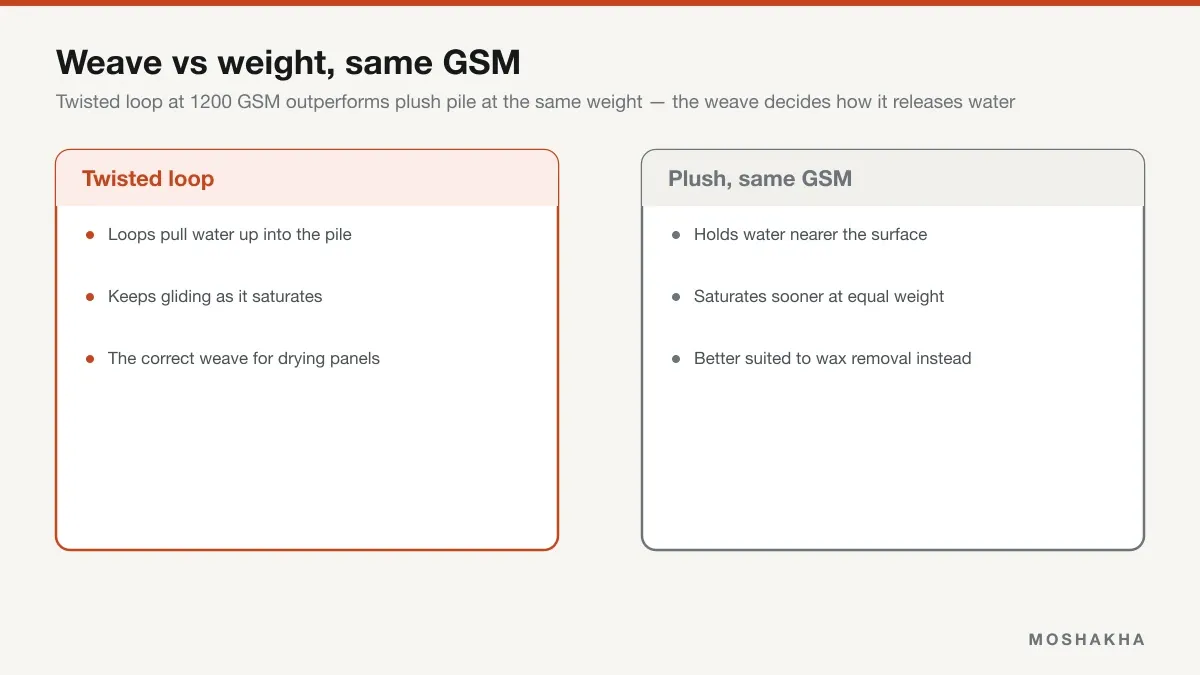
1200 GSM twisted loop is the spec most serious drying towels land on, and it’s worth understanding why that combination in particular.
The weave is the important half
GSM tells you density. The weave tells you behavior. Of the two, weave matters more here, and it’s the half that gets less attention.
Twisted loop means the fibers are twisted together into loops rather than standing as loose plush pile. Those loops create channels that draw water up into the body of the towel, away from the surface in contact with your paint.
The practical difference: a twisted loop towel keeps gliding. A plush towel of the same weight holds water nearer its surface, and once that surface is saturated it stops lifting water and starts pushing it around — which is where streaks and water spots come from.
Why 1200 specifically
1200 GSM sits at the top of the practical range for a general drying towel:
- Enough capacity to dry a sedan or mid-size SUV without wringing out
- Still light enough to handle when fully loaded
- Deep enough pile to be forgiving on paint
Push higher and you gain capacity while losing manoeuvrability and air-drying speed. Drop lower and you’ll be wringing on anything larger than a small car.
When it’s the wrong choice
On a small hatchback. You’ll never use the capacity, and you’ll fight the weight around mirrors, badges and door handles. Around 900 GSM in a smaller panel is more pleasant and just as effective.
On glass. Always. Deep pile can’t make even contact with a smooth surface, so it smears the final film of moisture. Glass wants 300–400 GSM — this is true of every drying towel and is not a fault of this one.
If you have nowhere to hang it. A 1200 GSM towel can take a full day to air-dry properly. Stored damp, microfiber develops mildew that permanently affects absorbency.
Two mid-weight towels vs one heavy one
For home use, two 900 GSM towels often beat one 1200 GSM towel. You can swap to a completely dry towel partway through, they’re easier to wring, and they launder and dry far faster.
The single heavy towel wins if you’re drying a genuinely large vehicle and want to do it in one pass without stopping.
What actually determines performance
In order:
- Weave — twisted loop for drying, always
- Blend ratio — 70/30 beats 80/20 at the same GSM
- Edge construction — suede or edgeless, never a hard stitched border
- GSM — matched to your vehicle, not maximised
Our guide to what GSM actually means covers this in full, and the drying towel guide applies it to specific products.
Frequently asked questions
Is 1200 GSM twisted loop good for drying a car?
It is the standard spec for a serious drying towel, and it suits most vehicles from a sedan upward. The twisted loop weave matters more than the 1200 figure — loops pull water up into the pile so the towel glides rather than drags.
What is twisted loop microfiber?
Long fibers twisted together into loops rather than left as loose plush pile. The twist creates channels that draw water up and away from the contact surface, which is why twisted loop towels keep gliding when plush towels of the same weight have started to smear.
Is 1200 GSM too much for a small car?
Often, yes. On a hatchback a 1200 GSM towel is heavy, slow to air-dry and awkward around mirrors and badges, and you will never use its full capacity. Around 900 GSM in a smaller panel size is easier to work with and dries a small car just as well.
How long does a 1200 GSM towel take to dry out?
Considerably longer than a thinner towel — often a full day hung with airflow. This is the main practical downside of high GSM and the reason two mid-weight towels often beat one heavy one for home use.