Blog
Is 1600 GSM Really the King of Drying Towels?
1600 GSM towels are sold as the ultimate upgrade. They are excellent on large vehicles and genuinely the wrong tool for most cars — here's the honest case.
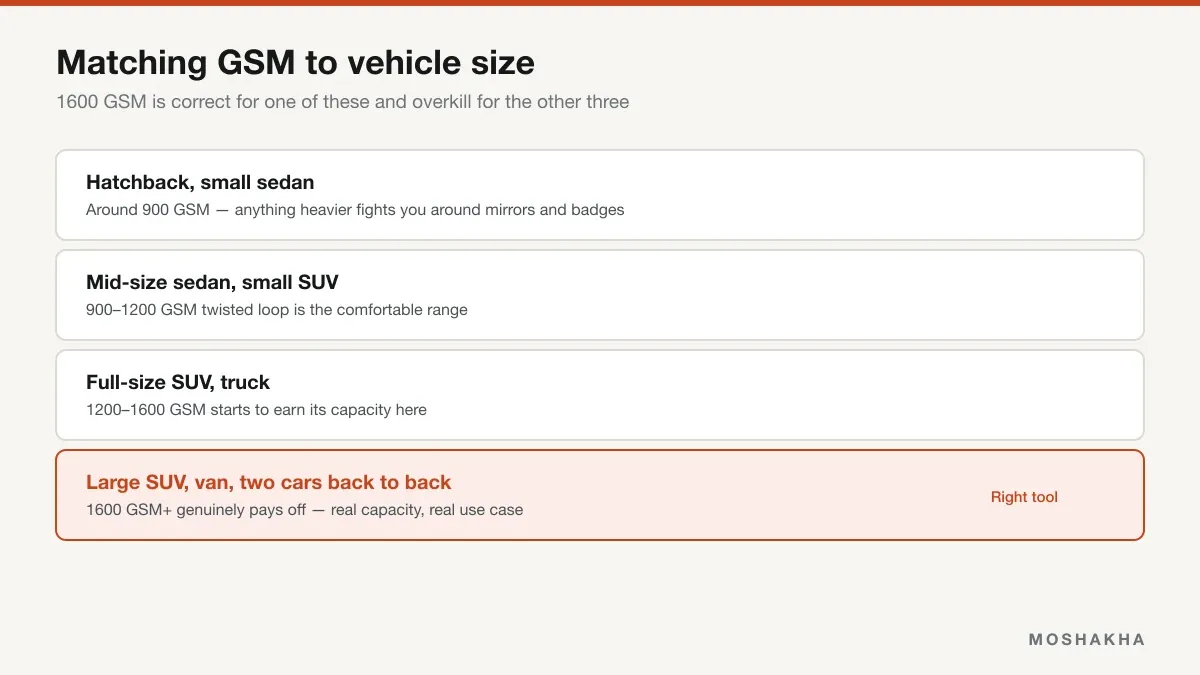
Search for drying towels and you’ll find 1600 GSM sold as the top of the range — the serious enthusiast’s choice, the “king”. It’s the biggest number on the shelf, so it must be the best one.
It depends entirely on what you’re drying.
Where 1600 GSM genuinely earns it
There are real cases for this much towel:
- Large SUVs, trucks and vans. Enough capacity to dry the whole vehicle without stopping to wring out.
- Two cars back to back. A 1600 GSM towel will still be working when a 900 GSM one has given up.
- Very wet climates, or if you’re drying after rain rather than after a wash.
If any of those describe you, this is a legitimate purchase and not a marketing trick.
Where it’s the wrong tool
Most cars. On a sedan or hatchback you will never approach the capacity limit of a 1600 GSM towel. What you will notice is the weight when it’s loaded, the bulk around mirrors and badges, and how long it takes to air-dry.
Glass. Always, without exception. The deeper the pile, the worse it makes contact with a smooth surface, and the more it smears rather than lifts. Glass wants 300–400 GSM.
Interiors. Far too clumsy for trim, screens and switchgear, and the deep pile carries grit into panel gaps.
Anywhere you need to feel the surface. Badges, vents, door shuts. A thick towel insulates your hand from what you’re doing.
The storage problem nobody mentions
A 1600 GSM towel holds an enormous amount of water and takes a long time to release it. In practice that means a full day hung somewhere with real airflow.
Stored damp — folded in a trunk, or in a bucket — microfiber develops mildew. That’s not just a smell problem: it permanently affects absorbency, and washing doesn’t reliably fix it.
If you don’t have somewhere to hang a large heavy towel properly, that’s a genuine argument for something lighter.
Why the number gets pushed so hard
GSM is a single figure that looks like a quality score and is trivial to put on a listing. It’s a good marketing asset.
The more useful specs — blend ratio, weave type, edge construction — are harder to advertise and harder to compare at a glance. And crucially, a retailer selling premium high-GSM towels has no commercial reason to publish the sentence “400 GSM is the right choice for your windows”.
That’s not a conspiracy, just incentives. But it does mean the loudest spec is the least informative one. Our GSM guide covers what to look at instead.
The honest recommendation
Buy 1600 GSM if you drive something large, or you dry more than one vehicle at a time.
Otherwise buy 900–1200 GSM twisted loop, and spend the difference on a low-pile glass towel — which will improve your results far more than the extra 400 GSM would. The drying towel guide has specific picks for both cases.
Frequently asked questions
Is a 1600 GSM towel better than 1200 GSM?
Only for large vehicles. 1600 GSM holds more water, which genuinely helps on a truck, van or full-size SUV. On a normal car it adds weight, bulk and air-drying time without giving you capacity you will ever use.
What is 1600 GSM actually good for?
Drying large vehicles in one pass, and drying two cars back to back without stopping to wring out. Those are real use cases where the extra capacity matters. For a sedan washed once a fortnight, it does not.
Why do retailers push high GSM so hard?
Because it is a single number that sounds like a quality score and is easy to advertise. A shop selling 1600 GSM towels has no commercial reason to explain that 400 GSM is the correct choice for glass. The number is a marketing asset, not a buying guide.
Can a 1600 GSM towel scratch paint?
Not because of its GSM — high-pile towels are among the more forgiving options. The risks are the same as any towel: trapped grit, fabric softener contamination, or a hard stitched edge. Weight does not make a clean towel dangerous.