Blog
Is a Bigger Drying Towel Always Better? The 60x90cm Question
Oversized drying towels promise one-pass drying. Here's when the extra size genuinely helps, and why two medium towels often beat one very large one.
“Bigger dries faster” is intuitive, and true up to a point. Past that point, size starts working against you in ways that aren’t obvious until you’re standing there with a soaking twelve-hundred-gram sheet.
Where a large towel genuinely wins
Roofs and hoods. Drape it flat and pull it across in one motion. On a large flat surface this is fast and puts almost no pressure on the paint.
Large vehicles. On an SUV, van or truck, a small towel means constant wringing — and a wrung towel never works as well as a dry one.
Drying more than one car. More capacity means fewer interruptions.
Where it works against you
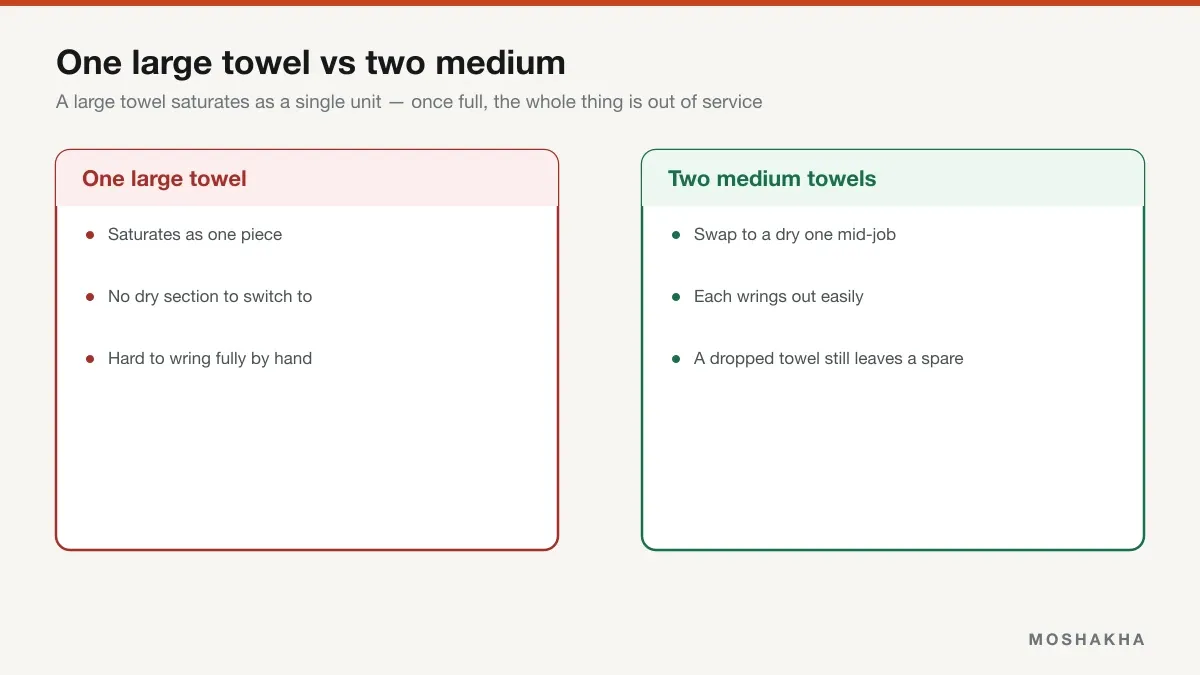
Saturation is all-or-nothing. This is the big one. A large towel soaks up as a single unit. When it’s full, the entire towel is full — there’s no dry section to switch to. Two medium towels give you a second dry one; one large towel gives you a wringing job.
Wringing is genuinely hard. A saturated 60x90cm high-GSM towel holds a lot of water and takes real effort to wring properly. Most people don’t get it fully wrung, which means they continue with a towel that’s still half-loaded.
Control around detail areas. Mirrors, badges, door handles, spoilers. A large towel is unwieldy exactly where you need precision, and the temptation is to bunch it up — which concentrates pressure into a small area, which is how marring happens.
Drying and storage. Large heavy towels take a long time to air-dry and need real hanging space. Damp storage means mildew, and mildew permanently affects absorbency.
The sizes that make sense
| Vehicle | Towel size | Why |
|---|---|---|
| Hatchback, small sedan | ~40x60cm (16x24in) | One-handed control, no wasted capacity |
| Mid-size sedan, small SUV | ~50x70cm (20x28in) | Panel in one pass, still manageable |
| Large SUV, truck, van | ~60x90cm (24x36in) | Reach and capacity genuinely needed |
The technique that matters more than size
However large your towel:
- Lay it flat and pull. Don’t rub, and don’t work in circles.
- Let it do the work. No pressure. A good drying towel needs contact, not force.
- Start at the top. Roof, glass, hood, then downward.
- Use a separate low-pile towel for glass. No drying towel of any size will leave glass streak-free.
- Drop it, retire it. A towel that’s touched the ground carries grit.
The recommendation
For most people: two medium towels rather than one very large one. You get a dry towel to switch to, easier wringing, faster laundering, and a spare if one hits the ground.
Buy the single large towel if you’re drying something big and want to do it in one continuous pass. Our drying towel guide has picks for both, and what GSM actually means covers the other half of the specification.
Frequently asked questions
What size drying towel is best for a car?
Around 40x60cm (roughly 16x24in) suits most sedans and hatchbacks — large enough to take a panel in one pass, small enough to control one-handed. Step up to 60x90cm only for SUVs, trucks and vans, where the extra reach genuinely saves passes.
Is a bigger drying towel always better?
No. A very large towel saturates as a single unit, so once it is full the whole thing is unusable until wrung out. It is also harder to wring, slower to air-dry and awkward around mirrors and badges. Bigger helps on big vehicles and hinders on small ones.
Should I buy one large towel or two medium ones?
Two medium towels, for most people. You can swap to a completely dry towel partway through, they wring and launder far more easily, and if one hits the ground you still have a clean one. One large towel is better only when drying a big vehicle in a single continuous pass.
How do I use a large drying towel properly?
Lay it flat on the panel and pull it toward you rather than rubbing in circles. On roofs and hoods you can drape it and draw it across the whole surface. Never bunch it up and scrub — that concentrates pressure and any trapped grit.