Blog
Washing a Black Car: It Shows, It Doesn't Wear Faster
Black paint isn't more fragile — it just hides nothing. The same technique that's adequate on silver becomes visible on black, which changes what's worth doing.
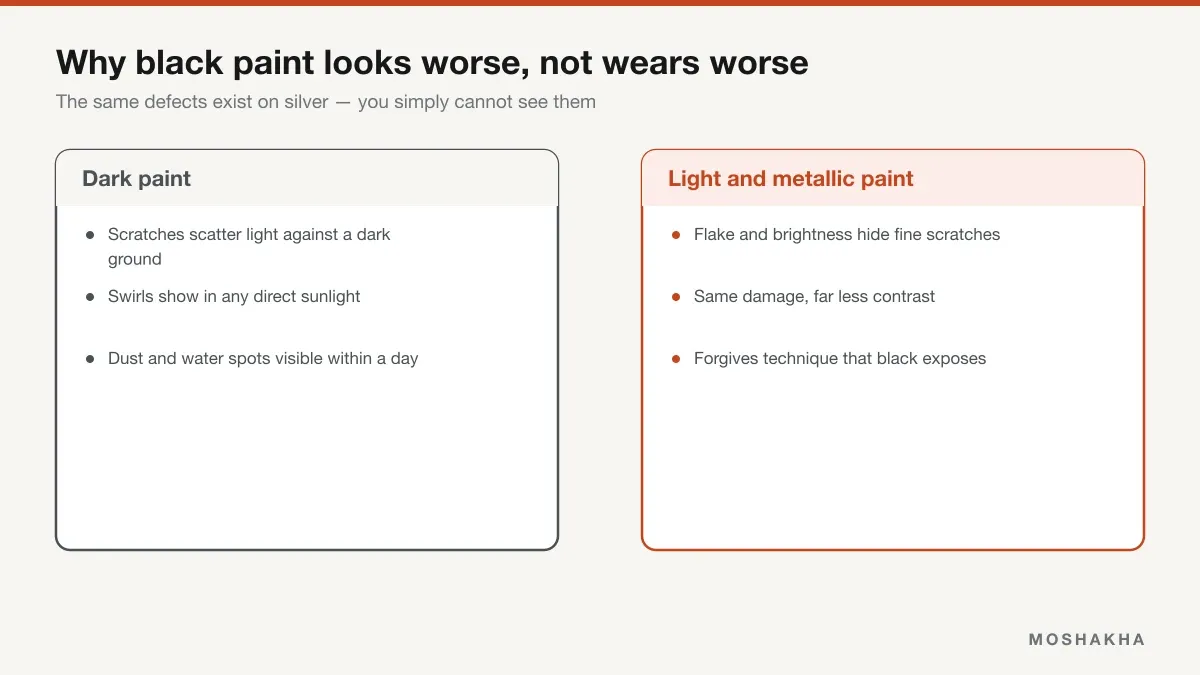
Black cars have a reputation for being fragile. They aren’t. They’re honest.
The paint isn’t softer — the contrast is higher
Paint hardness varies by manufacturer and formulation, not by color. There are hard black paints and soft white ones.
What changes is visibility. A scratch works by scattering light. Against a dark background that scattered light reads as a bright line. Against a light or metallic background — where the flake is already scattering light in all directions — the same scratch has almost nothing to contrast against.
The silver car next to yours has the same marks. You just can’t see them.
Which is why sunlight is the test
Swirl marks only appear under a point light source — direct sun, or a single overhead lamp in a car park.
Diffuse light from an overcast sky illuminates them from every direction at once, so there is no contrast and they vanish entirely. That’s why a car looks flawless in the driveway on a gray morning and dreadful at midday.
If you want to know what your technique is actually doing, inspect in direct sun. It’s uncomfortable and it’s the only honest feedback available.
The frequency trap
Black shows dust and water spots within a day, so the instinct is to wash more often.
More washing means more contact. More contact with mediocre technique means more marring — so the car that gets washed twice as often ends up looking worse, and the owner concludes black paint is delicate.
Rinse more. Contact-wash no more often than you would on any color. That’s the resolution, and it’s the same logic as pollen season, covered in pollen season car care.
The mitt matters more here
Everything in how to avoid swirl marks applies to every car. On black it applies visibly.
A mitt with deep, lofted pile holds grit away from the paint. A matted or dropped one doesn’t, and on black you’ll see the result the first sunny day afterwards.
See the wash mitt from our guideRetire mitts earlier than you would otherwise — the signals are in when to retire a wash mitt.
The single highest-value change
Use a drying aid.
Drying is the final contact step, performed on a clean panel with no lubrication left, and it’s where black paint most often picks up the fine marks people notice later.
Spraying a lubricant onto the wet panel before the towel touches it turns a dragging towel into a gliding one. It costs seconds per panel — the full mechanism is in drying aid explained.
Correction works, and isn’t free
Swirls are shallow scratches in clear coat. Polishing levels the surrounding clear coat and removes them, and on black the improvement is dramatic because the contrast was so stark.
The catch is that polishing removes clear coat, which is finite. It’s an occasional correction, not a maintenance routine — which is the argument for getting the washing right in the first place.
Frequently asked questions
Is black paint softer or more easily scratched?
Paint hardness varies by manufacturer and formulation, not by color — there are hard black paints and soft white ones. What changes with color is visibility. A scratch scatters light, and that scattering shows as a bright line against a dark background and disappears against a light or metallic one. The damage is the same; the contrast isn't.
Why does my black car look swirled only in sunlight?
Swirl marks are only visible when a point light source hits them at the right angle — direct sun, or a single overhead lamp. Diffuse light from an overcast sky illuminates them from all directions at once, so there's no contrast and they vanish. That's why a car can look flawless in the driveway and terrible in a car park at midday.
Does black paint need washing more often?
It needs washing more often to look the same, because dust and water spots are visible within a day rather than a week. That creates a trap: more frequent washing means more contact, and more contact with poor technique causes more marring. The resolution is to rinse more and contact-wash no more often than you would on any other color.
What single change helps most on black paint?
A drying aid, because drying is the last contact step and the one where marring shows most clearly. Spraying a lubricant onto the wet panel before the towel touches it turns dragging into gliding. It costs seconds per panel and addresses the step where black paint most often picks up the fine marks people notice afterwards.
Can swirl marks in black paint be removed?
Yes — swirls are shallow scratches in the clear coat, and polishing levels the surrounding clear coat to remove them. On black the improvement is dramatic precisely because the contrast was so visible. The catch is that polishing removes clear coat, so it's a correction to do occasionally and carefully rather than a routine maintenance step.