Blog
Microfiber vs Chamois: Why Chamois Fell Out of Favor
Chamois used to be the default drying tool. Here's what it actually did better, why microfiber replaced it anyway, and the one situation chamois still wins.
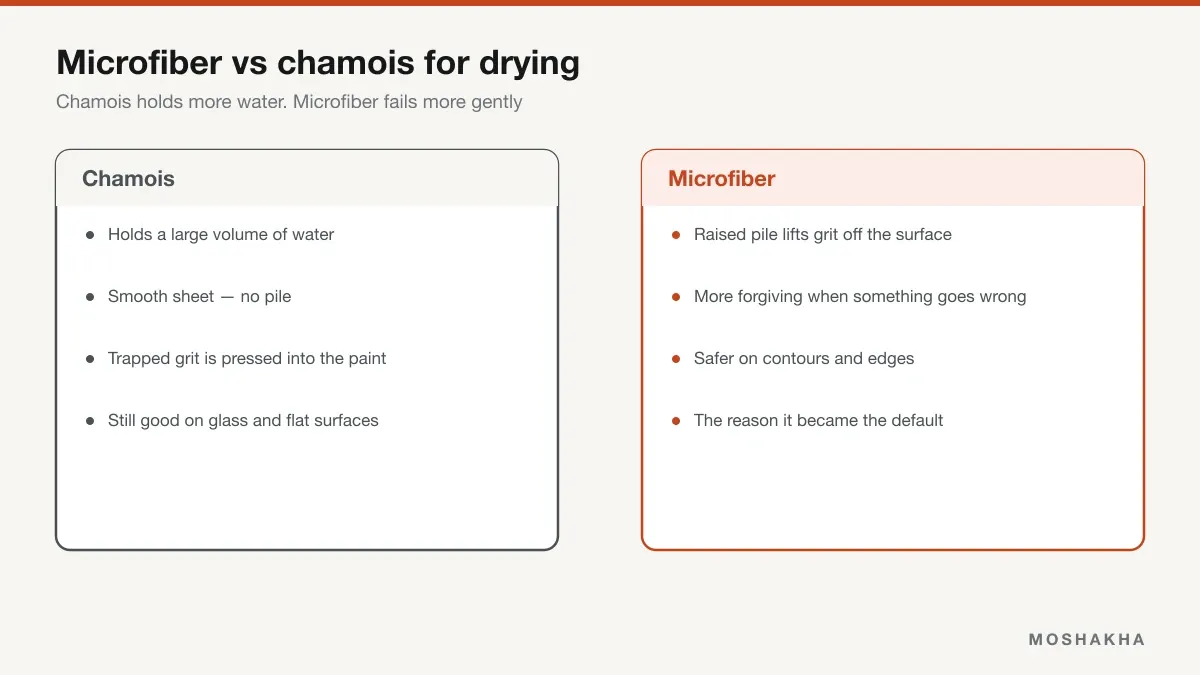
Chamois was the default car-drying tool for decades before microfiber largely replaced it. The reason isn’t that chamois stopped working — it’s that microfiber fails more gently when something goes wrong.
What chamois actually does well
A quality chamois — natural or synthetic — holds a genuinely large volume of water and wipes it away in fewer passes than most towels. Wrung out and reused, it can dry a full car with less total wiping than an equivalent microfiber towel. On pure water-holding capacity, it’s a legitimately strong tool.
Where it loses: the failure mode
The problem isn’t absorbency — it’s what happens when a chamois picks up a piece of grit mid-wipe. A chamois is a smooth, flat sheet. Grit trapped between that sheet and the paint gets dragged across the surface under real pressure, with nowhere for it to go. That’s a scratch risk on every pass, and it’s largely invisible until you inspect the paint closely afterward.
Microfiber’s raised pile changes this. The loops and fibers lift grit slightly away from direct contact with the paint as the towel moves across it, which meaningfully reduces — though doesn’t eliminate — the same risk. It’s not that microfiber never traps grit; it’s that when it does, the geometry is more forgiving.
For someone drying a car in a driveway, not stopping to inspect the towel between every pass, that forgiveness is worth more in practice than chamois’s marginal absorbency advantage.
Where chamois still makes sense
On a large, flat, lower-risk surface — a garage floor, a boat hull, a window — chamois’s raw water-holding capacity is a genuine advantage with less of the grit-trapping downside that matters specifically on car paint. The concern that pushed microfiber ahead is specific to paint safety, not a universal verdict against chamois as a material.
Natural vs synthetic chamois
Natural (leather) chamois is softer and more absorbent but needs care — it can crack if left to dry out stiff, and needs conditioning to stay usable long-term. Synthetic chamois is more durable and low-maintenance but generally holds somewhat less water per pass. Either way, the grit risk described above comes from the smooth, sheet-like design rather than the specific material.
The practical answer
For drying a car’s paint, microfiber’s safety margin is why it’s the default recommendation in best car drying towels. If you already own a good chamois, there’s no harm using it for bulk water removal on large flat panels before finishing with microfiber — just don’t let it be the last thing that touches contoured or detailed areas.
Frequently asked questions
Is chamois actually worse than microfiber at drying?
Not at the core job — a quality chamois holds a genuinely large amount of water and wipes it away in fewer passes than most towels. Where it loses is safety margin: a chamois is a single sheet with a smooth surface, and any grit trapped between it and the paint gets dragged across the surface with real pressure behind it. Microfiber's pile traps grit away from the paint instead of pressing it into contact.
Why did microfiber replace chamois as the default?
Because the failure mode is more forgiving. A chamois that picks up a piece of grit turns that pass into a scratch risk; a microfiber towel's raised pile fibers lift and hold grit slightly away from the surface being wiped, which meaningfully reduces the same risk. For most people who won't inspect the towel between every pass, that forgiveness matters more than the marginal absorbency difference.
Does chamois still have a legitimate use case?
Yes — on a large, flat surface with minimal risk of trapped grit, like a final pass on a garage floor or a boat hull, the sheer water-holding capacity of a good chamois is genuinely useful. For a car's paint, where swirl risk from trapped grit is the dominant concern, microfiber's safety margin outweighs that advantage.
Do natural and synthetic chamois behave differently?
Yes. Natural (leather) chamois is more absorbent and softer but requires more careful maintenance — it can crack if allowed to dry out stiff. Synthetic chamois is more durable and easier to care for but generally holds less water per pass. Either way, the grit-trapping risk relative to microfiber is a property of the smooth, sheet-like design, not the material specifically.
Can I use chamois and microfiber together?
Some people do — a chamois for the initial bulk water removal on large flat panels, followed by microfiber for final drying and the areas with more contours and edges. This isn't necessary for good results, but it's a reasonable way to use both if you already own a chamois.