Blog
Touchless vs Brush Car Wash: Which Risk to Take
Brush washes risk your paint, touchless washes risk your protection. Neither is strictly better — the right answer changes with the season.
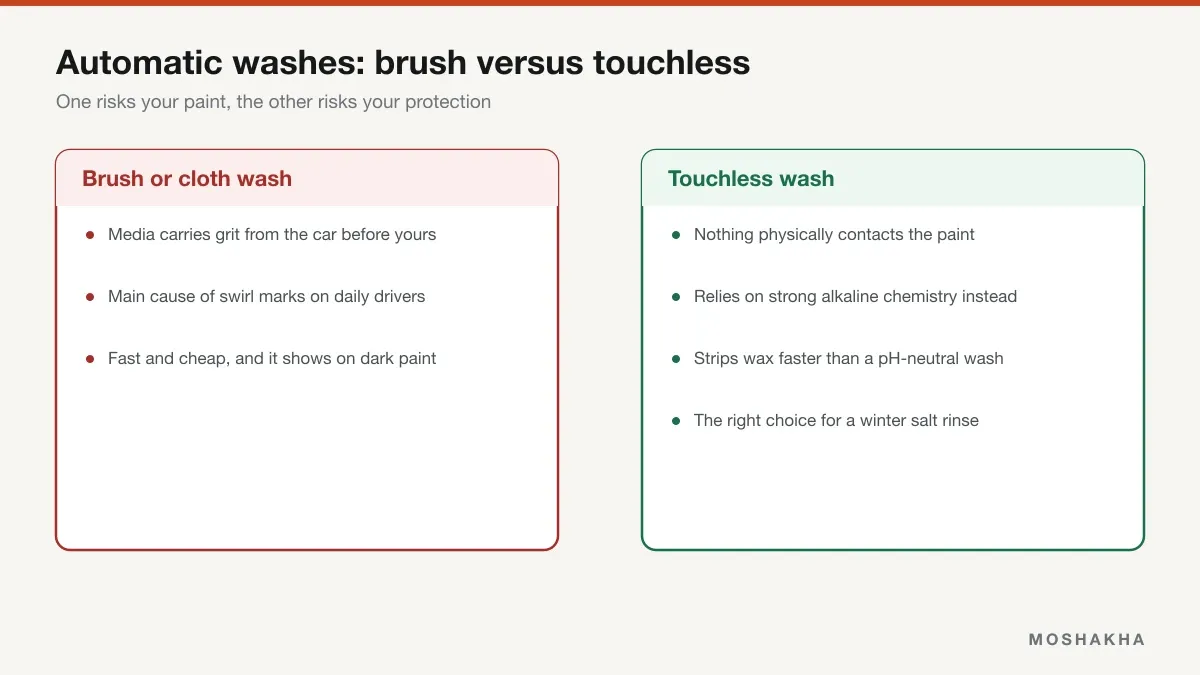
The usual advice is to avoid automatic washes entirely and hand wash everything. That’s correct in principle and unrealistic for a lot of people in February, so it’s worth understanding what each option actually costs.
Brush washes: the risk is physical
The media that touches your car touched the car ahead of you, and the one before that. Whatever grit came off those vehicles is what’s now being dragged across your paint.
That’s the mechanism behind the swirl marks that make dark cars look hazy under direct sun — the same mechanism as washing with a dropped mitt, repeated across every panel.
Modern closed-cell foam and soft-cloth systems are genuinely better than the old nylon brushes, and well-maintained sites rinse their media between vehicles. The problem is that you can’t tell which kind you’re in until afterwards.
Touchless washes: the risk is chemical
Nothing contacts the paint, so physical marring is off the table entirely.
The trade-off is that removing dirt without agitation requires chemistry to do all the work — strong alkaline pre-treatments, sometimes acidic ones. Those strip wax and sealant considerably faster than a pH-neutral hand wash does.
So you’re not choosing between risk and no risk. You’re choosing which risk: scratched clear coat, or protection that needs reapplying sooner.
Which to pick, and when
Winter, salted roads: touchless, ideally with an underbody rinse. The priority is getting salt off frequently, and the underbody spray is the part that addresses actual corrosion — covered in underbody rinsing and rust.
Ceramic-coated car: touchless. A coating handles aggressive detergent far better than wax, and its main vulnerability is exactly the marring a brush wash causes.
Dark paint you care about: neither, if you can avoid it. Black shows brush marring more than any other color — how to wash a black car covers why that’s a visibility problem rather than a durability one.
Summer, time available: hand wash. Nothing automatic matches it.
See the shampoo from our soap guideTouchless doesn’t fully clean
Worth being honest about the limitation. Without agitation, touchless struggles with bonded road film and the grimy band along the lower panels.
It removes loose dirt and salt well — which is the job that matters in winter. But a car washed only touchless for months accumulates a film that eventually needs contact washing to remove, so it works best as a winter routine punctuated by proper washes, not as a permanent replacement.
Avoid the self-service brush
The spinning brush at a coin-operated bay is usually worse than an automatic tunnel, because it sits in a bucket or on the floor between uses and collects grit from everyone who used it before you.
Use the pressure lance and your own mitt. Leave the supplied brush where it is.
If you do use a brush wash
Rinse the car yourself first if there’s a pre-rinse bay available — less grit going into the brushes means less being dragged across your paint. And accept that on dark paint the result will show, which is the trade you knowingly made for the time saved.
The technique that avoids all of this is in how to avoid swirl marks.
Frequently asked questions
Do automatic car washes actually scratch paint?
Brush and cloth washes can, and the mechanism is simple: the media that touches your car touched the car before yours, and carries whatever grit came off it. Modern closed-cell foam and soft-cloth systems are far better than the old nylon brushes, and well-maintained sites rinse their media — but you have no way to know which kind you're in until afterwards.
Is touchless completely safe for paint?
Safe from physical marring, yes, because nothing contacts the surface. The trade-off is chemical: touchless washes rely on strong alkaline and sometimes acidic pre-treatments to lift dirt without agitation, and those strip wax and sealant faster than a pH-neutral hand wash. You're trading scratch risk for protection life.
Which is better for a car with a ceramic coating?
Touchless, comfortably. A coating is chemically durable enough to handle the stronger detergents far better than wax is, and its main vulnerability is physical marring — which is exactly what a touchless wash avoids. For a coated car used in winter, touchless with an underbody rinse is a sensible routine.
Are touchless washes actually effective at cleaning?
Less so than contact washing, which is the honest limitation. Without agitation they struggle with bonded road film and the grimy band along the lower panels. They remove loose dirt and salt well, which is the job that matters in winter, but a car washed only touchless for months will accumulate a film that eventually needs contact to remove.
What about the spinning brushes at self-service bays?
Those are usually worse than an automatic tunnel, because the brush sits in a bucket or on the floor between uses and collects grit from whoever used it last. If you're using a self-service bay, use the pressure lance and your own mitt, and leave the supplied brush alone.