How-To Guides
How to Clean Exhaust Tips (Check the Finish First)
Metal polish transforms a stainless tip and permanently ruins a black or ceramic-coated one. Identify the finish before anything abrasive touches it.
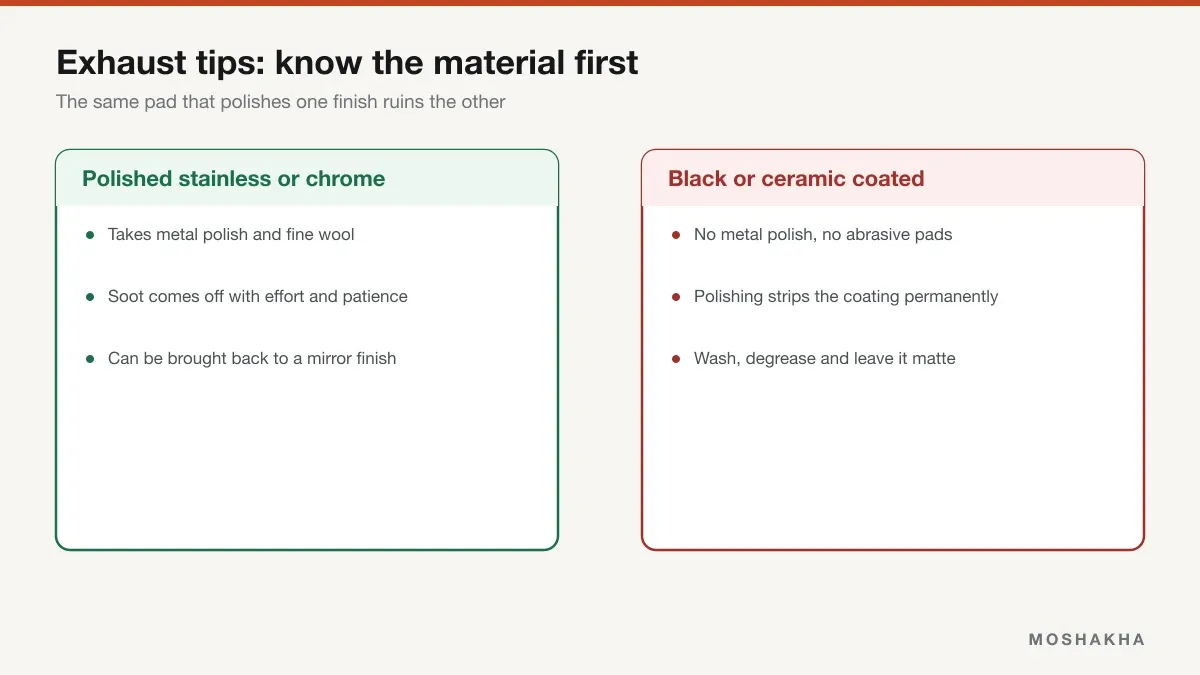
Exhaust tips are the one exterior detail where the wrong product causes damage that cannot be undone — and the two common finishes want opposite treatment.
Cold, first and always
This isn’t a paint-safety caution. Exhaust tips hold heat long after the engine is off, and a soot layer hides how hot the metal underneath still is.
If you’ve been driving, leave it overnight.
Identify the finish before anything abrasive
Polished stainless or chrome — bright, reflective, takes metal polish and fine steel wool. These can be brought back to a mirror finish with effort.
Black, matte or ceramic-coated — increasingly common as a factory fitment. Polish strips the coating, exposing the metal beneath, which then discolours unevenly with heat. There’s no way back from that short of re-coating.
If you can’t tell, assume coated and stay non-abrasive. The cost of being wrong in that direction is a tip that stays matte. The cost of being wrong the other way is a ruined finish.
Degrease first — it’s often the whole job
Much of what reads as permanent staining is oily soot sitting on the surface.
A degreaser or alkaline wheel cleaner plus a brush removes it, and on plenty of tips that alone gets you to a result you’re happy with. Doing this before reaching for abrasives tells you how much work actually remains.
See the wheel brushes from our guideAvoid acidic wheel cleaners here, for the same reason they’re wrong on polished wheels — they attack stainless and any coating present. The pH argument is in wheel cleaner pH.
For stainless, work in stages
Metal polish on a cloth first. If baked carbon resists, move to fine steel wool using the polish as lubricant, working with the direction of any existing grain.
Expect the cloth to come away black repeatedly before it starts lightening. That’s normal — you’re removing layers of carbon, not polishing metal, until quite late in the process.
These tools never touch paint again
Exhaust soot is oily and carbon-loaded. Steel wool sheds fine particles that will scratch anything they contact afterwards.
Keep a dedicated brush for this job, store it away from the paint and wheel tools, and throw the towels away rather than laundering them with everything else. Same separation discipline as wheels, covered in wheel and rim care.
On blue and gold tinting
That’s heat discoloration in the stainless itself rather than a deposit — the surface oxide layer changing under sustained high temperature.
Light tinting sometimes reduces with polish. Heavy tinting is effectively permanent, and it’s normal rather than a fault.
Frequently asked questions
Can I use steel wool on exhaust tips?
On bare polished stainless or chrome, fine grade steel wool with polish as a lubricant is standard practice and works well. On black, matte or ceramic-coated tips it destroys the finish permanently. The crucial step is identifying which you have before you start, because the damage is not recoverable.
Why do my exhaust tips turn blue or gold?
Heat discoloration in the stainless itself, not a deposit. Sustained high exhaust temperatures change the surface oxide layer and produce blue, gold or straw tinting. Light discoloration can sometimes be reduced with metal polish, but heavy heat tinting is effectively permanent and is generally considered normal rather than a fault.
Will wheel cleaner work on exhaust tips?
An alkaline wheel cleaner or degreaser works well on the oily soot layer, which is often most of the problem. Avoid acidic wheel cleaners on exhaust tips — they attack stainless finishes and any coating present, for the same reasons they are the wrong choice on polished wheels.
How do I stop them getting sooty again?
You largely cannot — soot is combustion residue and it will return. What helps is cleaning them regularly enough that the deposit never bakes on hard, and applying a metal sealant to polished stainless, which slows the build-up and makes the next clean much faster. Diesels and direct-injection petrol engines soot up faster than others.
Are exhaust tip cleaning products worth buying?
A dedicated metal polish is worth having if your tips are bare stainless, because it works considerably better than a general-purpose cleaner on baked carbon. For coated tips, no specialist product is needed — degreaser and a brush is the correct and complete answer, and anything stronger is a risk rather than an upgrade.