How-To Guides
How to Install a Dash Cam: Hardwire vs 12V Socket
The 12V socket is the easy option and the wrong one for parking mode. What hardwiring actually involves, and how to decide which one your setup needs.
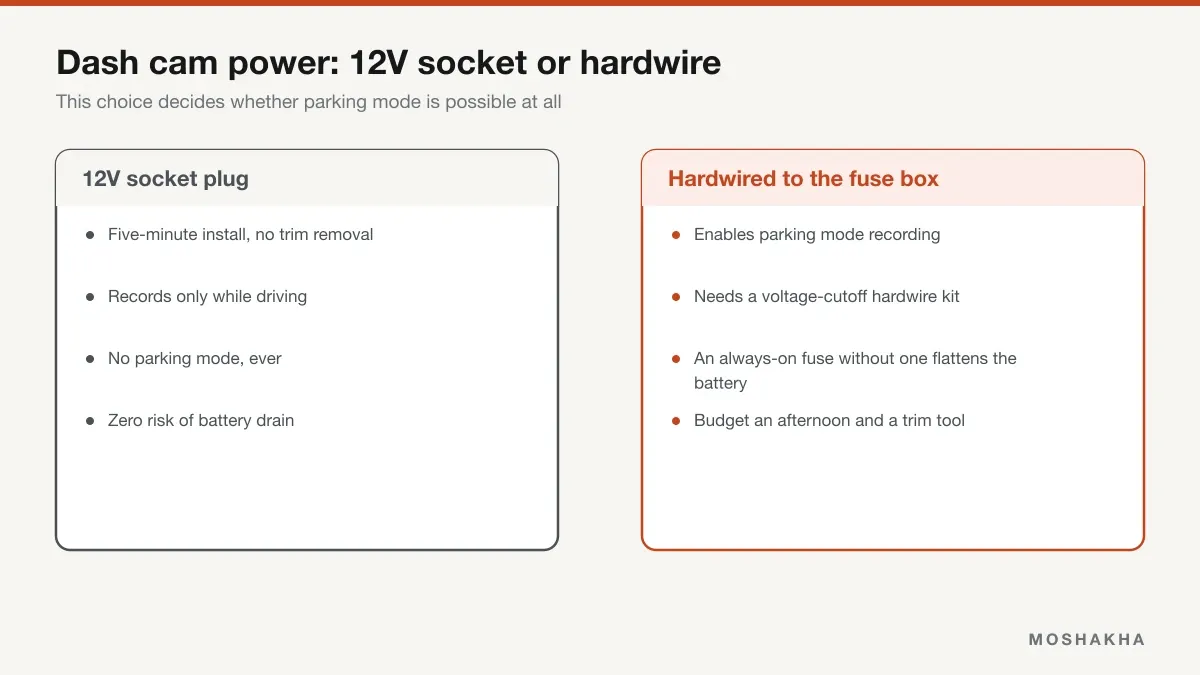
The install itself isn’t the hard part — mounting a camera to glass and running a cable is straightforward either way. The decision that actually matters is hardwire or 12V socket, because it determines whether your dash cam can protect you while parked.
The decision that comes before the install
A 12V socket plug powers the camera only when the car is running, or when the ignition is in accessory/on position. Five-minute install, zero risk of draining the battery, and zero parking-mode recording. If someone hits your parked car, it isn’t recording.
Hardwiring to the fuse box is what enables parking mode — recording (or motion- triggered recording) while the car is off. It takes longer, involves trim panels, and if wired to the wrong kind of fuse, can drain your battery.
If you don’t care about parking-mode footage, the 12V socket is the correct choice and you can skip straight to mounting. If you want it, hardwire — there’s no version of a 12V plug that gives you parking mode.
See the dash cam we reference in this guideIf you don’t have a dash cam yet, our top pick from best dash cams uses a supercapacitor rather than a lithium battery — worth knowing before you wire anything, since supercapacitors tolerate the heat of a closed, parked car far better than lithium cells do, and that’s specifically relevant if you’re about to hardwire for parking mode.
The always-on-fuse mistake
This is the mistake that actually costs people a flat battery: tapping an always-on fuse with a plain fuse-tap kit and no voltage-sensing hardwire kit. The camera draws a small but constant current, and over a parked weekend that adds up to a battery too flat to start the car.
The fix is one of two things: tap a switched fuse (powered only with the ignition on — parking mode won’t work, but the battery is safe), or use a proper hardwire kit with a built-in low-voltage cutoff, which powers parking mode until the battery reaches a safe threshold and then cuts off automatically.
Grounding matters more than it looks like it should
A dash cam hardwire kit needs a ground connection, and the temptation is to screw it into whatever metal is closest. Use an existing factory ground point instead — most cars have several accessible under the dash or behind a kick panel. A poor ground causes intermittent recording dropouts that look like a camera fault and are actually a wiring fault, which makes them much harder to diagnose after the install is buttoned up.
Before you close the trim back up
Test the install with the trim off first, confirm the camera powers on and records, then reassemble. Testing only after full reassembly means any wiring mistake costs you a second trim removal to fix it.
Once it’s back together, park, lock the car, and confirm parking mode actually triggers as expected — in your driveway, not after the incident it was supposed to catch.
Frequently asked questions
Is hardwiring a dash cam hard?
It's more involved than a 12V plug, but within reach for most people comfortable with basic trim removal — no cutting or soldering is typically required with a fuse tap kit. Budget closer to 45 minutes than the 5 minutes a socket install takes, mostly spent routing cable and reassembling trim.
Will hardwiring drain my car battery?
Only if wired incorrectly. Tapping an always-on fuse without a voltage-sensing hardwire kit will drain the battery over a parked weekend. Either tap a switched fuse (power only with ignition on, which disables parking mode) or use a hardwire kit with built-in low-voltage cutoff, which is the standard solution for keeping parking mode without a dead battery.
Do I need a professional to install a dash cam?
Not for a 12V socket install — that's plug and go. For hardwiring, most people can do it themselves with a trim tool and a fuse tap kit, though a professional install avoids any risk of damaging trim clips or wiring into the wrong fuse. If you're not confident identifying a switched fuse, that's the point to pay someone.
Where should the dash cam be mounted?
Centered and high, tucked behind the rearview mirror, so it's out of the driver's direct line of sight while still capturing a clear forward view. Avoid mounting low on the dash — it captures more hood and less useful road ahead, and sits in a spot more likely to obstruct visibility.
Can I install a rear camera myself?
Yes, though it means running cable the length of the car to the tailgate or rear window, typically along the headliner and down a rear pillar. Budget extra time for this over a front-only install — it's the same principles, just a longer cable run through more trim panels.