Reviews
VIOFO A129 Plus Duo Review: Two Channels Beat More Pixels
A rear camera covers the collision a front-only dash cam misses entirely. Why the second channel matters more than resolution, and what the install really costs.
Moshakha is reader-supported. When you buy through links on our site, we may earn an affiliate commission at no extra cost to you. How we make money.
Pros
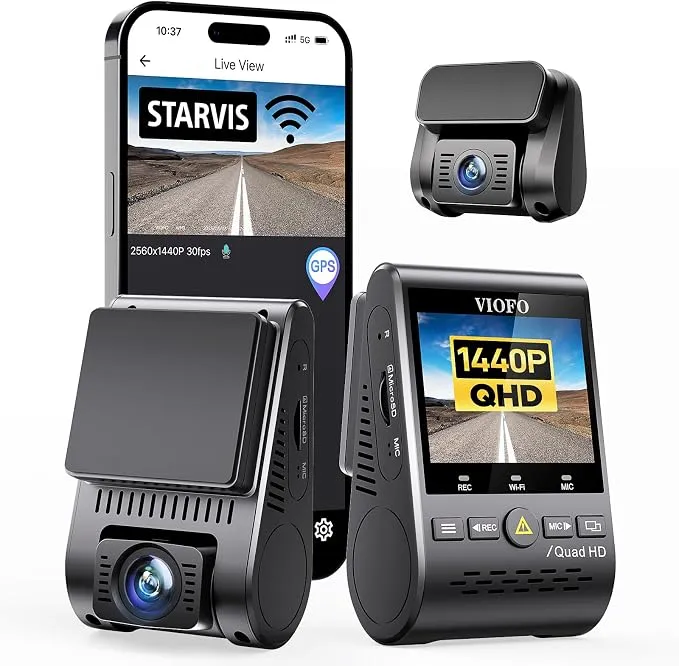
- Front and rear coverage — the actual gap in most setups
- Supercapacitor, not a lithium battery, so summer heat doesn't degrade it
- Buffered parking mode captures the moments before an impact, not just after
- Wi-Fi and GPS for pulling footage and logging speed and location
Cons
- Two-camera install means running cable to the tailgate — plan an afternoon
- Parking mode needs hardwiring to a fuse box, not the 12V socket
- App is functional rather than polished
Dash cams compete on resolution because it’s the number that prints well. This one earns its place on a different spec entirely.
The second channel is the product
A front-only dash cam records the incident you drove into. It records nothing at all when someone goes into the back of you — which is a large share of contested collisions, and the ones where fault is most often disputed.
2K front plus 1080p rear covers that. You are not buying more pixels; you are buying coverage of a failure the sharpest single camera physically cannot see.
That framing matters when comparing against a 4K single-channel camera at similar money. The 4K unit gives you more detail of the thing you were already recording. This gives you footage of the thing you weren’t.
2K front is enough
Enough to read a plate at sensible distance, which is the job.
Resolution beyond that mostly fills memory cards faster and generates more heat on a windshield. What actually determines whether a plate is legible is sensor quality and light — and the A129 Plus is competent rather than exceptional there, which is the honest trade for having two channels at this price. If night performance on a single channel matters more to you, the A119 Mini 2 has the newer sensor.
Supercapacitor, not battery
Non-negotiable in a dash cam, and this has one.
A camera stuck to a windshield in summer reaches temperatures that degrade lithium batteries quickly, with a small but real swelling risk. A supercapacitor only needs to hold enough charge to close the current file cleanly when power drops, and it tolerates heat far better. Every pick in best dash cams uses one for this reason.
Where the cost actually lands
Not the price — the install.
Running cable to the tailgate means tucking it along the headliner, down a rear pillar, and usually through a rubber grommet into the tailgate itself. It is within reach for most people with a trim tool, and it is an afternoon rather than ten minutes.
Then, if you want parking mode, there’s hardwiring on top — the 12V socket won’t do it, because most cars cut that with the ignition. The full decision is in how to install a dash cam.
Pair it with the right card
Two channels roughly double the write rate, which halves your loop length.
A standard photography card will fail under continuous overwriting, and it fails silently — the camera keeps appearing to record while producing unreadable files. Size up and buy endurance-rated: dash cam memory cards.
Should you buy it?
Yes, if you want the rear coverage and you’re willing to spend an afternoon on the install. That’s the honest summary — the hardware is good and the labour is real.
No, if you want something fitted in ten minutes, or your priority is the best possible single-channel night footage rather than two channels of good footage.
And whichever you fit, know what to do in the first minutes after an incident — the loop is already overwriting it. That’s in saving dash cam footage after an incident.
Frequently asked questions
Is the rear camera actually worth it?
It's the main reason to choose this over a single-channel camera. A significant share of disputed incidents are rear-end collisions, and a front-only camera records nothing useful when someone hits you from behind. No amount of front resolution covers that gap — only a second channel does. If you're deciding between higher front resolution and adding a rear camera, the rear camera is the better spend.
Why a supercapacitor instead of a battery?
A dash cam lives on a windshield, where summer interior temperatures get extreme. Lithium batteries degrade badly under sustained heat and carry a small but real swelling risk. Supercapacitors tolerate heat far better and last longer. The capacitor only needs to hold enough charge to close the current file safely on power loss, which is all a dash cam actually requires.
How hard is the two-camera install?
Harder than a single camera, mainly because of the cable run to the tailgate. You're tucking cable along the headliner, down a rear pillar, and usually through a rubber grommet into the tailgate itself. It's within reach for most people with a trim tool and patience, but it's an afternoon rather than ten minutes — and that's before hardwiring for parking mode.
Do I need to hardwire it for parking mode?
Yes. The 12V socket cuts power with the ignition on most cars, so parking mode needs a hardwire kit to the fuse box with a voltage cutoff. Without the cutoff, the camera will flatten the battery over a long weekend. There's no version of parking mode that works from the cigarette socket alone.
What memory card should I use with it?
A high-endurance card, and size it for two channels. Running front and rear roughly doubles the write rate, which halves your loop length compared with a single camera. A 256GB endurance-rated card is a sensible pairing; a standard photography card will fail silently under continuous looping, usually discovered at the worst moment.