Reviews
VIOFO A119 Mini 2 Review: The Sensor Is the Upgrade
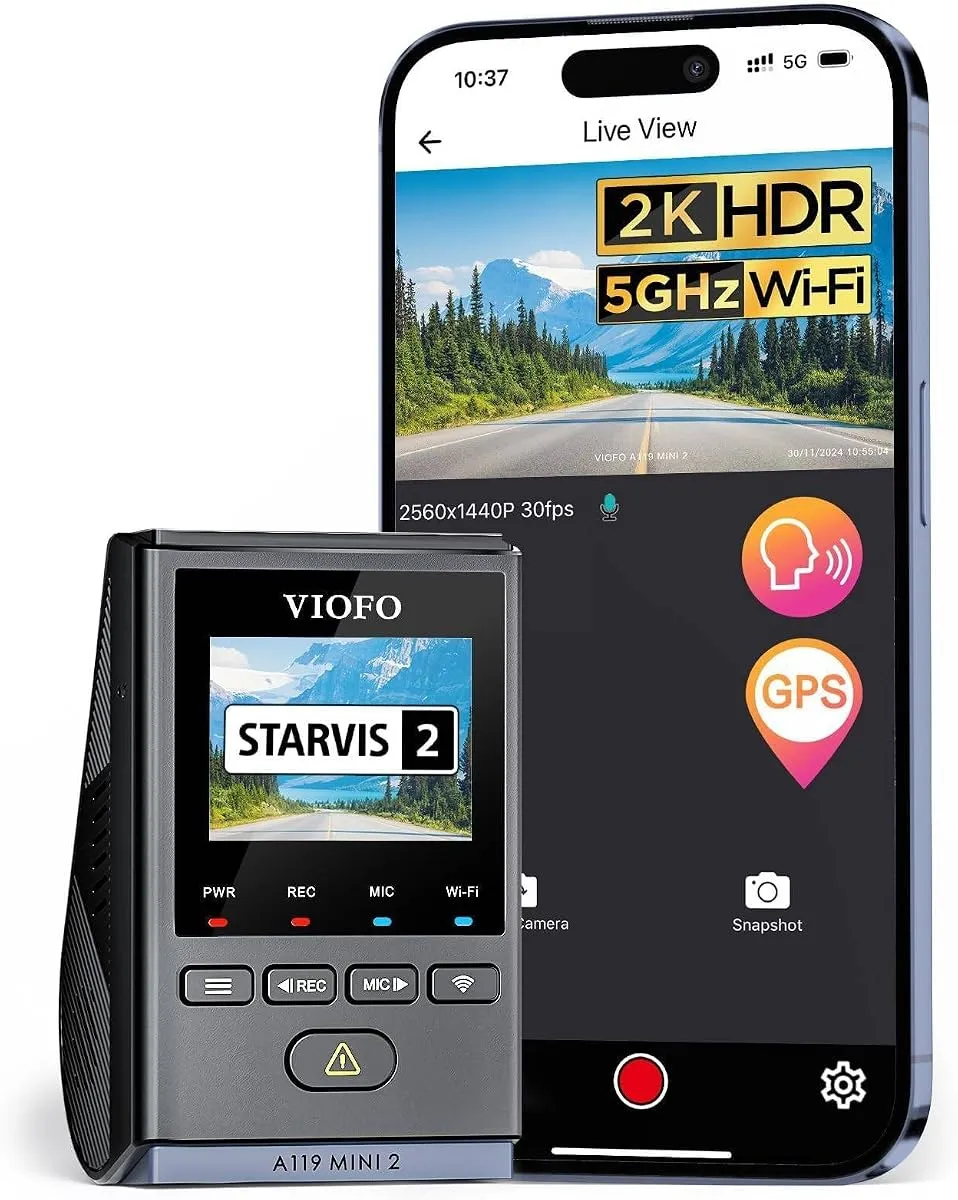
STARVIS 2 is the spec worth paying for, because almost all footage that matters is shot in poor light. Small, discreet, and front-only — which is the catch.
Moshakha is reader-supported. When you buy through links on our site, we may earn an affiliate commission at no extra cost to you. How we make money.
Pros
- STARVIS 2 sensor — the spec that actually improves usable footage
- Very compact; genuinely hides behind the rear-view mirror
- 60fps helps freeze plates on oncoming vehicles
- Voice control and 5GHz Wi-Fi for quick footage transfer
Cons
- Front only — no rear coverage, which is where many disputes happen
- No screen, so framing depends entirely on the phone app
Most dash cam marketing is a resolution number. This one is worth buying for a spec most listings bury.
The sensor, not the pixels
Think about when dash cam footage actually matters: dusk, rain, an unlit road, oncoming headlights. Almost never bright daylight, where any camera copes.
Those are exactly the conditions that defeat a cheap sensor. And no resolution fixes it — a 4K camera with a weak sensor gives you more pixels of the same unreadable smear.
STARVIS 2 is a genuine generational improvement in low-light gathering. That’s why this sits above higher-resolution cameras in best dash cams despite recording “only” 2K.
60fps earns its place
Not for smoothness — for freezing plates.
At 30fps, a plate on a car approaching at combined highway speed can blur across every frame it appears in. 60fps doubles your chances of catching a clean one. It matters on fast roads and barely at all in town.
It’s genuinely small
Small enough to sit behind the rear-view mirror and effectively disappear, which has two benefits: it stays out of your sightline, and it’s far less visible to anyone looking into a parked car.
The absence of a screen is part of how it gets that small. Framing is done through the phone app once, and then you don’t touch it again — which is the normal life of a dash cam anyway.
The catch, stated plainly
It’s front-only.
That’s not a flaw in the camera, it’s a category decision, and it’s the one thing worth thinking hard about. A front camera records the incident you drove into. It records nothing when someone hits you from behind, which is a large share of disputed collisions.
If that gap matters more to you than night performance, the A129 Plus Duo is the other answer at similar money — two channels, older sensor.
Should you buy it?
Yes, if you want the best single-channel footage in poor light, in a unit nobody notices, and you’re content with front coverage only.
No, if rear coverage is the thing you actually want. Buy the Duo instead; a better sensor doesn’t help with a collision it can’t see.
Either way, pair it with an endurance-rated card — standard cards fail silently under continuous looping. Sizing is in dash cam memory cards, and the install decision is in how to install a dash cam.
Frequently asked questions
What does the STARVIS 2 sensor actually change?
Low-light capability, which is where dash cam footage is most often needed and most often useless. Dusk, rain, unlit roads and oncoming headlights are the conditions that defeat cheap sensors, and no amount of resolution fixes a sensor that can't gather light. A 2K camera with STARVIS 2 routinely produces more readable footage than a 4K camera with an older sensor.
Is 2K enough, or should I get 4K?
2K with a good sensor is the sweet spot, and 4K is mostly a number. Higher resolution fills memory cards faster, generates more heat on a windshield, and produces files awkward enough that people stop pulling footage off. The variable that determines whether you can read a plate is sensor and lens quality in poor light, not pixel count.
Does no screen make it hard to set up?
It makes initial framing a two-step job — you position it, check the view in the phone app, adjust. After that you rarely touch it. The absence of a screen is partly why it's so small, and a dash cam you never look at doesn't especially need one. It's a reasonable trade for the size.
Why would I choose this over the dual-channel A129 Plus Duo?
Choose this if you want the best single-channel night footage in the smallest package, and you accept no rear coverage. Choose the Duo if rear coverage matters more than sensor quality — rear-end collisions are a large share of disputed incidents, and no front camera records them. They're solving different problems at similar money.
What's the 60fps for?
Motion clarity on fast-moving subjects. At 30fps, a plate on an oncoming car at closing speed can blur across frames enough to be unreadable. 60fps gives you more individual frames to find a clean one in. It matters most on faster roads, and less in town.