How-To Guides
How to Replace a Cabin Air Filter (Usually 10 Minutes)
It's behind the glovebox on most cars, needs no tools, and is almost certainly overdue. The one detail people get wrong is fitting it the wrong way round.
This is the cheapest meaningful improvement you can make to a car’s interior, it takes about ten minutes, and on most vehicles it needs no tools at all. It’s also the maintenance item people are least likely to have ever done.
Where it is
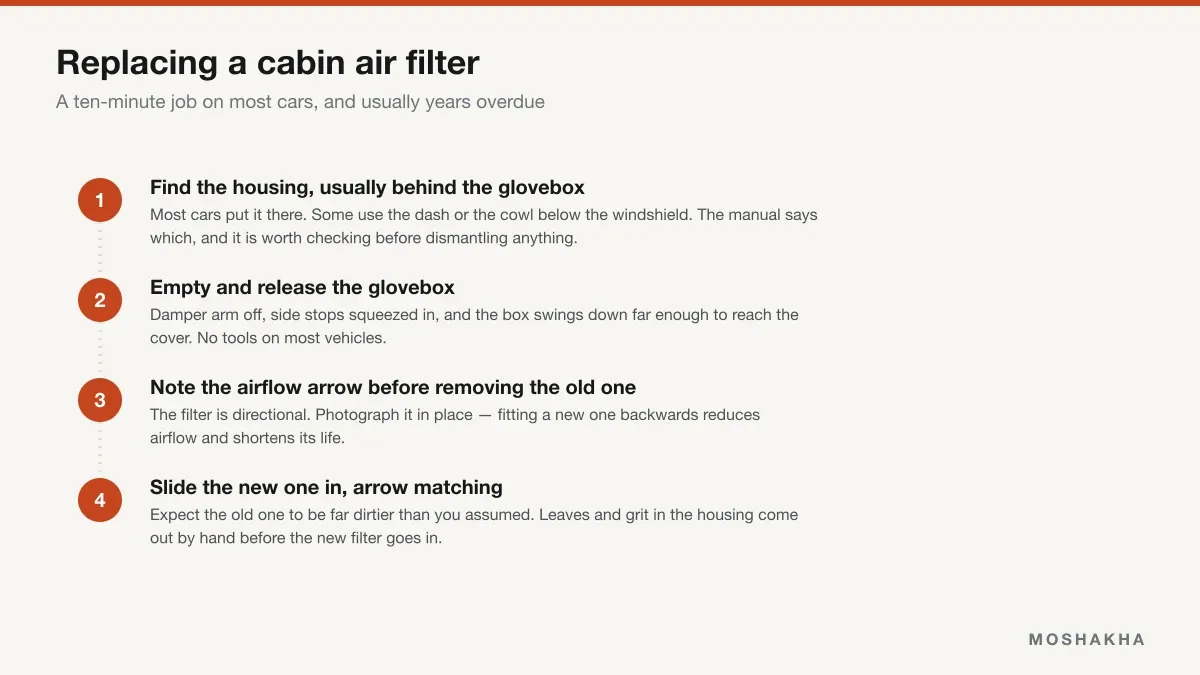
Behind the glovebox, on the large majority of cars. A minority put it under the dash on the passenger side, or up in the cowl area beneath the windshield where the wiper arms sit.
Check the manual before dismantling anything. Two minutes of reading saves taking apart a panel that was never hiding a filter.
Getting the glovebox out of the way
This is the part that looks intimidating and isn’t. Empty it completely, then find the damper arm — a small rod or fabric strap on one side that stops the box dropping too far. Unclip it.
Then squeeze the side walls of the glovebox inward with both hands. The molded stops clear the frame and the whole box swings down, exposing a rectangular plastic cover.
Nothing here is fragile in the way it feels. The plastic is designed to flex for exactly this job.
Photograph the old one before it comes out
There’s an airflow direction arrow printed on the filter’s frame. The new one has to point the same way.
A photo takes two seconds and removes any doubt later. Fitted backwards, the filter still works — but with reduced airflow and a shorter life, because the pleat structure loads from one face by design.
Expect it to be worse than you thought
Pull it out slowly and tip it downward as it clears the housing, so the debris it’s carrying falls into the footwell rather than back into the ductwork.
Most first-time replacements come out gray or brown, packed with leaf fragments and seed cases. That’s not neglect on your part so much as an item nobody mentions at service time.
While the housing is open, run a crevice tool along the bottom of it. Debris collects there and loads the new filter prematurely.
See the interior brushes from our guideA soft brush is useful for the housing edges and the vent slots nearby, where a vacuum nozzle alone bridges over the gap.
If the smell doesn’t go away
A new filter fixes a filter-shaped problem. If the smell specifically appears when the air conditioning starts, the likely source is mold on the evaporator behind the dashboard — which is downstream of the filter and unaffected by replacing it.
That distinction, and what actually does fix it, is covered in car air purifiers: check the cabin filter first.
Frequently asked questions
How do I know if my cabin air filter needs changing?
Pull it out and look — that's genuinely the only reliable test. A filter due for replacement is visibly gray or brown rather than white, often with leaf fragments and seed cases caught in the pleats. Symptoms like reduced fan airflow, a musty smell when the fan starts, or windows demisting slowly all point at it, but the visual check settles it in a minute.
How often should a cabin air filter be replaced?
Most manufacturers suggest between 12,000 and 20,000 miles or annually, but the interval matters far less than the fact that most cars have never had one changed. Dusty roads, heavy traffic and parking under trees all shorten it. If you don't know when yours was last done, it's overdue.
Does it matter which way round the filter goes?
Yes. There's an airflow direction arrow printed on the filter frame, and it needs to point the same way the old one did — normally downward or toward the blower. A filter fitted backwards still filters, but airflow is reduced and it loads up faster, because the pleats are designed to collect on one face.
Are carbon or HEPA-style cabin filters worth the extra?
Activated carbon versions add odour absorption, which genuinely helps in heavy traffic or if exhaust smell enters the cabin. Higher-grade particulate filters help if you have pollen allergies. Both restrict airflow slightly more than a basic filter, and both cost more — reasonable upgrades, but a clean basic filter beats a clogged premium one every time.
Can a dirty cabin filter cause a smell?
It can be the source, or it can be carrying a smell from elsewhere. A filter loaded with damp organic debris develops its own musty odour. But if the smell appears specifically when the air conditioning starts, the more likely cause is mold on the evaporator behind the dash, which a new filter won't fix on its own.