Blog
Car Air Purifiers: Check the Cabin Filter First
Before buying a 12V purifier, replace the cabin air filter most people have never touched. It's cheaper, it's usually overdue, and it does more.
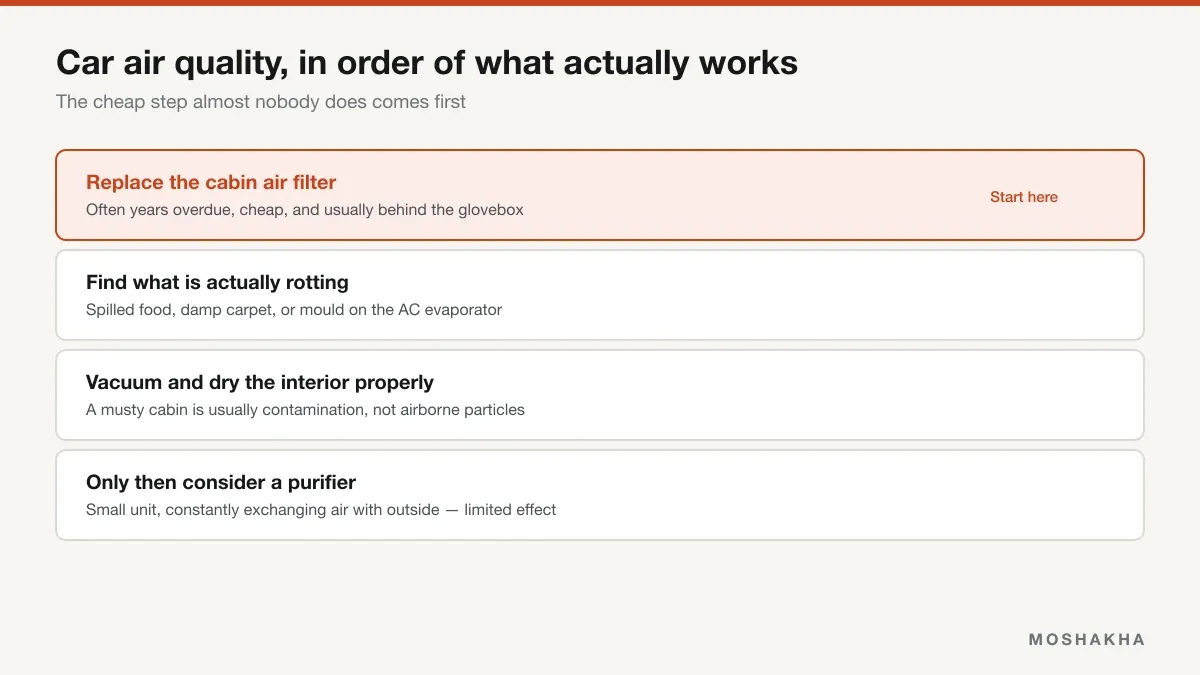
We set out to write a buying guide for car air purifiers. What the research turned up was that the category is thin, most of what’s sold is small and low-powered, and the thing that would actually improve the air in most cars costs less and is already fitted to the vehicle.
So this is that article instead.
The filter you already have
Nearly every car built since the early 2000s has a cabin air filter — a pleated filter cleaning the air that enters through the ventilation system. It sits behind the glovebox on most cars, sometimes under the dash or beneath the windshield cowl.
Most people have never replaced theirs.
A filter that’s been in place for five years is loaded with dust, pollen, leaf debris and whatever else the intake pulled in. That does two things: it restricts airflow, which is why the fan seems weaker than it used to be, and it stops filtering effectively, which is the actual air quality problem.
Replacing it is cheap, usually takes a few minutes, and on many cars needs no tools — a couple of clips behind the glovebox. If you don’t know when yours was last changed, it’s overdue.
Why a purifier struggles in a car
The physics are unfavourable, and it’s worth being clear about why.
An air purifier in a sealed room gets to work on the same air repeatedly, cleaning it a little more each pass. A car doesn’t work like that. While you’re driving, the cabin exchanges air with the outside continuously — through the ventilation system and around door seals — so a small 12V unit is trying to clean air that’s being replaced faster than it can process it.
That’s a much harder problem than the same device faces at home, and it’s why a fresh filter on the intake outperforms a purifier working on air that’s already inside.
If the complaint is a smell, a purifier is the wrong tool
This is the most common reason people buy one, and the most common reason they’re disappointed.
Musty smell when the AC starts is usually mold or bacteria on the evaporator, which sits wet and dark behind the dashboard. That smell is generated downstream of any purifier and blown directly at you. The fixes are a new cabin filter, an evaporator cleaner sprayed into the intake, and running the fan without AC for the last few minutes of a drive so the evaporator dries out.
Persistent stale or sour smell is usually contamination in the interior itself — spilled drink in carpet, food under a seat, damp that never dried. A purifier masks nothing here; the material is still there generating odour.
See the car vacuum we reviewedFinding and removing the source is the fix. The full interior sequence is in the interior detailing guide, and for fabric seats specifically — a common home for spilled liquid that never fully dried — cleaning fabric car seats covers the over-wetting problem that creates the smell in the first place.
A word on ozone generators
These get marketed for car deodorising, and they need a specific caution rather than a recommendation.
Ozone is a respiratory irritant. Units sold for this purpose can produce concentrations that aren’t safe to breathe. If one is used at all, the car needs thorough ventilation before anyone gets in — and the underlying source of the smell still needs removing, because ozone treatment doesn’t remove the material generating it.
When a purifier does make sense
There are legitimate cases, and it’s not our place to say nobody should buy one:
- Significant allergies, where every incremental reduction in pollen helps — though a higher-rated cabin filter is still the first move.
- Heavy traffic commuting in poor air quality, where you’re recirculating rather than drawing outside air in.
- You’ve already done the filter and want a further improvement.
What we won’t do is publish a ranked list of purifiers we couldn’t verify. When we researched this category, several listings we found were dead or turned out to be replacement filters sold under a purifier’s product name — which is its own signal about how well served this category is.
The order that actually works
- Replace the cabin air filter. Cheap, quick, almost certainly overdue.
- Find what’s actually producing the smell — evaporator, spill, or damp.
- Vacuum and dry the interior properly.
- Then, if you still want one, consider a purifier — with realistic expectations.
Most people stop being bothered after step one, which is rather the point.
Frequently asked questions
Do car air purifiers actually work?
They do something, but the physics are against them. A car cabin is a small volume that exchanges air with the outside continuously while you drive, through the ventilation system and around door seals. A small 12V unit is trying to clean air that's being replaced constantly, which is a much harder job than the same device would face in a sealed room. The effect is real but modest, and smaller than what a fresh cabin filter delivers.
What is a cabin air filter and where is it?
It's a pleated filter that cleans air entering the cabin through the ventilation system, and most cars built since the early 2000s have one. It usually sits behind the glovebox, sometimes under the dashboard or beneath the windshield cowl. Your owner's manual will say. Access is genuinely easy on many cars — often a couple of clips and no tools.
How often should the cabin air filter be replaced?
Most manufacturers suggest somewhere between 12,000 and 20,000 miles, or annually — but the honest answer is that the interval matters less than the fact that most people have never replaced theirs at all. If you don't know when it was last done, it's overdue. Cars driven in dusty conditions or heavy traffic need it more often.
Why does my car smell musty when I turn on the AC?
Usually mold or bacteria growing on the air conditioning evaporator, which sits wet and dark behind the dashboard. A purifier does nothing about this because the smell is being generated downstream of it and blown straight at you. The fixes are a replaced cabin filter, an evaporator cleaner sprayed into the intake, and running the fan without AC for the last few minutes of a drive to dry the evaporator.
Will an air purifier help with allergies in the car?
A fresh cabin filter will help more, and a good one is where the meaningful pollen filtration happens. If you have significant allergies, look for a cabin filter with a higher particulate rating rather than adding a separate device — filtering the air on the way in is far more effective than trying to clean it once it's already circulating.
Do ionizers and ozone generators clean car air?
Ionizers have limited effect on particulates in a moving car. Ozone generators are a different matter and worth a specific warning: ozone is a respiratory irritant, and units sold for car deodorising can produce levels that aren't safe to breathe. If one is ever used, the car needs thorough ventilation before anyone gets in. For most people the cabin filter and finding the actual source of the smell is the better path.